
Are you familiar with the futurist Ray Kurzweil?
His claims, quoted from Wikipedia, can be summarized as follows:
quotation Singularity, in English, means "a point of singularity." It refers to the turning point (technological singularity) when artificial intelligence (AI) surpasses human intelligence, or the concept that this will bring about significant changes in human life. Once a technological singularity arrives, a mechanical intelligence will emerge that autonomously strives to continuously improve itself, triggering an irreversible, hyper-accelerated technological advancement that will bring about immeasurable changes to the civilization that humanity has built (to the point where the magnitude of events that occurred in civilizations before the technological singularity seems almost zero).
This is a very long-term perspective on human history,AuthorAccording to him, his singularity theory is wrong. Kurzweil claims that the first singularity in human history will occur in 2045, but it has "already" happened.
While there are differing opinions, let's look at the changes in global GDP, which is the most well-known indicator of economic development.

The world economy over the last two millennia(Source)
Let's look at the per capita figures, rather than the global figures. Looking at these, you can clearly see that per capita development has been tremendous since around 1900.
The rate of development per capita follows the same pattern as in the UK. Let's take the UK as an example:

GDP per capita in England(Source)
It's the same in Japan ↓

GDP per capita, 730 to 2016(Source)
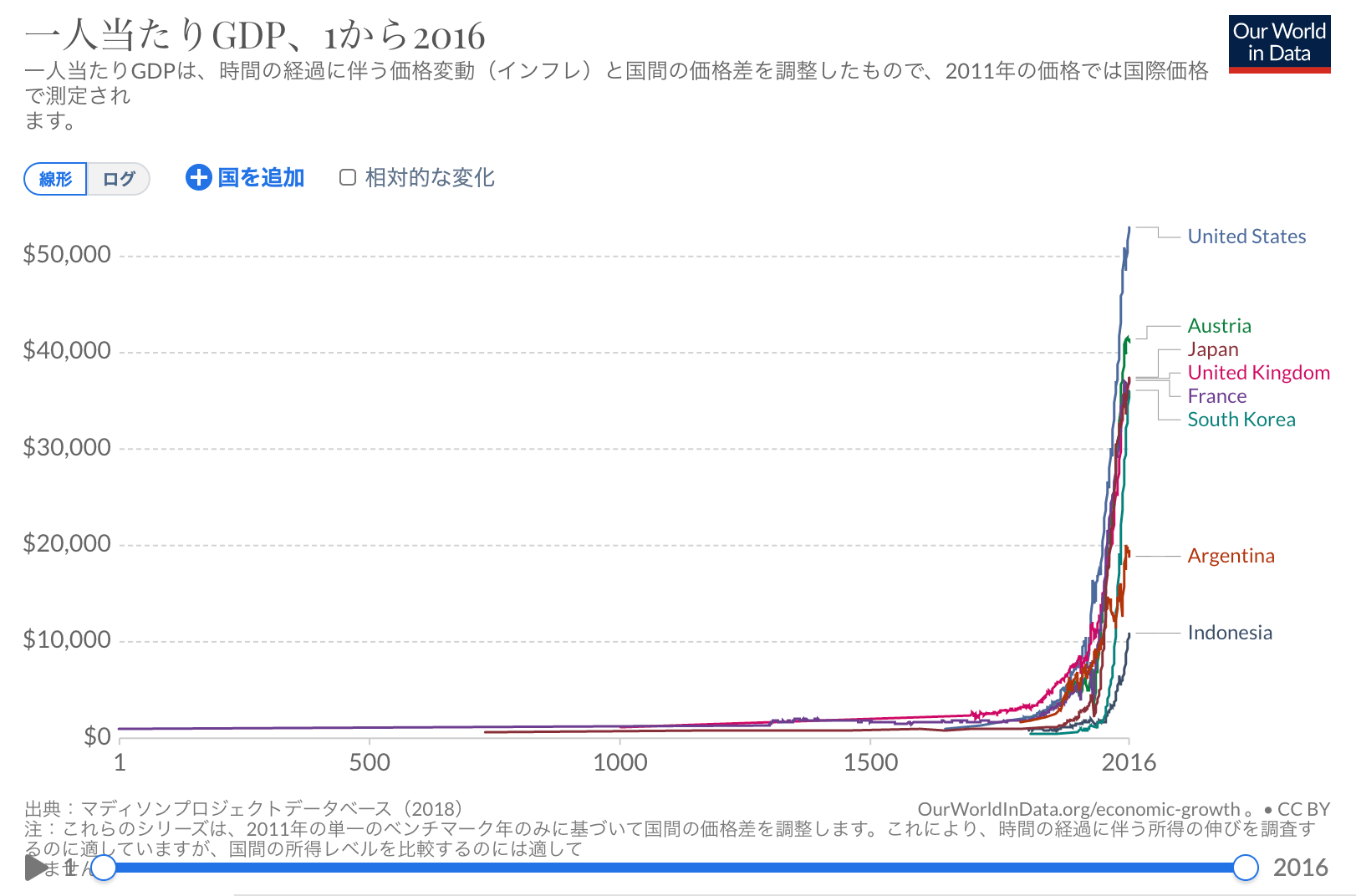
The same applies to other countries ↓

GDP per capita, 1 to 2016(Source)
Now, from the overwhelming amount of data, we can see that human development began a little before 1900 (around 1870, perhaps).
Until around 1870, humanity wasn't producing much, nor were they very wealthy. In other words, the Earth hadn't really developed until 1870. This clearly shows that 1870 was the singularity (technological singularity) for humanity. Well, that's obvious. 100 years before that (1770), nothing had changed from 1870, but 100 years later, everything we have today—except computers—is available, including telephones, cars, and air conditioners. To compare weapons, in 1870, humanity's best weapon was the matchlock gun, but in 1970, it was the hydrogen bomb (thousands of times more powerful than an atomic bomb). Some people might survive a matchlock gun, but no one would survive a hydrogen bomb.
Looking at the extent of development, it's astonishing to think, "What on earth was humanity doing before that...?" The truth is, they hadn't accomplished anything until then.
In 1870, development could only be described as a fortunate coincidence, where the necessary conditions for growth were in place.
In that sense, human history can be divided into three stages.
- Stage 1, 130,000 years ago (Birth of Homo sapiens = modern humans)
- Stage 2, 4,000 years ago (Birth of the Four Great Civilizations)
- Stage 3, 150 years ago (Singularity) Start

AuthorAlthough it was created by [name omitted], the above is likely the most appropriate representation of human history.
In 1870, a seed that had remained sproutless for thousands of years was given water and sunlight, fulfilling the conditions for germination. Once it sprouted, took root, and produced leaves, it was all set. From then on, it could absorb water on its own, receive sunlight through its large leaves, and perform photosynthesis. Once it began to develop, it could grow indefinitely.
reference;
We succeeded in germinating the seeds of an ancient plant from 2000 years ago.

Also, the larger a plant gets, the more likely it is to grow larger.
The larger the roots become → (the more stable) the less likely it is to fall over → the larger the roots can spread → and so on.
The larger the leaves become, the less likely they are to fall over (because nutrients are produced through photosynthesis), allowing them to grow more lush leaves, and so on.
↓
To grow indefinitely (to the limit)
The same applies to human activities. The more efficient things become, the more efficient they become.
The more advanced computers become, the more efficient internal batteries can be developed.
↓
The more efficient the internal battery, the more advanced computers become.
↓
The following is repeated (continuous development and efficiency)
Now, this fact is a universal phenomenon that can be observed at the level of humanity, nations, and individuals. Considering this, it's easy to surmise that if each of us is placed in a suitable environment where we can unleash our talents, we can develop at a tremendous pace. And all this is possible thanks to the miraculously assembled foundation that allows us to thrive.
In that case, there's no reason not to do so. At leastAuthorI intend to do that even if I'm alone.
comment