

In MBTI,psychological functionforPerceptual function (S/N) and judgment function (T/F)They explain that there is such a thing.
In "Narukin Psychology"S (sensory function) and N (intuitive function)、 T (thinking function) and F (feeling function)I don't consider them to be binary functions.What do you mean?


S (sensory function) and N (intuitive function)
first,S (sensory function) and N (intuitive function)Let's organize this.
The difference between S (Sensory function = Realistic type) and N (Intuitive function = Intuitive type) (Click to open)
Emphasis on facts and detailsDo you want to?
Or,Understanding the underlying meaning in informationDo you prefer to take your time with it?
The Realistic (S) type is fact-oriented and more grounded, processing knowledge gained through the five senses.However,Intuitive types (N) are more creative and respond to their sixth sense.This is a tendency. →Reference;Details of Sensation (S) and Intuition (N)
To summarize simply
- Psychological function that processes "S = concrete (physically existing concrete objects)"
- Psychological function for processing "N = Abstract (abstract concept)"
That can be said.
In Narukin psychologyFrom this relationship,S (sensory function) comes first, and N (intuitive function) is a derivative of S."That's what I think.The relationship in which N contains S. (N⊃S) is.
↓
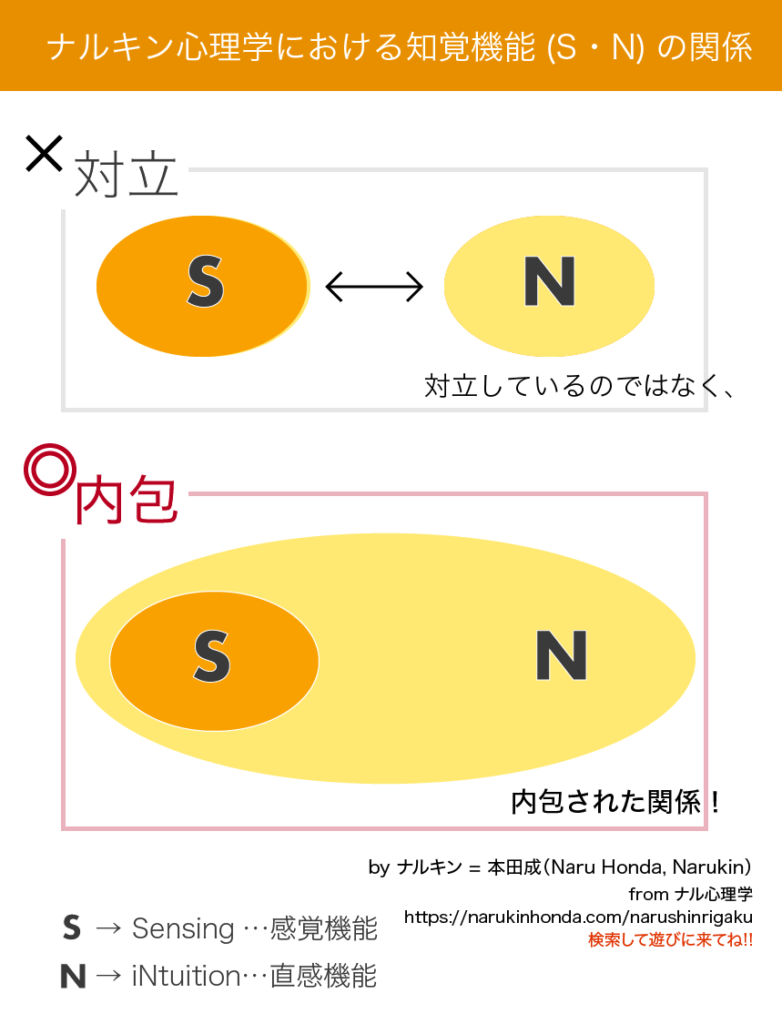
↓
By the way, and this is obvious, there are only concrete things (S) in the world. Abstraction (N) is ultimately something used to improve S.
T (thinking function) and F (feeling function)
nextT (thinking function) and F (feeling function)Let's take a look.
The difference between T (thinking function) and F (feeling function) (Click to open)
Are you making an objective judgment? Are you carefully comparing and considering both sides of the argument?
Or do you often consider your own feelings and the feelings of others?
Thinking types tend to think about things in a very logical and analytical way.And,Emotional types are highly sensitive and easily empathize with others.Therefore, if you prefer logical arguments, you are a T (thinking type), and if you believe that an emotionally appealing approach is important, you are an F (feeling type). →Reference;Details of Thought (T) and Feeling (F)
To put it simply, when making decisions
- "T = The psychological function of temporarily setting aside emotions"
- "F = Considering emotions" psychological function
That can be said.
T (thinking function) and F (feeling function)Similarly,
F (Emotional function))That comes first, and T (thinking function) = Derivation of FThat's what I think. The relationship where T contains F (T⊃F)is.
↓
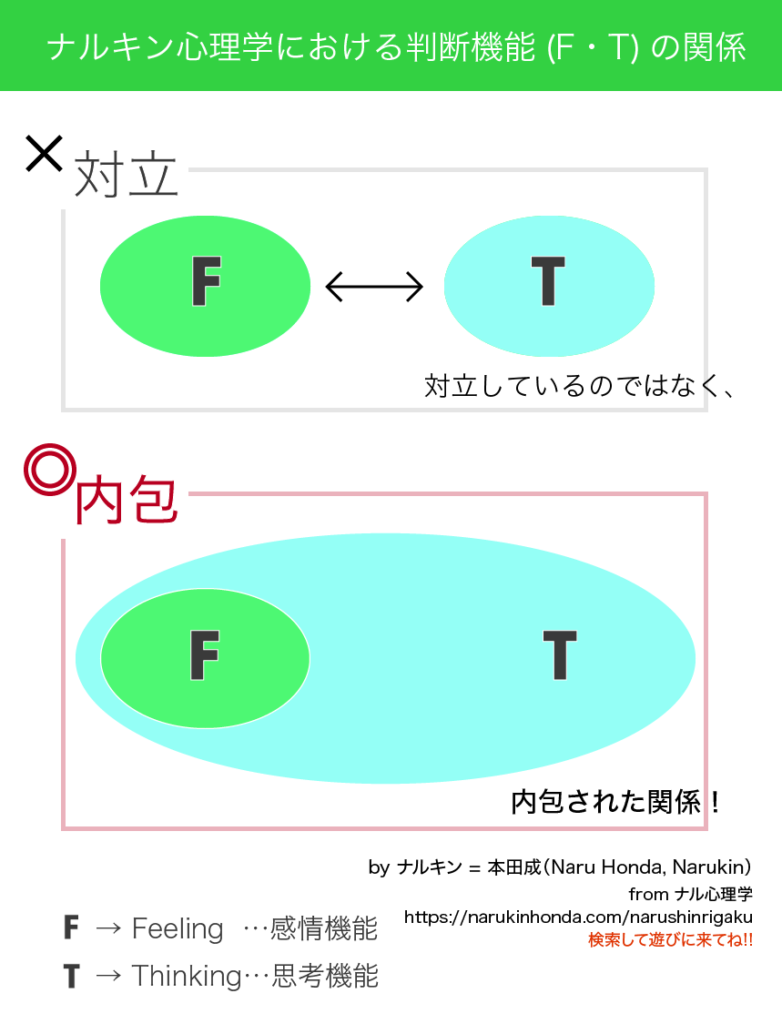
summary
In summary,The choice between N.S. and T.F. depends on whether you prefer to use derivatives.is.
In other words,Human cognitiveIt is as follows:
N contains S(N⊃S) SN are not necessarily opposing concepts.death,
T contains F(T⊃F) FT is not necessarily a contradictory concept.That's right.
*This is a minor point, but the physical relationship between S and N is reversed, with S (matter) containing N (abstract) (S⊃N).
This happens in the brain, firstUsing neurotransmitters, we can physically simulate (recreate) S in the brain.After that, Once againPhysically, we construct a pseudo-construction in our minds of "N (abstract) as a derivative of S".That's why. Copying the surrounding environment into the brain is a basic function of the brain.Physically, within the vast matter S (physical world) that is the world, there is a microcosm called S (brain), but In Narukin psychology, N is defined as "everything that is not in the exact form of S (everything derived from S) after a pseudo-world S is constructed in the brain using neurotransmitters."
*The above is a very complex topic, so I plan to add more details later.

comment