

According to MBTI psychology, when assessing personality,You can learn about your own strengths and weaknesses.The next step is,In response to that, how can I make my life better?It will probably be "."
In MBTI,Strengths and weaknessesThis will be explained using eight psychological functions (cognitive functions). This article will review psychological functions (pairs of psychological functions, etc.) and explain the problems that arise from an overemphasis on one's strengths (dominant function).


Review: What are psychological functions?
psychological functionThat is,Cognitive functionAlso known as,The human ability to acquire and judge information."This refers to...Psychological functions (cognitive functions)Broadly speaking,Extroverted function/Introverted functionIt is divided into, and in totalThere are eight types of psychological functions (cognitive functions).。
8 types of psychological functions (cognitive functions) (Click to display)
psychological functionteeth,Cognitive functionIt means the same thing. In general, in cognitive science,Cognitive functions「The function by which living organisms actively collect external information, perceive and remember it, and then process it by adding reasoning and judgment in order to acquire knowledge about their subject.It is defined as "
| Main cognitive functions | |
|---|---|
| memory | The ability to remember things and retrieve them when needed. |
| Planning ability | The ability to devise, prepare, and execute the optimal plan according to the situation at hand. |
| Attention | The ability to recognize and acquire what is important and necessary, to focus one's attention on it, and to persevere. |
| orientation | The ability to understand basic situations such as the current year, month, time, and location. |
| Spatial awareness | The ability to quickly and accurately grasp and recognize the state and relationships of objects in three-dimensional space, including their position, direction, orientation, size, shape, and spacing. |
*The table above is from the Cognitive Function Visualization ProjectCognitive Function – Overview –』 This is a quote and adaptation by the author.
The famous psychologistJungHis book "Type theory(Psychological Types)*」We assumed four types of psychological functions (cognitive functions).。
*「Type theory(Psychological TypesThe phrase ")" has been translated into Japanese, so if you're interested, why not check out the content via the link below?
theThe four functions of the mindfor,[Feeling type (F type), Thinking type (T type)], [Sensing type (S type), Intuition type (N type)] There is also.[Feeling type (F type), thinking type (T type)]をDecision-making (judgment) function、[Sensing type (S type), Intuitive type (N type)]をInformation gathering (perceptual) functionThese are called [names of the terms]. Each will be explained in detail below.
Dictionary of Clinical Psychology Terms「Psychological functions (thinking, feeling, sensing, intuition)Quote begins from (partially modified by the author)
An example using an ashtray
The example of "how we perceive a ceramic ashtray" is used to explain the four types of ways of perceiving things: thinking, feeling, sensing, and intuition. It goes something like this:
- thinking
—Let's consider that this belongs to the category of ceramics, and its inherent properties such as its fragility. - emotion
—You decide whether the ashtray looks good or bad. - feelings
—Accurately grasp the shape and color of the ashtray. - Intuition
—It brings about possibilities that transcend the attributes of the object itself, such as instantly coming up with a solution to a problem about geometric circles the moment you see it.
End of quote
Humans use this function to perceive the world and to engage with things.(In MBTI, the balance of development in these psychological functions determines strengths and weaknesses, and personality types are classified into 16 categories.)
Furthermore, Jung said,Introvert (I)/Extrovert (E)He is also famous as the psychologist who first proposed this concept.Whether your awareness is directed towards the outside world or your own inner selfThat's the point. The preference for extroversion and introversion is oftenattitude* is called
*As a psychological termattitude」
→A psychological tendency based on emotions and evaluative judgments towards an object that underlie human behavior.
and,The four psychological functions (cognitive functions)teeth,It functions in conjunction with extroversion (E) and introversion (I).Yes, that is.Classified into 8 categoriesIt is possible. For example, the extroverted feeling function, that is,Extraverted Feeling (Fe)This is how it is expressed. The table below illustrates this:
| Thinking type (T type) | Emotional type (F type) | Sensory type (S type) | Intuitive type (Type N) | |
| Extrovert type (E type) | Extraverted Thinking (Te) | External emotions (Fe) | Extroverted Sensing (Se) | Extroverted Intuition (Ne) |
| Introvert type (type I) | Introverted Thinking (Ti) | Introverted Feeling (Fi) | Introverted Sensing (Si) | Introverted Intuition (Ni) |
People use the one of the eight psychological functions that they are best at,"I will find a balance between myself and the threatening outside world, and learn to get along with the world and manage to cope."For more details, please refer to the article below ↓
If you read the following article,Psychological functions (cognitive functions)You can gain a deeper understanding of it.
- 「Reasons for the existence of psychological functions (cognitive functions)」
- 「The useful truths (psychological functions) that each individual discovers」
In addition, the following books8 psychological functionsThis book explains the topic very clearly, so I recommend it. It is based on Jung's book "Type theory(Psychological TypesThis is also recommended for those who find the term ")" difficult to understand.
Strengths are the flip side of weaknesses.
Furthermore, for most people, it is difficult to use all psychological functions equally effectively.Each person has different strengths and weaknesses in their psychological functions.People,The psychological function known as the primary function (dominant function)I trust it and always use it, so basicallyThat's the only thing I'll become good at..but,Strengths are the flip side of weaknesses.It is also the case that,Strengths and weaknesses go in pairs.Understanding it this way will make it easier to grasp.
for example,"I'm good at steadily completing tasks according to plan."But,I'm not good at responding flexibly to sudden accidents.And so on (and vice versa).The relationship between dominant hand and non-dominant handThey are very similar. You are good at using your dominant hand, so you use it all the time and become even more proficient with it. On the other hand, your non-dominant hand tends to remain unused and unskilled.
The same structure exists in psychological functions.If you are good at that psychological function, then you are not good at this psychological function." and so onPairs of psychological functionsThere is a combination that can be described as such.reference Pairs of psychological functions (cognitive functions)
So,Pairs of psychological functionsLet's take a look at this. First, the following "pairs of psychological functions"clickTry it below ↓
Pairs of psychological functions (click to display)
- Extroverted Sensing (Se) - Introverted Intuition (Ni)
- Introverted Sensing (Si) - Extroverted Intuition (Ne)
- Extraverted Thinking (Te) - Introverted Feeling (Fi)
- Introverted Thinking (Ti) - Extraverted Feeling (Fe)
These pairs,They work together in pairs, but they also have opposing qualities. However, in most cases, the use of one or the other becomes biased. And that bias becomes a defining characteristic of one's personality. In fact,The first psychological function (= strongest) relies on the latent function of the fourth psychological function (= weakest).。 as a matter of fact,These two psychological functions should ideally work together.However,In most cases, it's impossible (because the functions work in opposite ways).
(*Even if you don't understand this sentence now, you will understand it if you continue reading the article.)
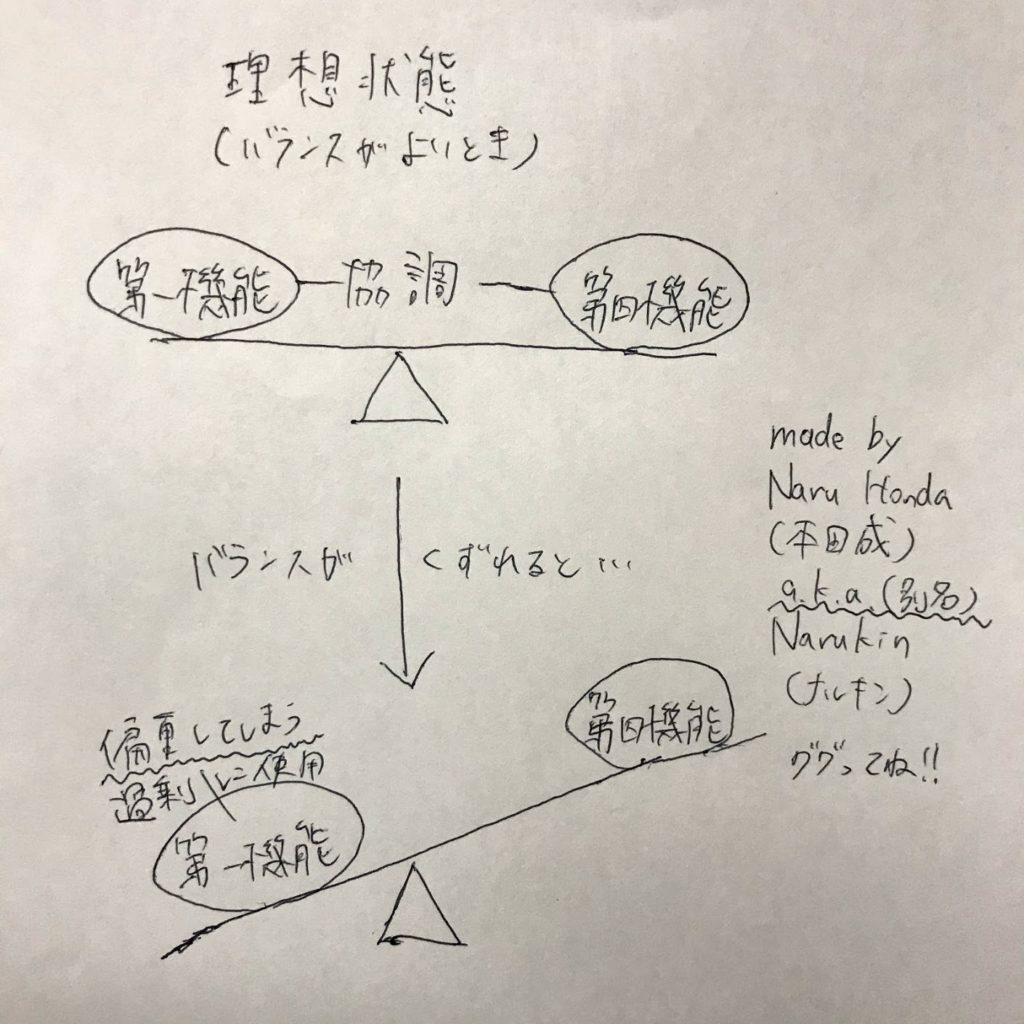
When people's psychological functions are ranked in order of their strengths, from top to bottom:1st function ~ 4th functionThis is how it is expressed. And,The "first function and fourth function" and the "second function and third function" are in opposition.They are doing it. (=The relationship between strengths and weaknesses). This can be represented in a diagram as follows ↓

As a specific example,ENTP (Inventor Type)のPairs of psychological functionsTo explain it, it is as follows:
Example) The first and fourth functions of an ENTP (Inventor type)
for example,ENTP (Inventor Type)のFirst function (main function)はExtroverted Intuition (Ne)in,The fourth function is (the inferior function)はIntroverted Sensing (Si)。
In other words,To come up with or find new ideas that are unlike anything before (=Ne)things likegood atThat's right. However, instead,Focusing only on the reality in front of you and tackling things one by one in order (=Si)がweak pointis.
Ideally,First functionとFourth functionIdeally, one should be able to use both, but in most cases, that is difficult.
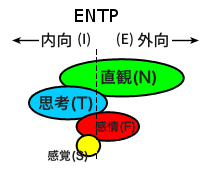
The following diagram shows,ENTP (Inventor Type)This is a list of their preferred psychological functions, from top to bottom:
- Extroverted Intuition/Ne
Very good at it /First functionThey possess a superior ability to see the entire future and foresee various possibilities and destinies. - Introverted Thinking/Ti
I'm a little good at it /second function: They are responsible for verifying the facts, determining whether statements and findings make logical sense, and what is true or false. - Extraverted Feeling/Fe
I'm not very good at it.Third functionThey want to make people happy and feel positive. When that's not the case, it tends to turn into insults, sarcasm, and imposing a sense of superiority. - Introverted Sensing/Si
I'm really bad at it /Fourth functionThey feel anxiety and fear about trying new things and failing. They dislike or are unable to do routine work (simple, repetitive tasks).
<ENTP cognitive axes>
If you only focus on developing your strengths, you'll lose your balance.
Basically, peopleTendency to use only what you are good at (= primary function)There is. So,Things you're not good at (=fourth function) will be used even less.So,The balance is disrupted, and problems arise.To explain what kind of problems arise,First and fourth loops (also known as inferior grips)」Let me introduce you to this psychological phenomenon.
「First and fourth loops (also known as inferior grips)That is,Simply put, it's a situation where the balance is severely skewed towards the primary or fourth function, leading to uncontrolled behavior.It means "..." It was usually used in a positive sense.The primary function (strength and advantage) manifests in a negative way.do / not usually useSuddenly using the fourth function (a weakness and something you're not good at) can backfire.Things like this happen.
First and fourth loops (also known as inferior grips)Please refer to the table below as one example. (The malfunctioning function may be either the first or fourth function.)
| type | Main function | Inferior function | Impact of inferior grip |
| ESFJ (Sociable Type) ENFJ (Collaborator Type) | Fe (Extraverted Feeling) | Ti (introverted thinking) | When things don't go well due to emotional judgment, Become critical. "That's nothing more than..." Uncreative thinking |
| ESTJ (Responsible type) ENTJ (Leader type) | Te (extroverted thinking) | Fi introverted feeling) | When things do not operate according to axioms, They force their own values on others without regard for those around them. |
| ESFP (Optimist type) ESTP (Adventurer type) | Se (Extroverted Sensing) | NI (Introverted Intuition) | Realism is gaining strength, and people are becoming less receptive to things that are mediated through reason. "That's how it is, isn't it!" and so on. As the unhealthy state progresses, one can also become trapped in delusions. |
| ENFP (Reformer type) ENTP (Inventor Type) | Ne (Extroverted Intuition) | Si (Introverted Sensing) | My easily bored personality has gone too far. They will suffer from poverty. Physical ailments become more pronounced. |
| ISFP (Artist type) INFP (Psychologist type) | Fi introverted feeling) | Te (extroverted thinking) | My emotions are like axioms (mainly rules, etc.) They become threatened and suffer a nervous breakdown. |
| ISTP (Practitioner type) INTP (Researcher Type) | Ti (introverted thinking) | Fe (Extraverted Feeling) | I get frustrated when my thoughts aren't understood. |
| ISFJ (Parental Type) ISTJ (Hardworking Type) | Si (Introverted Sensing) | Ne (Extroverted Intuition) | I become overwhelmed by nothing but negative thoughts. Obsessive-compulsive disorder, etc. |
| INFJ (Empathy Type) INTJ (Strategist type) | NI (Introverted Intuition) | Se (Extroverted Sensing) | Derived from external information and internal insights Suffering from friction with possibility |
The table above shows,Character Personality Test Thread Summary Wiki『Regarding inferior gripQuoted from and modified by the author from "[Title of work]".
Why does this phenomenon occur?The primary function (main function) and the fourth function (inferior function) are,Paired but with opposite functionsHaving(=The first function is supported by the fourth function, and they work together as a pair, but they have opposing properties.)This is the causeIt happens there.
While a balanced approach would yield optimal results, typically, we tend to favor using only one of the two functions.This can result from (sometimes being the primary function, sometimes being the quaternary function).
Opposite, yet pair
「Opposite, yet pairLet me explain in more detail what this means. As already mentioned, the following psychological functions are paired together:
- Extroverted Sensing (Se) - Introverted Intuition (Ni)
- Introverted Sensing (Si) - Extroverted Intuition (Ne)
- Extraverted Thinking (Te) - Introverted Feeling (Fi)
- Introverted Thinking (Ti) - Extraverted Feeling (Fe)
Why are these pairsOppositionTo understand why, please first read the following explanation ↓
- Ne (Extroverted Intuition)(= "Look beyond the reality in front of you" and search for alternatives that don't already exist.)
⇕
Si (Introverted Sensing)(= "Looking only at the reality in front of you" and continuing with existing choices) - Ni (Introverted Intuition)(This involves perceiving changes in things from the past to the future and then predicting what will happen.)
⇕
Se (Extroverted Sensing)(This means confirming what is happening physically right in front of you at that moment.) - Te (extroverted thinking)(= Repeatedly improve and expand efficiently, no matter what the method is.)
⇕
Fi (introverted feeling)(This means adhering to one's own standards and carefully examining whether something meets those standards.) - Ti (introverted thinking)(To reveal the truth or falsity and mechanisms of things)
⇕
Fe (Extroverted Feeling(Rather than arguing about what is right or what should be done, we should prioritize harmony among people.)
-Production: Narukin = Naru Honda (Nari Honda)
↑Google it!
As you can see from the above, two pairs of psychological functions cannot be used simultaneously.so-calledA dilemma, a contradiction (the inability to turn right and left at the same time)This is how it is. This should be easy to understand (Ni might be difficult, though).Here(Please refer to the separate document.)

comment