16 Personality Types

16 Personality Types

Characteristics and advice on choosing academic subjects based on 16 personality types.

Different personality types tend to study different academic fields during their student years. However, the very way people choose and approach academic fields and careers also differs depending on their personality type. Below are the characteristics and advice for choosing a personality type. (EJ type, EP type, IP type, IJ type...).
16 Personality Types

Column: What if Romeo – an INTJ (strategist type) and Juliet – an ESFP (optimist type) fell in love?

The romantic tragedy "Romeo and Juliet," written by the English playwright William Shakespeare, is extremely famous. "Romeo of the Montague family" and "Juliet of the Capulet family." Their difference in social standing makes their union difficult, but what if Romeo - INTJ (...
16 Personality Types

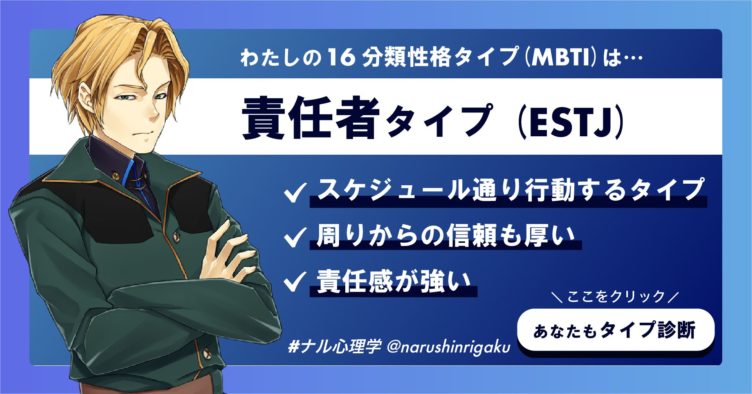
The relationship between ESTJ (Executive/Responsible Type) and the Big Five personality traits

The relationship between the Big Five personality traits* and the 16-type MBTI personality assessment has been investigated, and the table below shows the correlations. By comparing which personality traits and their sub-traits (facets) each type correlates with, we can gain a more detailed understanding of each type's tendencies...
16 Personality Types

16 Personality Types: Inspiring Quotes from Great Figures

ISTJ: "Success is not the ultimate failure, and failure is not the ultimate success. It is courage that counts." - Winston Churchill "I never break my promises. That is my rule." - Abraham Lincoln "Perfection is a state where there is no room for improvement." - Aristotle...
16 Personality Types

16 Personality Types: How to Enjoy Life to the Fullest…?

ISTJ - Vacationing in a historic travel destination; ISFJ - Homemade dinner party with family and friends; INFJ - Deep conversation at a philosophy salon; INTJ - Challenging difficult puzzles and riddle games; ISTP - Learning a new sport or hobby; ISFP - Beauty...
16 Personality Types

16 Personality Types: Preferences and Strengths/Weaknesses in Majors and Subjects

16 Types: Characteristics of Strengths and Favorite Majors and Subjects SJ: Accurate facts and details SP: Practical practice NJ: Interesting and learning complex ideas and their connections NP: Exploring possibilities, alternatives, and hypotheses TP: Solving problems and testing hypotheses TJ: Leadership and systematization FP: Creativity...
16 Personality Types

16 Personality Types: Strengths, Weaknesses, and Ways to Improve Weaknesses

16 Types: Strengths - Positive Points ESFJ - Good at inviting people and creating a fun atmosphere ESFP - Has a lovely smile and the ability to brighten up those around them INFP - Can empathize with others' feelings and show deep understanding ESTJ - Is particular about accuracy...
16 Personality Types

Income by 16 Personality Types – Misconceptions and Truths –

As you learn about MBTI types, one thing that will likely interest you is the income levels associated with each of the 16 personality types. If you don't yet know your own personality type, try the following diagnostic test. Now, the image below is one that's circulating on the internet...
16 Personality Types

The Difference Between Extroverted Feeling (Fe) and Introverted Feeling (Fi) - Part 2: A Comparison of Psychological Functions

Both extroverted feeling (Fe) and introverted feeling (Fi) are psychological functions involved in judgment and decision-making, shaping values and ethics based on how we feel. They share a commonality in considering the feelings of others and our impact on them. However, because they direct their attention in different directions, they also have conflicting aspects...
16 Personality Types

Summary of the 8 Psychological Functions (Cognitive Functions) of the 16 Personality Types - Basic Knowledge Edition

As common knowledge for the personality typologies introduced on this site, we will briefly explain the "eight psychological functions," which are the psychological tendencies and fundamental elements. When describing the characteristics of introverts and extroverts, you may use terms like "introverted person" or "extroverted person" in everyday life...
Copied title and URL