

Inulin is a natural insulin.It is also known as [another name] and is said to be good for health, as it has effects such as preventing blood sugar levels from rising. In addition, inulin has various other effects.It can increase beneficial bacteria like bifidobacteria and also help improve constipation.The list goes on and on. This article will explain some of the lesser-known effects of inulin.


What is inulin?
InulinInulin is a type of storage polysaccharide produced by plants of the Asteraceae family, among others. Starch is also a type of storage polysaccharide. Inulin refers to a substance in which one or more fructose molecules are linked to glucose. It also has a slightly sweet taste.
and,Inulin is a water-soluble dietary fiber that serves as food for intestinal bacteria.
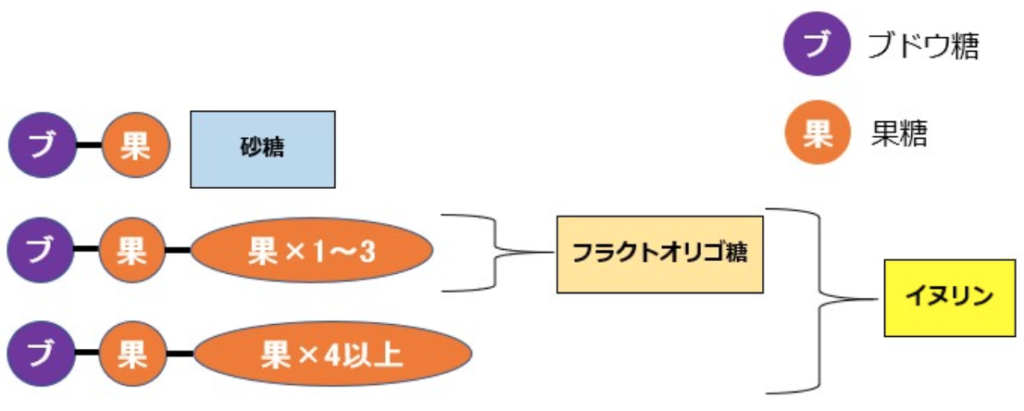
The above information is based on the Japanese Food Standard Composition Table 2015 Edition (7th Revised Edition).
Precautions when consuming water-soluble dietary fiber such as inulin
Taking inulin is highly recommended for health reasons, but there are a few things to keep in mind.
- Don't overeat
→ Eating too much all at once can cause loose stools. - Eat right before a meal
→By doing so, you can suppress the rise in blood sugar levels.
Please be sure to keep the above points in mind when consuming water-soluble dietary fiber such as inulin!
[Bonus Episode] What are oligosaccharides that are sweet but don't raise blood sugar levels?
Besides inulin,It's sweet, but it doesn't cause a rapid rise in blood sugar levels.There is food.OligosaccharidesThat's right! Moreover, oligosaccharides are sweeter than inulin.
The sweetness of sugar is 100If that's the case, then it would be as follows:
- Oligosaccharides...20-70(The sweetness varies depending on the type of oligosaccharide used.)
- Inulin... ~20 or less
In other words,To prevent blood sugar spikes, it's best to eat oligosaccharides when you crave something sweet, and to take inulin before meals!
OligosaccharidesFor more information, please refer to the following:


[Reference] Foods containing water-soluble dietary fiber
Inulin and otherWater-soluble dietary fiberIt is found in abundance in foods such as Jerusalem artichokes, burdock root, and onions. Incorporating water-soluble dietary fiber into your regular diet will further improve your health.
Please refer to the table below for the amount of water-soluble dietary fiber.
| Food (100g) | calorie (kcal) | moisture (g) | water soluble Dietary fiber (g) | Insoluble Dietary fiber (g) | Dietary fiber Total amount (g) | protein (g) | Lipids (g) | carbohydrates (g) | mineral (g) |
| Jerusalem artichoke | 35 | 81.7 | 0.5 | 1.4 | 1.9 | 1.9 | 0.4 | 14.7 | 1.3 |
| Burdock | 65 | 81.7 | 2.3 | 3.4 | 5.7 | 1.8 | 0.1 | 15.4 | 0.9 |
| onion | 37 | 89.7 | 0.6 | 1.0 | 1.6 | 1.0 | 0.1 | 8.8 | 0.4 |
| garlic | 136 | 63.9 | 4.1 | 2.1 | 6.2 | 6.4 | 0.9 | 27.5 | 1.4 |
| Chives | 21 | 92.6 | 0.5 | 2.2 | 2.7 | 1.7 | 0.3 | 4.0 | 1.1 |
| Potato | 76 | 79.8 | 0.6 | 0.7 | 1.3 | 1.6 | 0.1 | 17.6 | 0.9 |
| sweet potato | 140 | 64.6 | 0.9 | 1.8 | 2.8 | 0.9 | 0.5 | 33.1 | 0.9 |
| Taro | 58 | 84.1 | 0.8 | 1.5 | 2.3 | 1.5 | 0.1 | 13.1 | 1.2 |
| Konjac (Processed products) | 5 | 97.3 | 0.1 | 2.1 | 2.2 | 0.1 | trace amount | 2.3 | 0.3 |

comment