
What are 'ketone bodies'?These are short-chain fatty acids produced in the mitochondria of liver cells when the body's glucose reserves are depleted. In short, ketone bodies are the same as short-chain fatty acids. When the body is in a state of starvation and its glucose reserves are depleted, the body produces short-chain fatty acids as an alternative energy source, and these are called ketone bodies.


What are ketone bodies?
These "ketone bodies" are produced in the liver to "supply the brain with energy." Fatty acid molecules are too large to cross the blood-brain barrier and therefore cannot be used as an energy source for the brain. However, because ketone bodies have small molecules, they can cross the blood-brain barrier and become an energy source for the brain.
(The blood-brain barrier acts like a "checkpoint" for substances entering the brain from blood vessels, blocking substances harmful to the brain. It strictly controls the transport of substances between the circulating blood and the brain, preventing substances in the blood from easily passing into the brain. In the capillaries of the brain, the gaps between endothelial cells are narrow, making it difficult for substances to pass through.)
Only substances with a molecular weight of 500 or less, substances that can pass through the gates in this barrier, and lipid-soluble substances that can pass through cell membranes can cross the blood-brain barrier. Other substances are restricted from moving from the blood vessels into the brain.
Fatty acid molecules are too large to cross the blood-brain barrier and therefore cannot serve as an energy source for the brain.
However, substances with small molecules, such as glucose, ketones, and short-chain fatty acids, can cross the blood-brain barrier and reach brain cells, becoming an energy source for the brain.
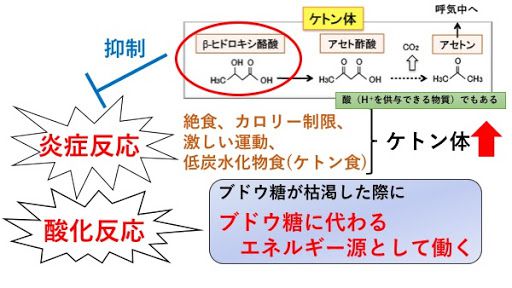
The above diagram shows,Mechanism of renal protective effects by ketone bodies (β-hydroxybutyrate) (Quoted from)
"Ketone bodies" is a general term for three substances: acetoacetic acid, beta-hydroxybutyrate, and acetone (beta-hydroxybutyrate accounts for 75% of ketone bodies: see "Medical ShoinAs a water-soluble fat, it is quickly transported from the liver to tissues such as the heart, muscles, kidneys, and brain via the bloodstream, where it is metabolized in the mitochondria of normal cells (other than red blood cells and liver cells) and converted into energy.
(Short-chain fatty acids are also water-soluble fats.)
Acetoacetate and beta-hydroxybutyrate serve as alternative energy sources to glucose. (75% of ketone bodies are beta-hydroxybutyrate.)
However, acetone is excreted through respiration, so it cannot be used as an energy source.
Therefore, of the three substances, "acetoacetic acid," "β-hydroxybutyric acid," and "acetone," only "acetoacetic acid" and "β-hydroxybutyric acid" can serve as an "alternative energy source" to glucose.
When glucose in the body is depleted, fatty acids are broken down (beta-oxidized) in the mitochondria of liver cells to produce acetyl-CoA. The three substances synthesized from this acetyl-CoA—acetoacetate, beta-hydroxybutyrate, and acetone—are collectively called "ketone bodies," and this entire process is called "ketone production."
*Note that among the substances collectively referred to as "ketone bodies"—beta-hydroxybutyrate, acetoacetic acid, and acetone—beta-hydroxybutyrate does not contain a "ketone group," so strictly speaking, it is not a "ketone body" but a "short-chain fatty acid."
For more details,What is ketone production? Let's look at its mechanism. Please refer to the following.
What are short-chain fatty acids?
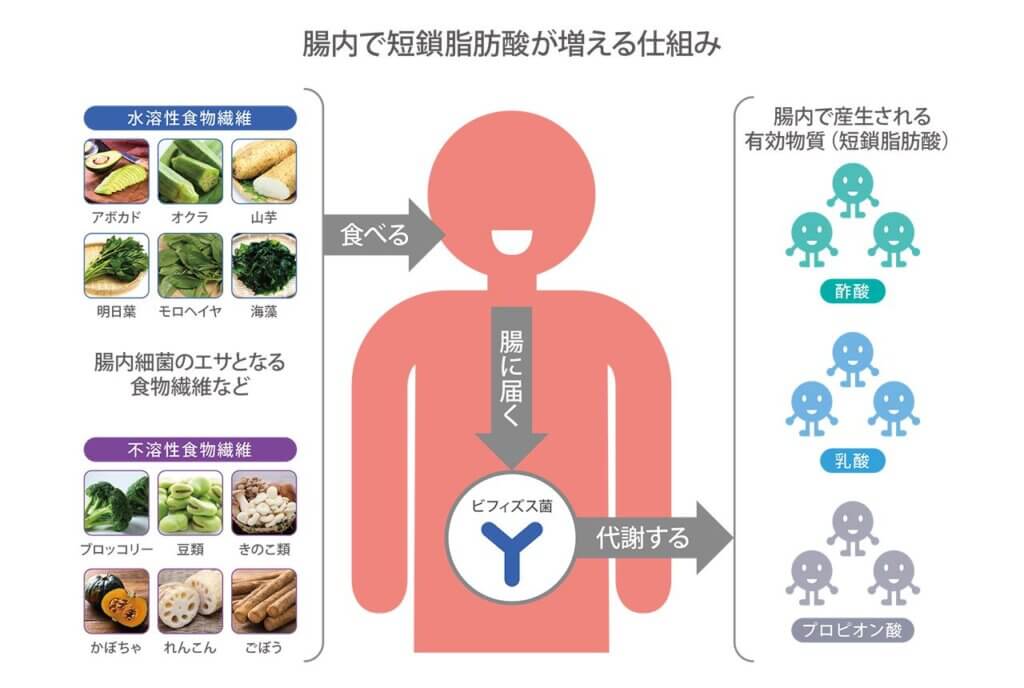
The above diagram shows,The key to increasing the much-talked-about short-chain fatty acids is dietary fiber and gut health. (Quoted from)
Short-chain fatty acids are substances produced as fermentation products when intestinal bacteria ferment and break down "beta-starch (indigestible starch)," "cellulose (insoluble dietary fiber)," and "soluble dietary fiber" (indigestible components) in raw grains (such as raw brown rice).
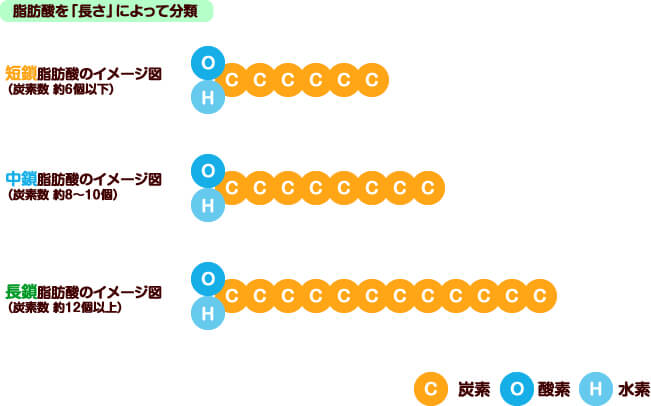
The above diagram shows,Caregiving Column 24 [Medium-Chain Fatty Acids] (Quoted from)
Short-chain fatty acids refer to six types of fatty acids: formic acid, acetic acid, propionic acid, butyric acid, valeric acid, and caproic acid. These fatty acids have 1 to 6 carbon atoms and, like glucose, are "small-molecule" fatty acids (low-molecular-weight fatty acids), so they can cross the blood-brain barrier and reach brain cells. Therefore, these short-chain fatty acids can serve as an alternative energy source to glucose for "all cells in the body, including brain cells," except for red blood cells.

The above diagram shows,Yasuo Marumoto's Visual Nutrition + Recipes: May 2012 (Quoted from)
In summary, ketone bodies and short-chain fatty acids can be described as follows:
- Ketone bodies= "Acetoacetic acid," "β-hydroxybutyrate," "Acetone (excreted in breath and not used as an energy source)."
- Short-chain fatty acids= "Formic acid," "Acetic acid," "Propionic acid," "Butyric acid," "Valeric acid," "Caproic acid"
In other words, what is commonly known as "ketone bodies" is equivalent to "short-chain fatty acids."
So,What is the difference between 'ketone bodies' and 'short-chain fatty acids'?For more information, please refer to the following article ↓
What is the difference between 'ketone bodies' and 'short-chain fatty acids'?
Ketone bodies are an alternative energy source to glucose.
Ketone bodies arered blood cellsとliver cellsIt is used as an energy source for "all cells in the body, including the brain," excluding the brain.A very convenient “alternative energy source” for glucose” is.
Energy sources for each cell
(below,The small and large intestines are unique as energy sources for human body cells. (Includes some quotations and modifications)
Cells need an energy source to function.
(1) Red blood cells
Since they lack mitochondria, glucose is their only energy source.
(2) Brain
Although it contains mitochondria, fatty acids are too large to pass through the blood-brain barrier.
Therefore, glucose and the smaller 'ketone bodies' are the energy sources.
(3) Somatic cells
Since all cells other than red blood cells have mitochondria, somatic cells such as skeletal muscle, cardiac muscle, and internal organs use glucose, ketone bodies, and fatty acids as energy sources.
(4) Hepatocytes
Liver cells produce ketone bodies within their mitochondria, but instead of using them themselves, they release them into the bloodstream to provide energy to other cells. Therefore, liver cells use glucose and fatty acids as their energy sources.
Furthermore, the small and large intestines utilize special energy sources.
(A) Small intestine
The energy sources for cells in the small intestine are glutamine (50-60%), ketones (15-20%), and glucose (a very small amount, 5-7%).
Glutamine is the most abundant free amino acid in the blood.
(B) Large intestine
The only energy source for cells in the large intestine is short-chain fatty acids.
・
・
・
Red blood cells do not have mitochondria, so glucose is their only energy source. However, even if you don't consume any carbohydrates at all through carbohydrate restriction, they can still use glucose as needed.gluconeogenesisThis is covered by "glucose production" due to the * symbol, so it's fine.
*For more information on gluconeogenesis, click here →What is "gluconeogenesis," a phenomenon to be aware of when restricting carbohydrates?」
(Ketone bodies and short-chain fatty acids are metabolized in mitochondria to produce ATP (adenosine triphosphate: bioenergy). Since red blood cells lack mitochondria, they cannot use ketone bodies or short-chain fatty acids as an energy source. Therefore, glucose is the sole energy source for red blood cells.)
Furthermore, liver cells act as factories that produce "ketone bodies" when the body enters a state of starvation. However, liver cells themselves do not use these "ketone bodies" but release them into the bloodstream to be used as an energy source for other cells. Therefore, liver cells do not use "ketone bodies" as an energy source. The energy sources for liver cells are "glucose" and "fatty acids." When glucose is depleted, liver cells can use "fatty acids" as an energy source.
In summary, ketone bodies are used as an energy source for all cells in the body, including the brain, except for red blood cells and liver cells, making them a very convenient alternative energy source to glucose.

comment