

The novel coronavirus is classified as a Category 2 designated infectious disease.
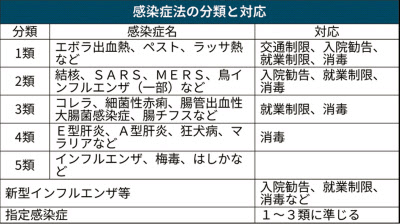
(The table above is quoted from the Nikkei Shimbun.)
As you can see, the closer a virus is to Category 1, the stronger it is, and the closer it is to Category 5, the weaker it is. Therefore,The COVID-19 pandemic has forced hospitals to adopt a response similar to that of Ebola hemorrhagic fever, which has a fatality rate of over 50%.It is as it is.


Why many hospitals are refusing to treat COVID-19 patients
For example, if a healthcare worker in a hospital is identified as a close contact, they will have to self-isolate at home for two weeks.
What if a cluster of infections occurred within a hospital? Most of the hospital's healthcare workers would have to self-isolate at home for two weeks, making it impossible to continue operations, and the hospital would face financial ruin (restaurants are already experiencing a wave of bankruptcies due to the self-imposed restrictions).
Furthermore, media coverage might deter patients from coming to the hospital. For hospitals, treating COVID-19 patients is entirely detrimental and offers no benefits whatsoever.
Therefore,Many hospitals are refusing to treat patients with COVID-19.Moreover,In Japan, by law, prefectural governors cannot give instructions regarding the medical practices of hospitals.That's right.
Therefore, all they could do was instruct public medical institutions such as prefectural hospitals and public hospitals to treat COVID-19 patients, and most private practitioners (local doctors) turned a blind eye.As a result, the burden is concentrated on public medical institutions.
(*More than 80% of medical facilities are private hospitals, mainly run by local doctors, but the reality is that the majority of "local doctors" who are members of the Japan Medical Association are not treating COVID-19 patients.)
Apparently, they're treating it the same way they would a Class 1 Ebola hemorrhagic fever. And this is despite the fact that they also have to treat patients with far more fatal conditions like stroke and heart disease. This enormous burden is falling on public hospitals and other public medical institutions.
The measures currently being implemented are more equivalent to those for Ebola (Category 1) than Category 2 (handling of linens, handling of corpses, protective equipment used, etc.). The risk of severe illness for the elderly and those with underlying medical conditions is the same as with influenza. Personally, I think it will eventually be appropriate to classify it as equivalent to Category 5 seasonal influenza.
The coronavirus is also causing a shortage of hospital beds.
This is not just a response on the same level as for Ebola hemorrhagic fever,This will also lead to a shortage of hospital beds due to the coronavirus.The more hospitalized patients with COVID-19 there are,Because it would result in a shortage of hospital beds for other critically ill patients.For example, even if you suffer a stroke or heart disease, you may not be able to be hospitalized due to a shortage of hospital beds.
As a result of private hospitals (local doctors) refusing to accept patients, even public medical institutions are facing a shortage of hospital beds. Consequently, patients infected with the coronavirus are often turned away from hospitals, and some even die despite being able to survive.
See below for reference.
Naturally, the same applies to patients with other serious illnesses. This is not so much a harmful effect of the coronavirus, but rather...Harm resulting from flaws in the healthcare systemIt can be said that...
Solution
In fact, if you see a local doctor (or a public medical institution) early on, you can recover from COVID-19 without any problems.That's right.
Dr. Kazuhiro Nagao, director of the Nagao Clinic in Amagasaki City, Hyogo Prefecture, is the local doctor who has seen the most COVID-19 patients in Japan, but as a local doctor, he has seen the most cases of the novel coronavirus in Japan.We have had zero deaths from COVID-19! Furthermore, not a single infection has been reported among our approximately 100 staff members.That's right!
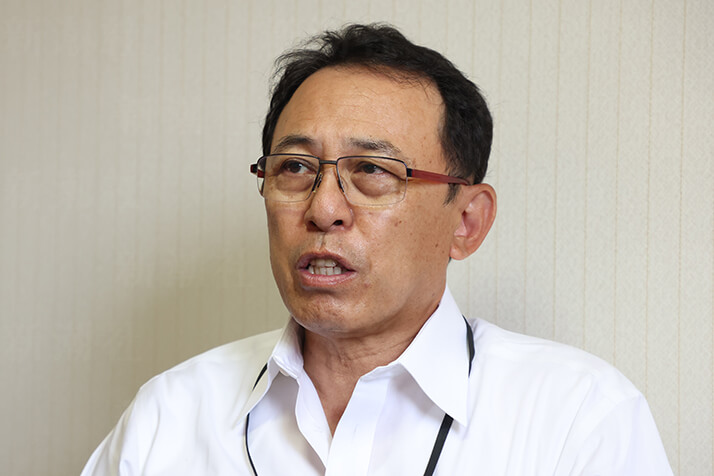
I would make house calls, measure oxygen saturation levels, and inform the public health center if hospitalization was necessary. However, since immediate hospitalization wasn't possible, if the oxygen saturation level was below 93%, I would arrange for home oxygen therapy, prescribe the steroid drug Decadron, and have the patient take ivermectin on the spot. I spent the entire Golden Week holiday rushing around to patients' homes doing just that.
Should the classification of COVID-19 be downgraded from Category 2 to Category 5?
Due to the structure described above, there are frequent calls on social media platforms such as Twitter for the classification of this item to be downgraded from Category 2 to Category 5.In fact, this is not strange. As you all know, influenza is classified as a Category 5 disease, and every year around 10 million people are infected, and about 10,000 die.This is clearly worse than COVID-19, and it's unacceptable that COVID-19 is classified as a Category 2 virus while influenza is classified as a Category 5 virus.。
In fact, many doctors feel that the handling of the coronavirus is flawed. This can be seen from the following:
m3.com*According to a survey conducted by [company name], as of September 8, 2020 (Tuesday)Nearly 70% of doctors believe that "a review of the measures equivalent to Category 2 is necessary."We understand that this is what they are thinking.
(*Japan's largest website exclusively for healthcare professionals, with over 300,000 registered doctors)

Among them, the important ones are,
"Q. When the designation of this disease as a specified infectious disease expires at the end of January 2021, what kind of response do you think would be desirable?"In order of the number of responses from doctors
- 30.1% were classified as "novel influenza, etc."
- 28.4% classified items into categories 3-5.
- 17.2% responded, "Amend the law by the deadline and establish a new classification."
- 13.9% chose "extend the designation for one year."
That's how it is.
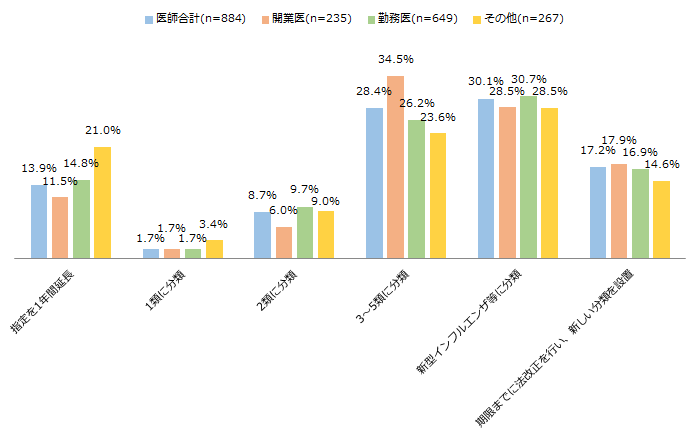
"Q. Please select all the items you think need to be reviewed."The most common answers are in order of frequency.
- "Hospitalization of asymptomatic carriers (including home isolation, etc.)" was the most frequent response at 55.31 TP3T.
- "Patient hospitalization measures" is 43.4%
- "Public funding of medical expenses" is 33.8%
That's how it is.
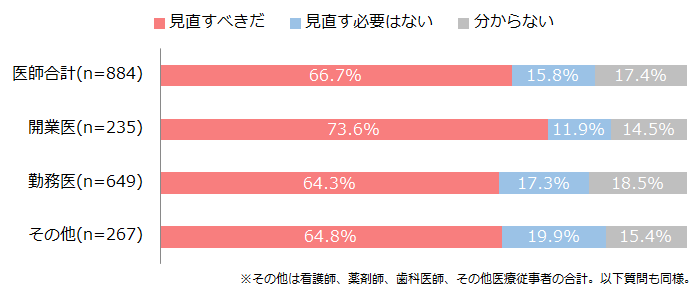
Even many doctors think this way deep down.Simply changing the designated infectious disease category for COVID-19 from Category 2 to Category 5 would solve many of the problems and concerns.This approach would actually be beneficial, as it would allow people infected with COVID-19 to be seen by their local general practitioners earlier. (Moreover, it would not lead to a shortage of hospital beds in public medical institutions.)
The remaining two problems
There are two remaining issues.
1.It could become highly toxic.
If the virus were to mutate and become highly virulent, it would be a serious problem. After downgrading it to Category 2, there's a possibility that they kept it that way to avoid taking responsibility if that were to happen, and have simply left it at that level. It's only a possibility, but it can't be ruled out, which is why it's a problem.
2. Doctors, who are experts, should speak up,As a healthcare worker, you might find yourself speechless when someone demanding zero risk says, "Even with COVID-19, at least one person has died."。
However, if that's the case, then the manufacture of cars and trains should also be completely banned to prevent traffic accidents, and besides, many other diseases have also disappeared, so it's not just COVID-19... (Many people have pointed this out as well).
You might also like this article ↓

Share your thoughts on this article on social media using the button below to let your followers know!
↓The following diagnoses are also recommended↓
COVID-19 psychological resilience check
To spread this blogPlease click once.↓

Related Topics
Coronavirus symptoms and infection information
- Coronavirus symptoms
- COVID-19 mortality rate
- Details of the coronavirus fatality rate (mortality rate)
Coronavirus prevention information and a collection of useful links, etc.
- Recommended Masks - COVID-19 Prevention Measures -
- How to protect yourself from the coronavirus
- How to wash your hands [COVID-19 infection prevention measures]
- Useful links related to the coronavirus
- Contact information and consultations regarding the coronavirus.
- The Real Reason Why Toilet Paper Sold Out Due to "Coronavirus" Misinformation [Explained from a Psychological Perspective]
- Why researchers don't recommend mRNA vaccines for COVID-19
- COVID-19 news you should know
- COVID-19 News You Should Know 02
- Structural problems associated with the novel coronavirus
- The vaccine promotion policy may need to be re-evaluated!

comment