
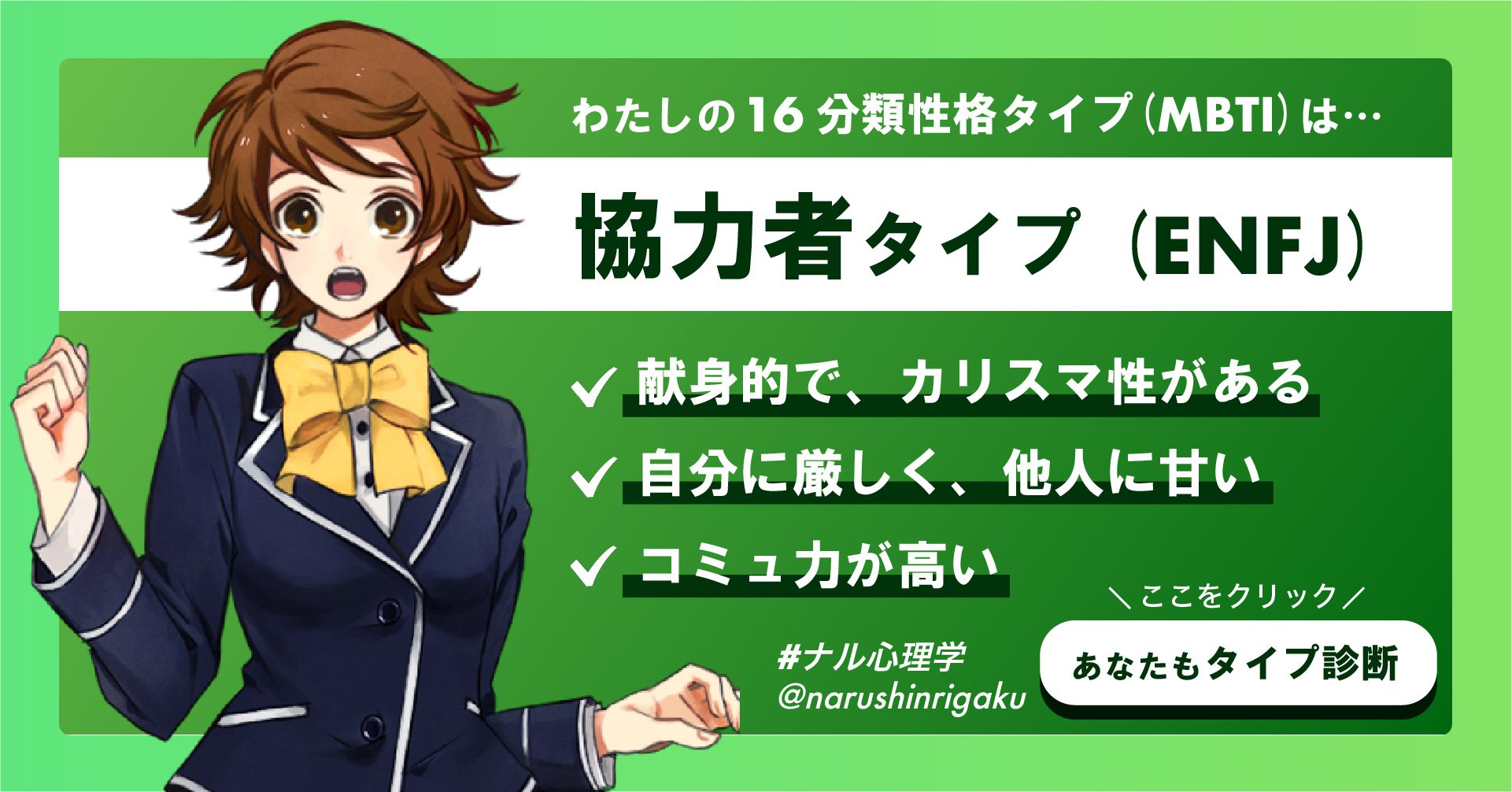
On this page, out of the 16 types,ENFJ (Protagonist/Collaborator type)This article explains their personality, characteristics, values, and views on love.
youENFJ (Protagonist/Collaborator type)Then
Share it on social media (tweet it) and let your followers know!
↓↓↓Share on social media (tweet)↓↓↓
↑↑↑Share on social media (tweet)↑↑↑
Classifying personalities into 16 types16-Type Personality TestCheck which type you are using the following↓↓

↑16-Type Personality Test↑
↑Diagnose↑
Your 16-type personality test result is...
"ENFJ type (Collaborator type)"
Detailed diagnosis results ↓
Let's get straight to your diagnosis results.
Share it on social media (tweet it) and let your followers know!
↓↓↓Share on social media (tweet)↓↓↓
↑↑↑Share on social media (tweet)↑↑↑
Your type,ENFJ (Collaborator Type)This explains their personality, characteristics, values, and views on love.


- Great figures and characters who embody the ENFJ (protagonist/collaborator type)
- Description of the ENFJ (Protagonist/Collaborator Type) personality traits
- Strengths and weaknesses of the ENFJ (Protagonist/Collaborator type)
- Hobbies and interests of an ENFJ (protagonist/collaborator type)
- Further characteristics of the ENFJ (protagonist/collaborator type) and compatibility with other types
- The values and motivations of an ENFJ (protagonist/collaborator type).
- Types similar to ENFJ (protagonist/collaborator type)
- Instructions for ENFJ (Protagonist-Collaborator Type)
Great figures and characters who embody the ENFJ (protagonist/collaborator type)
first,ENFJ (Protagonist/Collaborator type)To give you a sense of what kind of type it is,ENFJ Let me introduce the characters.
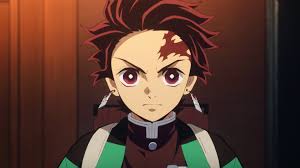
Master Roshi from Dragon Ball and Tanjiro from Demon SlayerENFJ (Protagonist/Collaborator type)(Author's estimate)

Famous anime characters from Dragon Ball, Studio Ghibli, and more are categorized into 16 personality types!
Let's get a feel for the unique atmosphere of each type ↓
From the following Amazon link,ENFJ characters (Master Roshi, Tanjiro Kamado)You can read a sample of the manga featuring this character, so please check it out if you're interested ↓
Great ENFJsClick here ↓
Here is a collection of famous quotes from great figures and celebrities categorized by their 16 personality types.
↓
Other great figures and characters who fit the ENFJ (protagonist/collaborator type) description ↓
- Shanks (One Piece)
- Nausicaä (Nausicaä of the Valley of the Wind)
- Minato Namikaze (NARUTO)
- Michael Moore (film director)
- Hyunjae (THE BOYZ)
- Anpanman (Anpanman)
- Martin Luther King Jr. (American social activist)
- Naomi Watanabe (Talent)
- Oracle (The Matrix)
(Estimated by the author)
youENFJ (Protagonist/Collaborator type)Then
Share it on social media (tweet it) and let your followers know!
↓↓↓Share on social media (tweet)↓↓↓
↑↑↑Share on social media (tweet)↑↑↑
Description of the ENFJ (Protagonist/Collaborator Type) personality traits
ENFJs are responsible, sociable, and loyal. This type is good at bringing together diverse opinions and finding common ground among people, making them excellent leaders.
ENFJs are sometimes called "givers," "protagonists," or "teachers."ISTP (Practitioner type)This is the opposite personality type of ENFJ. (All four letters are the opposite.)
This type possesses a captivating personality. They can build friendly relationships with all types of people and charm many with their overwhelming appeal. ENFJs are extroverted and love spending time with others. They crave attention and become energized and lively when they are with people.
ENFJs possess excellent interpersonal skills, excelling at communicating effectively in both large and small groups. However, despite their sociable nature, they also need more alone time than most to organize their thoughts and recover emotionally.
ENFJs are incredibly empathetic and easily connect with others' feelings. They have an excellent ability to understand other people's emotions and know the importance of allowing others to fully express their own feelings.
I also strive to have a positive influence on those around me, and I enjoy helping people solve their problems.
However, sometimes ENFJs are so empathetic that they tend to get too involved. They have a tendency to take on other people's problems as their own. They tend to take on other people's troubles as if they were their own.
In terms of values, ENFJs have a firm and unwavering set of values within themselves. They advocate for authenticity, altruism, and love and compassion for others, and they have a deep desire to be a positive presence in the world.
Driven by a genuine desire to do the right thing and unlock people's potential, they can sometimes wield the persuasive power and influence to change people's hearts. They stand up for the people and ideas they believe in, and they truly believe they can bring about significant change.
Furthermore, because they intuitively see areas for improvement in others, they enjoy helping people become their best selves. Leveraging their charisma, they excel at mediating between diverse groups, creating a harmonious atmosphere, and fostering good relationships. However, they need to be careful not to neglect their own needs by spending too much time helping others.
reference
・"They are articulate and persuasive" - ENFJ How do gender differences affect the lives of ENFJs?
・A Guide to the ENFJ Personality ~ Let's delve deeper ~
Strengths and weaknesses of the ENFJ (Protagonist/Collaborator type)
Strong Points
- Extroverted and warm
- Being able to empathize and be considerate
- Wide circle of friends
- Encouraging
- Neat, diligent, and meticulous
- loving and gentle
- Good at persuasion
Strong Points
- Strong need for approval
- Sometimes I react too sensitively.
- Indecisive and lacking in resolve
- Sometimes they are too self-sacrificing.
- Strict and uncompromising
- Becoming overprotective
- They sometimes try to manipulate people skillfully.
Hobbies and interests of an ENFJ (protagonist/collaborator type)
Planning social events, reading, art, museums, reading picture books (to children), listening to music, writing, gourmet cooking, etc.
Further characteristics of the ENFJ (protagonist/collaborator type) and compatibility with other types
- ENFJ (Collaborator Type) Personality
- ENFJ (Collaborator Type) Personality Trait 02
- Hobbies of ENFJ (Collaborator type)
- Things that ENFJs dislike
- The strengths and weaknesses of ENFJs
- Suitable occupations for ENFJs
- ENFJ leadership
- Compatibility between ENFJ and other personality types
- ENFJ Relationships and Romance
- How ENFJs set goals and gather information
- ENFJ's Decision-Making Methods
- ENFJ parent-child relationships
- ENFJ's Talents and How to Utilize Them
- For ENFJs to succeed
↓Learn more↓
Compatibility chart and advice for ENFJ (protagonist/collaborator type) and other types.
Ideal compatibility type pair
ENFJs are compatible with people who are sociable, understand others' feelings, and respect others.
From an ENFJ's perspective...
- INFP (Psychologist type):Fi – NeThey possess high empathy, the ability to understand other people's feelings, and creative thinking that can be applied in many different ways.
- ENFP (Reformer type):Ne – FiThey have a similar view of the world as I do, and they can understand other people's feelings.
- INTJ (Strategist type) :Ni – TeHaving a progressive vision and being able to translate it into practical, usable ideas.
Type pairs that are prone to conflict
ENFJs tend to clash with people who lack respect or consideration for others, have a different view of society than ENFJs, and are indifferent to social issues.
From an ENFJ's perspective...
- ISTP (Practitioner type):Ti – SeHe has his own unique preferences, is difficult to deal with, doesn't conform to those around him, and is excessively meticulous about minute details.
- INTP (Researcher Type):Ti – NeThey disregard the feelings of those around them and are only willing to follow their own opinions.
- ENTP (Inventor Type):Ne – TiThey are troublesome people who do not follow the common sense of society that should naturally be followed, thus creating conflicts of interest.
Romantic compatibility type pair
ENFJs are compatible with people who share their ideal vision and can reassure them even in difficult situations.
From an ENFJ's perspective...
- INTJ (Strategist type) :Ni – TeIt provides a logical explanation of how things work.
- INFP (Psychologist type):Fi – NeThey can understand other people's feelings and have their own ideals.
- INFJ (Empathy Type):Ni – FeBeing able to understand other people's feelings
- ISFP (Artist type):Fi – SeHe is able to see things realistically and is a charismatic person with a keen aesthetic sense.
*The pairs that tend to clash and the pairs that have good romantic compatibility may overlap. This is because while people may dislike those who are the complete opposite of themselves due to disagreements, they may also be attracted to those who appear mysterious because they are different. However, it seems that these relationships often end up breaking down.
(Advice for those dating an ENFJ)
ENFJs are very sensitive to the feelings of others, so the happiness of their partner is essential to their own happiness. ENFJ partners should express how grateful they are for the support and care their partner provides, and make an effort to reciprocate in the same way, even if their partner doesn't ask for help.
A collection of links explaining the psychological functions of the ENFJ (Protagonist/Collaborator type) (for those who want to understand the workings of the mind)
Reading the following roadmap from top to bottom will help you understand the ENJF mindset in a logical order ↓
- Roadmap – ENFJ (Collaborator Type) –
- Introduction – What is MBTI?
- Summary of my personality
- Cognition is
- Type-specific cognitive characteristics
- Four personality indicators (psychological tendency axes)
- Conflicts over personality indicators
- “The meaning of the four letters "ENFJ"
- First character:Introvert (type I) or extrovert (type E)
- Second character:Intuitive type (N type) or Sensing type (S type)
- Third character:Feeling type (F type) or thinking type (T type)
- 4th character:Perceiving type (P type) or Judging type (J type)
- About psychological functions (cognitive functions)
- What are psychological functions (cognitive functions)?
- The eight psychological functions (cognitive functions)
- Decision-making (judgment) function
- Information gathering (perceptual) function
- Understanding your own psychological functions (cognitive functions)
- The developmental process of psychological functions (cognitive functions)
- ENFJ's psychological functions (cognitive functions)
- First function:Extraverted Feeling (Fe)
- Second function:Introverted Intuition (Ni)
- Third function:Extroverted Sensing (Se)
- Fourth function:Introverted Thinking (Ti)
- Making good use of psychological functions (cognitive functions)
- The strengths and weaknesses of the ENFJ (Collaborator type)
- Make the most of your strengths
- Reasons for focusing too much on the advantages
- How to improve your weaknesses
- If you are alone
- In a team setting: Have others compensate for your weaknesses (fourth function).
To truly understand ENFJ (protagonist-collaborator type),Psychological functions (cognitive functions)This is important ↓
- Extraverted Feeling/Fe
Very good at it /First functionFollow what you deem right for everyone, what is good for the group. - Introverted Sensing/Ni
I'm a little good at it /second function: You are responsible for predicting whether your will, desires, and actions will cause harm in the future. - Extroverted Sensing/Se
I'm not very good at it.Third functionPeople want to stop and listen to what you have to say. Otherwise, they feel stifled, become critical, and tend to try to impose their own opinions and positions on others. - Introverted Thinking/Ti
I'm really bad at it /Fourth functionThey fear and are anxious about things that are not logically correct. They don't know how to thoroughly analyze available information (or are unwilling to do so).
<The cognitive axis of ENFJ>

Related articles about ENFJ (Protagonist/Collaborator type) Click to open
↑Learn more↑
The values and motivations of an ENFJ (protagonist/collaborator type).
ENFJs are driven by deep compassion and empathy for others. They can intuitively sense the emotions of others and act as a barometer for the emotional fluctuations of those around them.
Moreover, this compassion is often humanitarian, and it's not limited to those close to them; sometimes it stems from a genuine concern for the worries, misfortunes, and problems of all humanity. They feel people's emotions acutely, and when they see people suffering, they feel compelled to do something to help and take action.
ENFJs value interpersonal connections and believe that collaboration is the best way to accomplish things. They enjoy being liked and are very sensitive to feedback (evaluation from others), both positive and negative. They expect the best from others as well as themselves, and can be disappointed and discouraged if others do not act with the same sincerity and genuine intentions as an ENFJ. They work hard every day to maintain good relationships and strive to be an indispensable part of their family, group, and community.
youENFJ (Protagonist/Collaborator type)Then
Share it on social media (tweet it) and let your followers know!
↓↓↓Share on social media (tweet)↓↓↓
↑↑↑Share on social media (tweet)↑↑↑
Types similar to ENFJ (protagonist/collaborator type)
- INFJ: E (extrovert) and I (introvert) But they are different.
- ESFJ: N (Intuitive type) and S (Sensing type) But they are different.
- ENTJ: T (thinking type) and F (feeling type) But they are different.
- ENFP: J (Judgment type) and P (Perception type) But they are different.
If you're not confident that you're an ENFJ, you might be one of the four types mentioned above. Read the article or take some time to think about it again.diagnosisLet's try it.
Instructions for ENFJ (Protagonist-Collaborator Type)
If your friend, colleague, or family member is an ENFJ, there are things you can do to communicate with them more effectively and deepen your relationship with them.
*If you are an ENFJ, showing this guide to your friends and family may help improve your relationships.
To build good friendships
One of the best ways to be a good friend to an ENFJ is to accept the care and help they naturally offer. ENFJs love to help their friends, so it's important to accept their help and show your appreciation.
However, it's important to reciprocate. ENFJs aren't always good at asking for help when needed. Often, simply listening to them is incredibly helpful.
Learn more ↓
- Relationships and romance for ENFJ (Collaborator type)
- How extroverts (Type E) and introverts (Type I) can get along well
- How Sensing types (S type) and Intuitive types (N type) can get along well
- How Thinking (T-type) and Feeling (F-type) People Can Get Along Well
- How to get along well with Judging type (J type) and Perceiving type (P type)
To build a good parent-child relationship
ENFJ children may find it difficult to meet their parents' high expectations. Parental over-involvement can make them feel stifled, making it difficult for them to explore the world on their own.
Parents of ENFJ children need to be aware that their child is highly empathetic and can sometimes be overwhelmed by the intense emotions of others. ENFJ children are generous and caring, but they may struggle with the feeling that they cannot burden others with their own internal conflicts.
If your child is an ENFJ, encourage them to take care of their own mental health while also being considerate of others.
Learn more ↓
- Parent-child relationships of ENFJ (Collaborator type)
- Parent-child relationships between extroverts (Type E) and introverts (Type I)
- Parent-child relationships between sensing types (S-type) and intuitive types (N-type)
- Parent-child relationships between thinking types (T-type) and feeling types (F-type)
- Parent-child relationships between judging types (J type) and perceiving types (P type)
List of 16 Personality Types
A Collection of Information on the 16 Personality Types – The Little-Known Truths of Each Type (Summary, Illustrations, and Analysis)
- Summary of 16 Personality Type Test Websites
- List of articles categorized by personality type (16 types)
- Compatibility chart for 16 personality types
- Suitable occupations, ideal jobs, and dream jobs for each of the 16 personality types
- Nicknames (names) for each of the 16 personality types
- What if there were a country with 16 personality types...?
- The relationship between national characteristics around the world and the 16 personality types
- List of 16 Personality Types Based on Famous Characters
- Detective Conan: A Summary of 16 Personality Types for Each Character
- Percentage of 16 personality types
- Reactions of 16 Personality Types – Heaven and Hell
- To describe the 16 personality types in one word:
- 16 Simple Explanations of Personality Types
- 16 Personality Types: Strengths, Weaknesses, and Ways to Improve Weaknesses
- 16 Personality Types: Preferences and Strengths/Weaknesses in Majors and Subjects
- 16 Personality Types: How to Enjoy Life to the Fullest…?
- 16 Personality Types: Inspiring Quotes from Great Figures
- What if each of the 16 personality types were a murderer?
- How to become an attractive husband or wife based on your personality type (16 types)
- What 16 personality types do after a breakup
- Reasons for fighting according to 16 personality types
- Income by 16 Personality Types - Misconceptions and Truths -
- Characteristics of employees based on 16 personality types
- Potential pathological tendencies of 16 personality types
- Psychological Functions of 16 Personality Types Based on Statistics
- Viewing percentage of the detailed personality pages for each of the 16 personality types
- Summary of the characteristics of the 16 personality types
- 8 psychological functions: "What if I did...?"
- Approaches to tasks based on psychological function: Intuitive (N-type) & Sensing (S-type)
- Social interaction explained by psychological functions
- Understanding Your Financial Habits Through Psychological Functions – Are You a Saver or a Spender?
- Humor (sense of humor) as revealed by psychological functions
- How extroverts (Type E) and introverts (Type I) can get along well
- How Sensing types (S type) and Intuitive types (N type) can get along well
- How Thinking (T-type) and Feeling (F-type) People Can Get Along Well
- How to get along well with Judging (J-type) and Perceiving (P-type) types
- Characteristics of parents with 16 personality types
- Parent-child relationships between extroverts (Type E) and introverts (Type I)
- Parent-child relationships between sensing types (S-type) and intuitive types (N-type)
- Parent-child relationships between thinking types (T-type) and feeling types (F-type)
- Parent-child relationships between judging (J-type) and percepting (P-type) types
- How to identify your partner's personality type: [16 Personality Types]

comment