
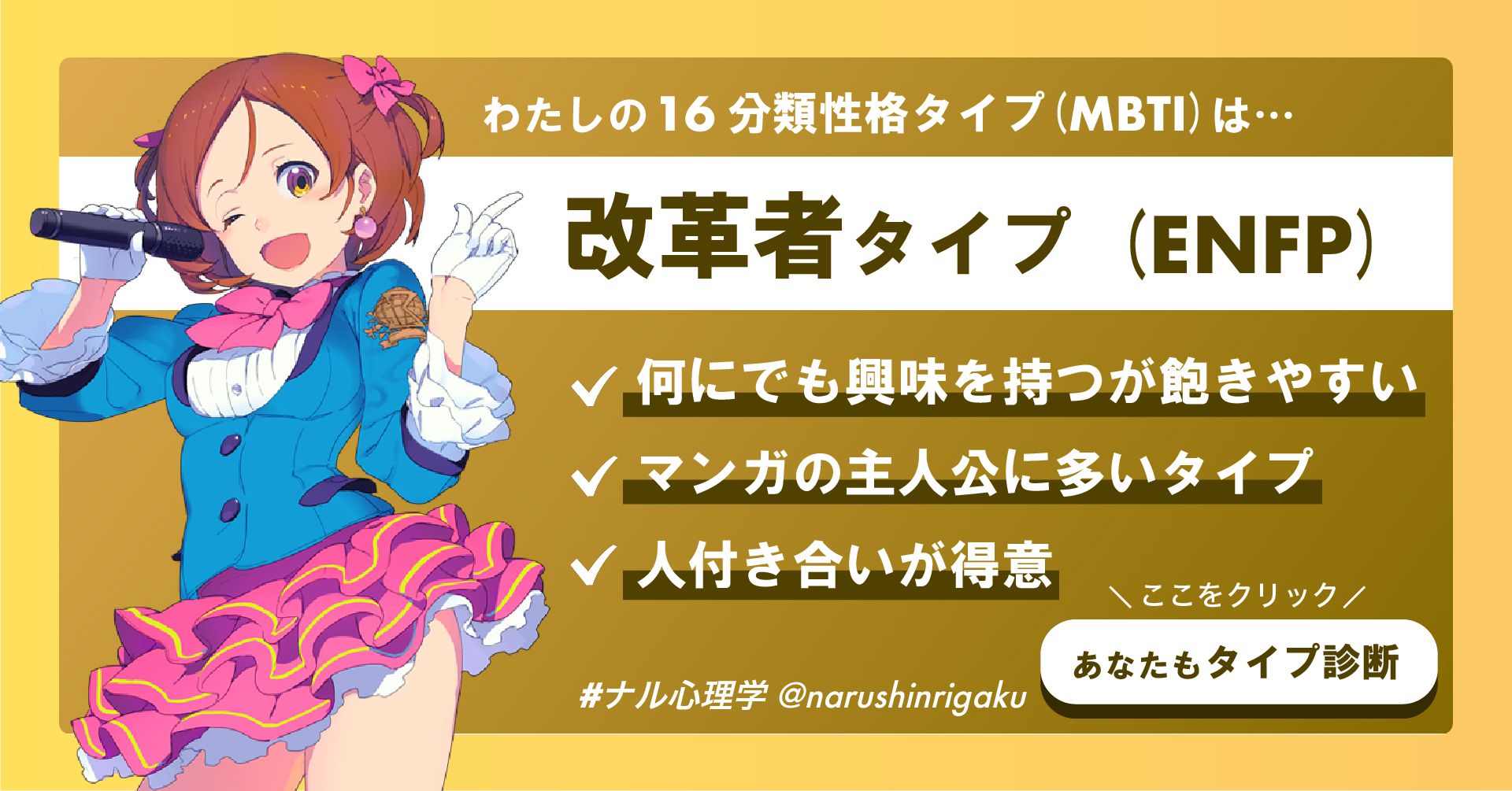
On this page, out of the 16 types,ENFP (Reformer type)This article explains their personality, characteristics, values, and views on love.
youENFP (Activist/Reformer type)Then
Share it on social media (tweet it) and let your followers know!
↓↓↓Share on social media (tweet)↓↓↓
↑↑↑Share on social media (tweet)↑↑↑
Classifying personalities into 16 types16-Type Personality TestCheck which type you are using the following↓↓

↑16-Type Personality Test↑
↑Diagnose↑
Your 16-type personality test result is...
"ENFP type (Reformer type)"
Detailed diagnosis results ↓
"Cheerful and bright! Friendly and charming, they seem like someone people would like. They also seem positive and motivated in everything they do. Well, if I had to say something negative, some people might find them a bit too familiar at first and not like them? They seem to enjoy having fun with everyone, and I always picture them hanging out with someone somewhere."
Let's get straight to your diagnosis results.
Share it on social media (tweet it) and let your followers know!
↓↓↓Share on social media (tweet)↓↓↓
↑↑↑Share on social media (tweet)↑↑↑
Your type,ENFP (Reformer type)This explains their personality, characteristics, values, and views on love.


- Famous people, celebrities, and anime characters who are ENFP (Activist/Reformer type)
- First impressions of an ENFP (Activist/Reformer type)
- Characteristics of the ENFP (Activist/Reformer) personality type
- Strengths and weaknesses of the ENFP (Activist/Reformer type)
- Hobbies and interests of ENFP (Activist/Reformer type)
- “What do the letters "ENFP" stand for?
- Interesting facts about ENFP (Activist/Reformer type)
- Further characteristics of the ENFP (Activist/Reformer type) and compatibility with other types
- The values and motivations of the ENFP (Activist/Reformer type)
- Similar types to ENFP
- Instructions for ENFP (Activist/Reformer Type)
Famous people, celebrities, and anime characters who are ENFP (Activist/Reformer type)
ENFP is the fifth most common personality type among women. The composition of an ENFP is as follows:
- population1 in 12 people(about 8%)
- men1 in 16 people(about 6%)
- women1 in 10 people(approx. 10%)
ENFP (Reformer type)To give you a sense of what kind of type it is,ENFP (Reformer type)Let me introduce the characters.

- Naruto
- Monkey D. Luffy (One Piece)
- Usopp (One Piece)
Famous anime characters from Dragon Ball, Studio Ghibli, and more are categorized into 16 personality types!
Let's get a feel for the unique atmosphere of each type ↓
youENFP (Activist/Reformer type)Then
Share it on social media (tweet it) and let your followers know!
↓↓↓Share on social media (tweet)↓↓↓
↑↑↑Share on social media (tweet)↑↑↑
Here you can find famous people, psychologists, philosophers, and quotes for all 16 personality types.
↓
Other great figures and characters of the ENFP (Reformer type)
- Naruto
- Monkey D. Luffy (One Piece)
- Usopp (One Piece)
- Howl (Howl's Moving Castle)
- Rapunzel (Disney)
- Aladdin (Aladdin)
- Walt Disney (animator, producer)
- V (BTS)
- RM (BTS)
- Salvador Dalí (painter)
- Will Smith (actor, film producer, rapper)
- Laura (model)
(Estimated by the author)
First impressions of an ENFP (Activist/Reformer type)
"Cheerful and bright! Friendly and charming, they seem like someone people would like. They also seem positive and motivated in everything they do. Well, if I had to say something negative, some people might find them a bit too familiar at first and not like them? They seem to enjoy having fun with everyone, and I always picture them hanging out with someone somewhere."
Characteristics of the ENFP (Activist/Reformer) personality type
ENFPs are often described as enthusiastic, charismatic, and creative. They are independent, energetic, and very attractive. This type can easily get distracted when working on things that seem boring or unexciting. ENFPs are highly flexible and try to keep as many options as possible. They can act quickly on impulse and adapt quickly to change. However, they may have problems with everyday tasks, such as being disorganized or procrastinating.
ENFPs are energized by new, exciting, and inspiring ideas. They also enjoy discussing their thoughts with others and brainstorming. Working with energetic and passionate creators will allow ENFPs to grow significantly.
I also enjoy building relationships with people. Whether it's friends, family, colleagues, or even complete strangers, I feel energized when I'm with people. Meeting new people and forming connections always excites ENFPs.
ENFPs love to try new things. They tend to seek out unknown experiences and world-first attempts, and are exceptionally tolerant of risk and change. They also constantly strive to step outside their comfort zone*, broaden their horizons, and grow as individuals.
*Comfort zone... A comfortable state free from psychological stress.
This type of person is filled with anticipation for the future and can lead a vibrant life. Being optimistic, they can steadily move forward, and while they don't plan too far ahead, they are confident that the future will always be positive.
ENFPs are motivated when they feel heard and understood by others. This is because when friends, family, and colleagues take the time to listen to their opinions and participate in discussions, ENFPs feel welcomed and valued for their presence and ideas.
reference
・Personality Guide for ENFP (Activist/Reformer) Type
Strengths and weaknesses of the ENFP (Activist/Reformer type)
Strong Points
- Warm and passionate
- They are considerate and can understand other people's feelings.
- I am good at building good relationships.
- Possesses strong communication skills
- Flexible
- It is very creative.
Disadvantages
- Strong need for approval
- I can't keep things tidy.
- I tend to accumulate stress.
- I can sometimes become overly emotional.
- I overthink things and end up overheating.
- I have trouble following the rules.
Continue →Strengths and weaknesses of the ENFP (Activist/Reformer) personality type
Hobbies and interests of ENFP (Activist/Reformer type)
ENFPs are interested in listening to music, playing musical instruments, creating and appreciating art, participating in local theater, reading novels, and writing.
Continue →Hobbies of ENFP (Activist/Reformer type)
“What do the letters "ENFP" stand for?
“"ESTJ" is an acronym used to describe one of the 16 personality types, each with its own personality traits (cognitionThis represents the style.
- E = Extroverted type...I feel energized by spending time with others (↔︎Spending time alone: Introvert/I)
- N = Sensing type...Attention is focused on abstract ideas, concepts, and the overall picture (↔︎Specific facts and details of things: Sensation/S)
- F = Emotional type...making decisions based on one's own or others' feelings* (↔︎rationality and rationale: thinking/T)
- P = Perceptual type...to act flexibly and adapt to the situation (↔︎ to plan and act: to make a judgment/J)
*Includes concepts of good and evil and ethics.
Interesting facts about ENFP (Activist/Reformer type)
- On the personality trait scale, he scored highly on traits such as enthusiastic, sociable, easygoing, fickle, impulsive, energetic, and caring.
- Of all 16 types, this type scored the highest in stress coping ability.
- ENFP women have a lower risk of developing heart disease.
- Men with an ENFP personality type are less likely to suffer from chronic pain.
- According to psychologists, this type of person is considered to be the most likely to cause problems at school.
- This is often seen in academically gifted elementary school students.
- Personal values include things like "home and family," "friendship," "creativity," "learning," and "social welfare."
- It is common among people working in professions related to counseling, education, religion, and the arts.
Further characteristics of the ENFP (Activist/Reformer type) and compatibility with other types
- ENFP Personality Traits 02
- ENFP's hobbies
- Things that ENFPs dislike
- Compatibility between ENFP and other personality types
- ENFP and Relationships
- ENFP and romance
- Strengths and weaknesses of ENFPs
- Suitable occupations for ENFPs
- ENFP leadership
- Compatibility between ENFP and other personality types
- ENFP and Relationships
- ENFP and romance
- How ENFPs set goals and gather information.
- ENFP's Decision-Making Methods
- ENFP parent-child relationships
- For ENFPs to succeed
↓Learn more↓
Compatibility chart and advice for ENFP (Activist/Reformer type) and other personality types.
Ideal compatibility type pair
ENFPs are compatible with people who share their idealistic worldview, have a sense of humor, and are imaginative and understanding.
From an ENFP's perspective...
- ESFP (Optimist type):Se – Fi, a sense of humor and other things that we get along well with
- ENFJ (Collaborator Type):Fe – NiThey share a similar ideal vision and are compatible in their efforts to achieve it.
- ENTP (Inventor Type):Ne – TiIt also allows for brainstorming, deepening discussions, and exchanging information.
- ISFP (Artist type):Fi – SeWe can think about things from a practical perspective and be inspired by each other's ideas.
Type pairs that are prone to conflict
ENFPs tend to clash with people who not only refuse to accept opinions different from their own but also criticize them.
From an ENFP's perspective...
- ISTJ (Hardworking Type):Si – TeThey lack humor and are unwilling to accept new ideas.
- INTJ (Strategist type) :Ni – TeThey lack a good sense of humor, are overly cautious about new ideas, and tend to look for flaws that make them unlikely to work, offering harsh criticism.
Romantic compatibility type pair
ENFPs are most compatible in romantic relationships with someone who shares their ideal worldview, understands their groundbreaking ideas, and provides a sense of security even in difficult situations.
From an ENFP's perspective...
- ENFJ (Collaborator Type):Fe – NiThey actively accept my ideas and think about how to make them feasible.
- INTP (Researcher Type):Ti – NeThey can help us brainstorm ideas and discuss things, and they also gather information and teach us useful things.
- INTJ (Strategist type) :Ni – Te...and we can discuss our thoughts and, moreover, it gives us peace of mind in the long term.
- ESFJ (Sociable Type):Fe – SiThey're fun to talk to, and they help create schedules, making it easy to understand what needs to be done next.
*The pairs that tend to clash and the pairs that have good romantic compatibility may overlap. This is because while people may dislike those who are the complete opposite of themselves due to disagreements, they may also be attracted to those who appear mysterious because they are different. However, it seems that these relationships often end up breaking down.
(Advice for those dating an ENFP)
ENFPs tend to be passionate and enthusiastic in romantic relationships. Because they often focus on what's possible rather than the present, long-term relationships can sometimes be challenging. To maintain a romantic relationship and keep it going, it's important for them to explore new ways to add excitement to their love life.
A collection of links explaining the psychological functions of the ENFP (Activist/Reformer type) (for those who want to understand the workings of the mind)
Reading the following roadmap from top to bottom will help you understand the ENFP mindset in a logical order ↓
- Roadmap – ENFP (Reformer type) –
- Introduction – What is MBTI?
- Summary of my personality
- Cognition is
- Type-specific cognitive characteristics
- Four personality indicators (psychological tendency axes)
- Conflicts over personality indicators
- “The meaning of the four letters "ENFP"
- First character:Introvert (type I) or extrovert (type E)
- Second character:Intuitive type (N type) or Sensing type (S type)
- Third character:Feeling type (F type) or thinking type (T type)
- 4th character:Perceiving type (P type) or Judging type (J type)
- About psychological functions (cognitive functions)
- What are psychological functions (cognitive functions)?
- The eight psychological functions (cognitive functions)
- Decision-making (judgment) function
- Information gathering (perceptual) function
- Understanding your own psychological functions (cognitive functions)
- The developmental process of psychological functions (cognitive functions)
- ENFP's psychological functions (cognitive functions)
- First function:Extroverted Intuition (Ne)
- Second function:Introverted Feeling (Fi)
- Third function:Extraverted Thinking (Te)
- Fourth function:Introverted Sensing (Si)
- Making good use of psychological functions (cognitive functions)
- Strengths and weaknesses of ENFPs
- Make the most of your strengths
- Reasons for focusing too much on the advantages
- How to improve your weaknesses
- If you are alone
- In a team setting: Have others compensate for your weaknesses (fourth function).
To truly understand the ENFP (Activist/Reformer type),Psychological functions (cognitive functions)This is important ↓
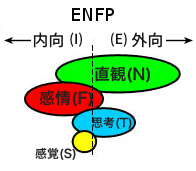
- Extroverted Intuition/Ne
Very good at it /First functionIt can control our perception of the future and allow us to predict various possibilities and destinies. - Introverted Feeling/Fi
I'm a little good at it /second functionIf your actions are based on moral reasons aligned with your vision, you can take responsibility for how others feel. - Extraverted Thinking/Te
I'm not very good at it.Third functionI prefer an environment where everyone can feel comfortable. Once an environment is disrupted, it cannot be fixed by avoiding responsibility. - Introverted Sensing/Si
I'm really bad at it /Fourth functionThey are afraid and anxious about trying new things and having unpleasant experiences. They don't know how to deal with routines and patterns (or don't like them).
<ENFP's cognitive axis>
ENFP (Activist/Reformer type)Related articlesList
↑Learn more↑
The values and motivations of the ENFP (Activist/Reformer type)
ENFPs are curious about others and are engrossed in finding deeper meaning in people and ideas. They also seek genuine value and pursue strong emotional experiences. ENFPs are easily bored and have low tolerance for details and repetition, so they seek situations that allow them to escape from the mundane and mundane. Many ENFPs are "novelties," have a wide range of hobbies, and have friends from diverse backgrounds. ENFPs value individuality and often consider the pursuit of happiness, both for themselves and others, to be their top priority in life. They value personal freedom and self-expression, and want to go wherever their inspiration leads them.
youENFP (Activist/Reformer type)Then
Share it on social media (tweet it) and let your followers know!
↓↓↓Share on social media (tweet)↓↓↓
↑↑↑Share on social media (tweet)↑↑↑
Similar types to ENFP
- INFP: E (extrovert) and I (introvert) But they are different.
- ESFP: N (Intuitive type) and S (Sensing type) But they are different.
- ENTP: T (thinking type) and F (feeling type) But they are different.
- ENFJ: J (Judgment type) and P (Perception type) But they are different.
If you're not confident that you're an ENFP, you might be one of the four types mentioned above. Read the article or take some time to think about it again.diagnosisLet's try it.
Instructions for ENFP (Activist/Reformer Type)
If your friends, colleagues, or family members are ENFPs, there are things you can do to communicate with them more effectively and deepen your relationships.
*If you are an ENFP, showing this guide to your friends and family may help improve your relationships.
To build good friendships
ENFPs make fun and exciting friends. They love trying new things they've never experienced before and have many friends and acquaintances. They are also good at sensing other people's feelings and can quickly understand them.
The way you can help your ENFP friend is by being a source of emotional support for them as they strive to achieve their goals.
Learn more ↓
- Relationships and romance for ENFP (Reformer type)
- How extroverts (Type E) and introverts (Type I) can get along well
- How Sensing types (S type) and Intuitive types (N type) can get along well
- How Thinking (T-type) and Feeling (F-type) People Can Get Along Well
- How to get along well with Judging type (J type) and Perceiving type (P type)
To build a good parent-child relationship
ENFPs dislike a rigid daily routine, so children may sometimes find their parents' parenting style contradictory. However, ENTP parents generally have a strong bond of love with their children and are skilled at conveying their values.
Parents of ENFP children will notice that their children have rich imaginations and are full of enthusiasm. While you may sometimes feel overwhelmed by your child's energy, try to find ways to help them express their creativity.
One challenge that ENFP children may face is difficulty with self-discipline. While they recognize the need for autonomy, they are not always good at it. In such cases, ENFP parents can encourage their children to be creative while also setting guidelines and disciplines for them.
Learn more ↓
- Parent-child relationships of ENFP (Reformer type)
- Parent-child relationships between extroverts (Type E) and introverts (Type I)
- Parent-child relationships between sensing types (S-type) and intuitive types (N-type)
- Parent-child relationships between thinking types (T-type) and feeling types (F-type)
- Parent-child relationships between judging types (J type) and perceiving types (P type)
List of 16 Personality Types
A Collection of Information on the 16 Personality Types – The Little-Known Truths of Each Type (Summary, Illustrations, and Analysis)
- Summary of 16 Personality Type Test Websites
- List of articles categorized by personality type (16 types)
- Compatibility chart for 16 personality types
- Suitable occupations, ideal jobs, and dream jobs for each of the 16 personality types
- Nicknames (names) for each of the 16 personality types
- What if there were a country with 16 personality types...?
- The relationship between national characteristics around the world and the 16 personality types
- List of 16 Personality Types Based on Famous Characters
- Detective Conan: A Summary of 16 Personality Types for Each Character
- Percentage of 16 personality types
- Reactions of 16 Personality Types – Heaven and Hell
- To describe the 16 personality types in one word:
- 16 Simple Explanations of Personality Types
- 16 Personality Types: Strengths, Weaknesses, and Ways to Improve Weaknesses
- 16 Personality Types: Preferences and Strengths/Weaknesses in Majors and Subjects
- 16 Personality Types: How to Enjoy Life to the Fullest…?
- 16 Personality Types: Inspiring Quotes from Great Figures
- What if each of the 16 personality types were a murderer?
- How to become an attractive husband or wife based on your personality type (16 types)
- What 16 personality types do after a breakup
- Reasons for fighting according to 16 personality types
- Income by 16 Personality Types - Misconceptions and Truths -
- Characteristics of employees based on 16 personality types
- Potential pathological tendencies of 16 personality types
- Psychological Functions of 16 Personality Types Based on Statistics
- Viewing percentage of the detailed personality pages for each of the 16 personality types
- Summary of the characteristics of the 16 personality types
- 8 psychological functions: "What if I did...?"
- Approaches to tasks based on psychological function: Intuitive (N-type) & Sensing (S-type)
- Social interaction explained by psychological functions
- Understanding Your Financial Habits Through Psychological Functions – Are You a Saver or a Spender?
- Humor (sense of humor) as revealed by psychological functions
- How extroverts (Type E) and introverts (Type I) can get along well
- How Sensing types (S type) and Intuitive types (N type) can get along well
- How Thinking (T-type) and Feeling (F-type) People Can Get Along Well
- How to get along well with Judging (J-type) and Perceiving (P-type) types
- Characteristics of parents with 16 personality types
- Parent-child relationships between extroverts (Type E) and introverts (Type I)
- Parent-child relationships between sensing types (S-type) and intuitive types (N-type)
- Parent-child relationships between thinking types (T-type) and feeling types (F-type)
- Parent-child relationships between judging (J-type) and percepting (P-type) types
- How to identify your partner's personality type: [16 Personality Types]

comment