
On this page, you will find a selection of 16 types.ENTP (Inventor Type) PersonalityI will explain this.
youENTP (Debater-Inventor Type)Then
Share it on social media (tweet it) and let your followers know!
↓↓↓Share on social media (tweet)↓↓↓
↑↑↑Share on social media (tweet)↑↑↑
Classifying personalities into 16 types16-Type Personality TestCheck which type you are using the following↓↓

↑16-Type Personality Test↑
↑Diagnose↑


ENTP (Debater-Inventor type) personality
The following is a quote (with some modifications) from "Let's Look at the World from the Perspective of MBTI Personality Type Theory" (website no longer exists).
They seek consistent and logical explanations, striving to thoroughly understand the structure and mechanisms of things, while continuously searching for new ideas. They possess a strong intellectual curiosity, can grasp the relationships and underlying meanings of things, and have a multifaceted perspective. They are skeptical of existing concepts and methods, avoiding preconceived notions, and instead seek to find more innovative and better concepts and methods through their own thought processes. They communicate, share, and discuss their ideas with others. They are always willing to adopt better ideas or concepts whenever they arise.
They are optimistic and eager to act on anything that seems promising. Intelligent and quick to understand, they learn a great deal and expand their knowledge with each challenge. They are excited to try new things, wondering what they can accomplish and what they will discover.
They are full of adventurous spirit, but in the initial stages, they don't always have a clear answer about what will happen. Even if they think an idea is good at first, they often realize it's a failure later on. However, even then, they don't dwell on the disappointment. They don't give up easily, and it's not uncommon for them to come up with new ideas from the experience of failure itself.
I love to play and I enjoy games and toys. The more intellectually sophisticated they are, the more I enjoy them. I want to participate in popular games and games that everyone is playing. Once I've solved one or understood how it works, my interest shifts to the next new thing.
They are competitive, competent, and can handle many things strategically. They want to work with capable people to achieve goals efficiently. They are competitive, focus on beating their opponents, and get excited when they can find an opportunity to win.
You are able to adapt flexibly to new situations. Although you tend to get bored easily, once you set a clear goal, you discipline yourself strictly and spare no effort. When faced with a major obstacle, you become even more motivated and try to overcome it at all costs. Even when you face one problem after another, you can come up with solutions and improvements each time, bringing you closer to your goal.
When they are focused on what they need to do, they don't want to be bothered by interpersonal relationships. However, during short breaks or after successfully completing a task, they value socializing. They often find that talking to people helps them to listen to their problems or gives them motivation. They are charming, amiable, and entertain people with their witty stories. They also actively seek out new encounters, which naturally expands their social circle.
I want others to know what I'm thinking and what I'm doing. I seek opinions from understanding people and showcase my achievements. I hit it off with people who share similar interests. When my ideas are accepted, I want to collaborate to make them a reality. I honestly ask for support from others when I'm not good at something. I value relationships and believe that it's best if everyone involved, including myself, can secure their own interests according to their respective roles. When I encounter talented people, a sense of rivalry may arise, but I respect and appreciate them when I can receive good advice.
They are open and honest about themselves, and possess a humble side. They genuinely enjoy praise and become even more motivated. They are understanding if others' perspectives are based on sound reasoning. When spoken to harshly or reprimanded, they reflect on their mistakes. They express their own opinions and are concerned about what others think.
They possess excellent analytical and planning skills and are adept at persuading others. They don't always see projects through to completion themselves, sometimes delegating tasks to others. However, as long as they build cooperative relationships, fairly share responsibilities, and distribute profits, there shouldn't be any problems. They struggle with paying attention to minute details during the actual execution phase. They believe that having others point out mistakes they might miss will improve the overall quality of their work.
ENTPs enjoy debates, which often become heated. They assert their own opinions with consistent reasoning from their unique perspective. They can shift perspectives and consider whether opposing viewpoints are valid, making their discussions resemble debates. They seek to explore what they believe to be more correct, more valuable methods and concepts, without being bound by common sense or existing ideas, by discussing them with others. This communication style is like a sport for ENTPs; they enjoy it. However, if even a slight doubt arises or they notice a lack of consistency, they pursue strictness and try to get to the bottom of things, which can be harsh on others. They may even look down on people who seem uncomprehending. Also, they sometimes introduce ideas that disregard morality or inappropriate assumptions and make plausible arguments, which can offend listeners. They become engrossed in discussions without realizing it, which can bore the other person and prevent the discussion from progressing as they wish. They may even be ignored. Or, if they decide that it's hopeless, they will give up on the other person, stop the discussion, and leave. I sometimes regret forgetting to be polite, but I tell myself it couldn't be helped and move on to other things. An understanding NT type or a mature INFJ might make a good discussion partner. They bring new perspectives to fields such as business strategy, science, technology, and philosophy.
You can trust your intuition and, through your unique thought process, accomplish creative work. If you can leverage these strengths, you can expect to excel in a wide range of fields. While you may not be good at focusing on details, you readily accept legitimate criticism and gradually refine and establish your own methods. It would be gratifying if, through collaboration, ideas were realized and eventually widely accepted and established.
Types that are compatible with ENTPs are:ISFP、ENTP、 ESFJ、INTJ、INFJis.
End of quote from "Let's Look at the World from the Perspective of MBTI Personality Type Theory" (website no longer exists) (partially modified)
reference
・What is ENTP? – Main Page –
・"Taking on one challenge after another" - ENTP ~ How do gender differences affect the lives of ENTPs? ~
youENTP (Debater-Inventor Type)Then
Share it on social media (tweet it) and let your followers know!
↓↓↓Share on social media (tweet)↓↓↓
↑↑↑Share on social media (tweet)↑↑↑
Further characteristics of ENTPs and their compatibility with other types
- What is ENTP? – Main Page –
- "Taking on one challenge after another" - ENTP ~ How do gender differences affect the lives of ENTPs? ~
- A Guide to the ENTP Personality
- ENTP hobbies
- Things you dislike about ENTPs
- The advantages and disadvantages of ENTPs
- Suitable occupations for ENTPs
- ENTP leadership
- Compatibility between ENTPs and other types
- ENTPs and social interactions
- ENTPs and romance
- How ENTPs set goals and gather information
- ENTP decision-making methods
- ENTP parent-child relationships
- For ENTPs to succeed
↓Learn more↓
Compatibility chart and advice for ENTPs (Debaters/Inventors) and other personality types.
Ideal compatibility type pair
ENTPs get along well with people who are logical, can exchange opinions, engage in discussions and debates, and can exchange information with a touch of humor.
From ENTP's perspective...
- INTP (Researcher Type):Ti – NeThey allow you to express your opinions and ideas and discuss them, and they also help gather information.
- INTJ (Strategist type):Ni – TeThey can think logically, share ideas, and discuss opinions.
- ENFP (Reformer type):Ne – FiWe can consider and discuss ideas, future prospects, and possibilities.
- ISTP (Practitioner type) :Ti – SeThe ability to apply and develop ideas in real society.
Type pairs that are prone to conflict
ENTPs tend to clash with people who cling to traditions that reject or question the need for discussion about future prospects and possible outcomes.
From ENTP's perspective...
- ISFJ (Parental Type):Si – FeThey are unwilling to listen to innovative ideas.
- ISTJ (Hardworking Type):Si – TeThey are extremely critical of innovative ideas.
- INTJ (Strategist type) :Ni – TeThey look at the idea in terms of practicality and feasibility, become skeptical, and don't agree with it.
- ESTJ (Responsible type):Te – SiThey only accept traditional ideas, and their worldview is fundamentally different.
Romantic compatibility type pair
ENTPs are most compatible in romantic relationships with people with whom they can freely exchange ideas, future prospects, and possibilities, and with whom they feel a sense of long-term security.
From ENTP's perspective...
- ISTP (Practitioner type):Ti – SeThey teach you knowledge and information that you can use immediately in the real world.
- INTP (Researcher Type):Ti – NeWe can share information and discuss our thoughts on future prospects and possibilities.
- ENFP (Reformer type):Ne – FiThey create a cheerful and fun atmosphere, allowing us to discuss future prospects and possibilities, and incorporating humor.
- ISFJ (Parental Type):Fe – SiIt provides reassurance even in difficult situations.
*The pairs that tend to clash and the pairs that have good romantic compatibility may overlap. This is because while people may dislike those who are the complete opposite of themselves due to disagreements, they may also be attracted to those who appear mysterious because they are different. However, it seems that these relationships often end up breaking down.
(Advice for those dating an ENTP)
reference ENTPs and romance
In close relationships, ENTPs are passionate and fun-loving. They are warm, affectionate, and skilled at understanding others' feelings and needs. However, ENTPs may be slow to follow through on promises, which can sometimes be frustrating.
If you are dating an ENTP, be aware that your partner has a desire to be relaxed and natural. It would be good to help them make plans and work towards their goals so that they don't abandon what they should be doing and impulsively start something else.
A collection of links explaining the psychological functions of ENTPs (Debaters/Inventors) (for those who want to understand how the mind works)
Reading the following roadmap from top to bottom will help you understand the ENTP mindset in a logical order ↓
- Roadmap – ENTP (Inventor Type) –
- Introduction – What is MBTI?
- Summary of my personality
- “The meaning of the four letters "ENTP"
- What are the personality traits of the four pairs?
- First character:Introvert (type I) or extrovert (type E)
- Second character:Intuitive type (N type) or Sensing type (S type)
- Third character:Feeling type (F type) or thinking type (T type)
- 4th character:Perceiving type (P type) or Judging type (J type)
- The quirks (tendencies) and conflicts of the four pairs of personality traits
- Cognitive mechanisms
- What are the personality traits of the four pairs?
- About psychological functions (cognitive functions)
- What are psychological functions (cognitive functions)?
- The eight psychological functions (cognitive functions)
- Decision-making (judgment) function
- Information gathering (perceptual) function
- Understanding your own psychological functions (cognitive functions)
- The developmental process of psychological functions (cognitive functions)
- ENTP psychological functions (cognitive functions)
- First function:Extroverted Intuition (Ne)
- Second function:Introverted Thinking (Ti)
- Third function:Extraverted Feeling (Fe)
- Fourth function:Introverted Sensing (Si)
- Making good use of psychological functions (cognitive functions)
- The advantages and disadvantages of ENTPs
- Make the most of your strengths
- Reasons for focusing too much on the advantages
- How to improve your weaknesses
- If you are alone
- In a team setting: Have others compensate for your weaknesses (fourth function).
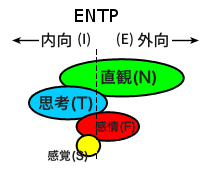
To truly understand ENTPs,Psychological functions (cognitive functions)This is important ↓
- Extroverted Intuition/Ne
Very good at it /First functionThey possess a superior ability to see the entire future and foresee various possibilities and destinies. - Introverted Thinking/Ti
I'm a little good at it /second function: They are responsible for verifying the facts, determining whether statements and findings make logical sense, and what is true or false. - Extraverted Feeling/Fe
I'm not very good at it.Third functionThey want to make people happy and feel positive. When that's not the case, it tends to turn into insults, sarcasm, and imposing a sense of superiority. - Introverted Sensing/Si
I'm really bad at it /Fourth functionThey feel anxiety and fear about trying new things and failing. They dislike or are unable to do routine work (simple, repetitive tasks).
<ENTP cognitive axes>
Related articles about ENTP (Debater/Inventor type)List
- ENTP psychological functions
- Comparison with other types
↑Learn more↑
List of 16 types (≒MBTI types)
A Collection of Information on the 16 Personality Types – The Little-Known Truths of Each Type (Summary, Illustrations, and Analysis)
- Summary of 16 Personality Type Test Websites
- List of articles categorized by personality type (16 types)
- Compatibility chart for 16 personality types
- Suitable occupations, ideal jobs, and dream jobs for each of the 16 personality types
- Nicknames (names) for each of the 16 personality types
- What if there were a country with 16 personality types...?
- The relationship between national characteristics around the world and the 16 personality types
- List of 16 Personality Types Based on Famous Characters
- Detective Conan: A Summary of 16 Personality Types for Each Character
- Percentage of 16 personality types
- Reactions of 16 Personality Types – Heaven and Hell
- To describe the 16 personality types in one word:
- 16 Simple Explanations of Personality Types
- 16 Personality Types: Strengths, Weaknesses, and Ways to Improve Weaknesses
- 16 Personality Types: Preferences and Strengths/Weaknesses in Majors and Subjects
- 16 Personality Types: How to Enjoy Life to the Fullest…?
- 16 Personality Types: Inspiring Quotes from Great Figures
- What if each of the 16 personality types were a murderer?
- How to become an attractive husband or wife based on your personality type (16 types)
- What 16 personality types do after a breakup
- Reasons for fighting according to 16 personality types
- Income by 16 Personality Types - Misconceptions and Truths -
- Characteristics of employees based on 16 personality types
- Potential pathological tendencies of 16 personality types
- Psychological Functions of 16 Personality Types Based on Statistics
- Viewing percentage of the detailed personality pages for each of the 16 personality types
- Summary of the characteristics of the 16 personality types
- 8 psychological functions: "What if I did...?"
- Approaches to tasks based on psychological function: Intuitive (N-type) & Sensing (S-type)
- Social interaction explained by psychological functions
- Understanding Your Financial Habits Through Psychological Functions – Are You a Saver or a Spender?
- Humor (sense of humor) as revealed by psychological functions
- How extroverts (Type E) and introverts (Type I) can get along well
- How Sensing types (S type) and Intuitive types (N type) can get along well
- How Thinking (T-type) and Feeling (F-type) People Can Get Along Well
- How to get along well with Judging (J-type) and Perceiving (P-type) types
- Characteristics of parents with 16 personality types
- Parent-child relationships between extroverts (Type E) and introverts (Type I)
- Parent-child relationships between sensing types (S-type) and intuitive types (N-type)
- Parent-child relationships between thinking types (T-type) and feeling types (F-type)
- Parent-child relationships between judging (J-type) and percepting (P-type) types
- How to identify your partner's personality type: [16 Personality Types]


comment