

A personality test that classifies people into 16 personality types.MBTIThere is such a thing, and it has a reputation for being very accurate.

This article will cover the following 16 types.INTP (Logician/Researcher Type)This explains the personality traits of [the character/person].
youINTP (Logician/Researcher Type)Then
Share it on social media (tweet it) and let your followers know!
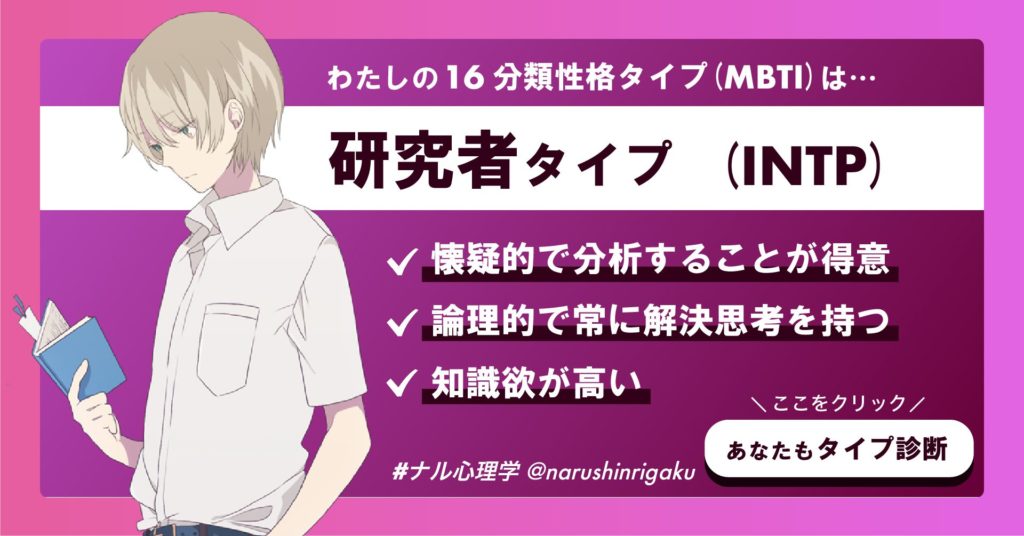
↓↓↓Share on social media (tweet)↓↓↓
↑↑↑Share on social media (tweet)↑↑↑


INTP (Logician/Researcher Type) Personality
The following is a quote (with some modifications) from "Let's Look at the World from the Perspective of MBTI Personality Type Theory" (website no longer exists).
I excel at pattern recognition and analysis, possess a strong curiosity about many things, and above all, I enjoy satisfying my intellectual curiosity. I examine the mechanisms of things from multiple perspectives and attempt to provide theoretical explanations through my own unique thinking.
They are intelligent, imaginative, and have an original way of looking at things. Because they tend to distance themselves from others and indulge in solitary thoughts and reflections, they may be perceived as eccentric.
As understanding deepens, we accumulate knowledge and consider various ways to improve things. From childhood, we are interested in things that can be understood systematically, such as natural phenomena, mathematics, or machines, devices, and computers, and we spontaneously become knowledgeable about them.
In such situations, I can utilize my accumulated knowledge and intuition, allowing me to respond flexibly to unforeseen circumstances.
They are always curious about new things and continue to explore a complete understanding and knowledge of this world, as well as universal concepts, without ever becoming bored.
They have a wide range of interests, from everyday things and natural phenomena to artificial systems, and they strive to grasp the fundamental principles and concepts behind them.
We can quickly discern the workings and relationships between parts and extract underlying principles. Often, intuition leads to the conclusion first. However, at that stage, the conclusion is vague, so we clarify its truth or falsity using theory. We start with assumptions and first principles that seem correct and attempt to make consistent reasoning. In doing so, we strive to be as consistent and rigorous as possible.
I will try to change my perspective and make sure I can withstand counter-arguments.
I actively absorb knowledge by reading books. I am impressed by the keen insights, intellectual discoveries, and rigorous pursuit of knowledge of those who came before me. However, I am never satisfied with simply cramming knowledge. I always look at things skeptically, thinking for myself whether they are truly correct, whether there are other perspectives, and whether there are more efficient methods.
I am reserved and gentle. I don't like to control others or be controlled by others. I prefer to be alone, quietly contemplating things in my mind and reaching profound understandings.
We do not blindly accept common sense or authority, nor do we sway the consensus of irrational groups. We seek to expose contradictions, deception, and inefficiencies from a different perspective. We take pride in this calm and objective stance.
They don't sugarcoat things or use flowery language. They are always bold, unaffected by people's emotions, and coldly try to reveal the unvarnished truth. As a result, they may act bluntly or ask audacious questions without hesitation. When that happens, those around them often feel uncomfortable.
INTPs often find themselves so absorbed in their thoughts that they become completely lost in their own world. They become so engrossed in their own thinking that they forget about their own body, the passage of time, and the existence of the world around them. INTPs often fail to notice things around them that others would immediately notice.
I make an effort to pay attention to even the smallest details in order to understand things that interest me, but I have no interest in the mundane tasks that have to be done to maintain daily life.
They often show interest in mathematics, physics and other natural sciences, linguistics, information science, computer science, economics, and sociology.
They immerse themselves in imagination and contemplation, prefer rigorous definitions, and strive to prove their predictions by making consistent inferences based on fundamental principles and thought models. They also excel at applying these principles to technologies, inventions, system development, and improvement.
While my thinking tends to be overly abstract, often involving contemplation for the sake of contemplation, I believe it's crucial to verify the validity of my inferences through engagement with the real world, practical application, and experimentation. I move back and forth between concrete examples and universal concepts. I devise practical methods to prove the truth or falsity of my conclusions.
They share their insights, ideas, and thought processes with understanding individuals to help others. They share interesting information with trustworthy people and seek to discover further ideas through discussion.
I focus on unresolved issues and lacks theoretical consistency. New discoveries may be found in these areas. I cannot tolerate inaccuracies and will strive to correct even the slightest nuances.
They tend to be perfectionists, adhering to their own standards. It takes time for them to express their reasoning process and conclusions. They often dwell on areas that need correction, constantly seeking alternative perspectives, and tend to overthink things. Sometimes, they consider the opposite viewpoint and continue reasoning until they are certain. In some cases, they conclude that the reverse is also true.
However, there are conditions and criteria that depend on the situation, and I'm becoming wiser. I often come up with different perspectives, which can make it difficult to understand the main point, and I sometimes get frustrated with myself. When there is a time limit, I think for as long as I can and adopt the conclusion that I believe is most accurate and appropriate.
They place too much emphasis on rigorous thinking and prefer solitude, making it difficult for them to appreciate the value of contributing to others. They may try to explain people's selfish side theoretically. They tend to believe there is no truth in morality and are prone to nihilism.
I hope that facts and concepts will be explained concisely and to the point. The thought processes and conclusions of INTPs can sometimes be difficult for others to understand. In such cases, I may use simplified metaphors to make them easier to grasp.
My true desire is to deepen my thoughts on the next task, but I am also concerned about the opinions of others. Receiving positive feedback from people I trust or those close to me gives me peace of mind. This also motivates me to tackle the next task. When I have truly close and intimate people, or even just a few people I respect, I cherish them.
INTPs thrive and become excited when they pursue a deeper understanding based on pure intellectual curiosity. They are adept at handling and solving problems involving machines and computers around them. They take the lead in developing unique strategies that bring benefits. As they acquire highly specialized knowledge, they begin to discuss abstract concepts. They may also add new perspectives to historical knowledge systems. These may not be immediately applicable. However, when the practicality of the concepts, technologies, and ideas they create is recognized and they become widespread, they bring substantial benefits to many people.
Types that are compatible with INTPs are ESFP, INTP, ISFJ, ENTJ, and ENFJ.
End of quote from "Let's Look at the World from the Perspective of MBTI Personality Type Theory" (website no longer exists) (partially modified)
For those who want to learn more about INTPs (Logician/Researcher type) (including compatibility, etc.)
For more information, please see below.Highly recommended (click to open) ↓
Compatibility: You can learn about compatibility and how to interact with other types.
RoadmapYou can learn about personality types and personality theories (MBTI) in a systematic way, from basic to specialized.
Related articlesLearn about the characteristics of each type (take a look at the parts that interest you)
Compatibility between INTP (Logician/Researcher type) and other types (click to show)
Ideal compatibility type pair
INTPs are compatible with people who understand their own arguments and can engage in logical discussions and debates.
From an INTP's perspective...
- INTJ (Strategist type) :Ni – TeThey can exchange information and share ideas.
- ISTP (Practitioner type):Ti – Se, it is possible to exchange specialized information.
Type pairs that are prone to conflict
INTPs tend to clash with people who attack them simply because their thoughts or positions differ from their own, or those who are largely incapable of logical reasoning.
From an INTP's perspective...
- ESFJ (Sociable Type):Fe – SiThey can be illogical and pushy.
- ESTJ (Responsible type):Te – SiThey are negative towards new ideas, controlling, and try to control you.
Romantic compatibility type pair
INTPs are most compatible in romantic relationships with partners with whom they can share ideas and create exciting experiences, as well as partners who can complement their weaknesses.
From an INTP's perspective...
- ENFJ (Collaborator Type):Fe – NiThey are responsible and listen attentively.
- ENFP (Reformer type):Ne – FiWe can share ideas and introduce each other to friends and communities.
- ESTJ (Responsible type):Te – SiThey think about my future stability and give me peace of mind.
- ESFJ:Fe – SiIt compensates for weaknesses and improves the stability of life.
*The pairs that tend to clash and the pairs that have good romantic compatibility may overlap. This is because while people may dislike those who are the complete opposite of themselves due to disagreements, they may also be attracted to those who appear mysterious because they are different. However, it seems that these relationships often end up breaking down.
(Advice for those dating an INTP)
INTPs often become engrossed in thinking things through on their own, which can make them difficult to get close to. In relationships, they tend to remain silent and not take action until they feel the other person is worthy of hearing their deepest feelings.
One thing to remember is that INTPs enjoy relationships based on deep mutual affection, but they don't play games. INTPs are not good at reading other people's feelings, so in this regard, you may need to be direct about what you need and want. Also, INTPs are not good at expressing their own thoughts and feelings, so you may need to pay attention to the subtle signals they give you.
INTP (Logician/Researcher Type) Roadmap (Click to open)
To truly understand INTP (Researcher Type),Psychological functions (cognitive functions)This is important ↓
By reading the roadmap below, you can learn about cognitive functions and gain a systematic understanding of INTPs ↓
- Roadmap – INTP (Researcher Type) –
- Introduction – What is MBTI?
- Summary of my personality
- Cognition is
- Type-specific cognitive characteristics
- Four personality indicators (psychological tendency axes)
- Conflicts over personality indicators
- “The meaning of the four letters "INTP"
- First character:Introvert (type I) or extrovert (type E)
- Second character:Intuitive type (N type) or Sensing type (S type)
- Third character:Feeling type (F type) or thinking type (T type)
- 4th character:Perceiving type (P type) or Judging type (J type)
- About psychological functions (cognitive functions)
- What are psychological functions (cognitive functions)?
- The eight psychological functions (cognitive functions)
- Decision-making (judgment) function
- Information gathering (perceptual) function
- Understanding your own psychological functions (cognitive functions)
- The developmental process of psychological functions (cognitive functions)
- INTP's psychological functions (cognitive functions)
- First function:Introverted Thinking (Ti)
- Second function:Extroverted Intuition (Ne)
- Third function:内向Sense of sensation (Si)
- Fourth function:Extraverted Feeling (Fe)
- Making good use of psychological functions (cognitive functions)
- Advantages and disadvantages of INTPs
- Make the most of your strengths
- Reasons for focusing too much on the advantages
- How to improve your weaknesses
- If you are alone
- In a team setting: Have others compensate for your weaknesses (fourth function).
INTP (Logician/Researcher Type) – A Comprehensive Guide with Links
- INTP explanation
- INTP psychological functions
- “The meaning of the four letters "INTP"
- INTP's psychological functions (cognitive functions)
- Integration of INTP's second and third functions
- The difference between extroverted thinking (Te) and introverted thinking (Ti)
- The difference between introverted thinking (Ti) and extroverted thinking (Te) [Part 2]
- IP Type: People who develop through self-discipline
- Comparison with other types
↑Click to open↑
youINTP (Logician/Researcher Type)Then
Share it on social media (tweet it) and let your followers know!
↓↓↓Share on social media (tweet)↓↓↓
↑↑↑Share on social media (tweet)↑↑↑


comment