
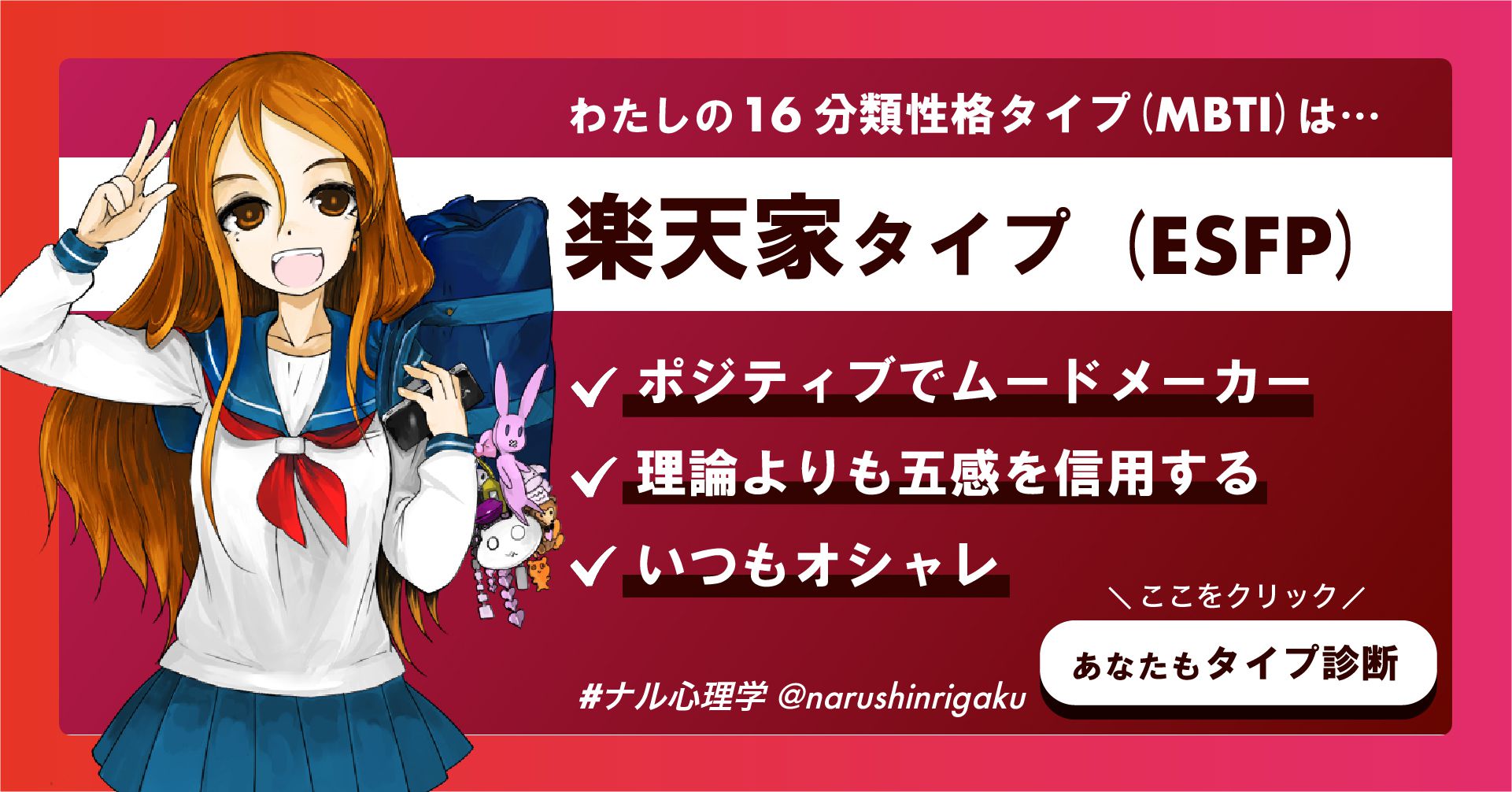
On this page, you can choose from 16 types.ESFP (Entertainer = Optimistic type)I will explain the personality traits of [this person/character].
youESFP (Entertainer = Optimistic type)Then
Share it on social media (tweet it) and let your followers know!
↓↓↓Share on social media (tweet)↓↓↓
↑↑↑Share on social media (tweet)↑↑↑
Classifying personalities into 16 types16-Type Personality TestCheck which type you are using the following↓↓

↑16-Type Personality Test↑
↑Diagnose↑


Description of the personality traits of ESFP (Entertainer/Optimist type)
The following is a quote (with some modifications) from "Let's Look at the World from the Perspective of MBTI Personality Type Theory" (website no longer exists).
I am passionate and deeply sensitive, I enjoy life to the fullest, and I want to share my joys with everyone. I am observant and proactive, I trust what is clearly visible above all else, and I am drawn to the changes and reactions that occur immediately. Therefore, I am practical and hands-on. I am positive and cheerful, attentive to others, generous, and friendly. I am curious and active, I intensely feel the present moment, and I want to act freely and express my thoughts in the moment.
When something looks fun, I don't just want to watch; I want to try it myself right away. I don't want to put off such opportunities as much as possible, because the opportunities I have now may not last forever.
I don't like being restricted. I express my thoughts frankly. However, by being aware of the influence and atmosphere of those around me, I can suppress my impulses and avoid becoming extremely selfish.
I am very observant of my surroundings, and whether I am in nature or in the city, I make various discoveries that move and excite me. Whatever I do, I learn a great deal by seeing with my own eyes, touching with my own skin, and experiencing things firsthand.
I spontaneously go to various places and am fascinated by new things. I discover and admire all sorts of things—beautiful, cute, interesting, delicious, or even practical and useful—and feel a sense of affection for them.
As we grow older and our range of activities expands, especially in our youth, we tend to seek out places with beautiful scenery, lively places, and fashionable places.
Whether it's an event I planned myself or one planned by someone else, I look forward to it from the day before, and in most cases, I spend the day energetically without getting bored.
They are very sociable and enjoy situations where they can talk and interact with many people without hesitation, such as parties and games. They are relaxed, easy to get along with, and take the lead in creating a lively atmosphere. Sometimes, they can even find value in things that seem to have no purpose.
They often become the center of conversations because they fluently express what they notice, think, and feel. They have a good sense of humor and often tell jokes, sometimes naturally adding gestures to entertain those around them.
They can maintain a natural demeanor and show no fear when expressing themselves or appealing to the public, or when advocating their values through speeches. They also seem to enjoy gaining popularity and receiving praise. However, above all, what matters to them is doing something meaningful for everyone, or at least making people smile.
For ESFPs, art, music, singing, dancing, comedy, theater, magic, and other forms of performance are ideal ways to express feelings that well up from deep within. We hope to use these means to appeal to the sensibilities of our audience and provide a space where we can all enjoy ourselves and relax together.
Fashion, too, is a way to enhance one's mood at any given time and express one's sensibilities, so people are particular about it.
Their keen observational skills are particularly directed towards those around them. Therefore, they develop a human-centered sensibility and values. They strive to relax, be approachable, and build close relationships. Furthermore, they are deeply moved or feel a sense of urgency to help those in distress or in danger.
They are generally optimistic and have a positive outlook on life. They act first, and if something good happens, they'll be happy and consider themselves lucky. They are full of energy, true to their instincts, and try to enjoy the present moment, but this can sometimes lead to them acting impulsively. This might make them seem carefree to those around them.
However, ESFPs are not simply fun-loving and innocent. They are also deeply moved and sensitive to things, possessing a serious side as well.
They are mentally tough, and that's the only side of them that stands out to those around them. However, in reality, they are also easily hurt.
When faced with sadness, I often find myself worrying and thinking alone, but ultimately, I actively choose to have hope and enjoy the present moment.
I have no interest in abstract discussions, and I would be extremely bored if I had to sit and listen to them. Overthinking is a waste of precious time in life. Experience is the best learning tool and teacher above all else. I seek practical happiness.
I believe it's important to raise children by providing them with positive stimulation and observing their spontaneous actions. And I think such an environment should be provided. This is essential for building a better society.
We strive to acknowledge the differences in each individual's values and the diversity of their ways of thinking and living. Rather than imposing our values on each other and forcing something upon others, we hope that people will naturally cultivate their sensibilities, think and judge spontaneously, and act based on those judgments. We regret that there is a tendency in schools and society for everyone to be confined to the same mold and made subservient.
However, I will be strict and try to warn anyone who causes trouble for others, does something dangerous, or ruins the atmosphere. I want people to follow the minimum rules.
Within an organization, they will respect their superiors, understand their role, and strive to fulfill their responsibilities. However, they may also have strong opinions against injustice and dishonesty.
When achieving a goal, you might make a plan to do it efficiently. You might ask for help with things you can't do alone. That, too, is a good opportunity to interact with people and make friends.
They are especially keen on achieving their goals when it comes to things they are particularly interested in and passionate about. Even when faced with difficulties, they will adapt to the situation and, with strong determination, strive to achieve their goals.
End of quote from "Let's Look at the World from the Perspective of MBTI Personality Type Theory" (website no longer exists) (partially modified)
reference
・ESFP (Entertainer/Optimist Type) – Main Page –
・"You only live once" ESFP How do gender differences affect the lives of ESFPs?
Further characteristics of ESFP (Entertainer/Optimist type) and compatibility with other types
- ESFP Personality Traits 02
- Things that ESFPs dislike
- Suitable occupations for ESFPs
- Compatibility of ESFP with other types
- ESFP Relationships and Romance
- How ESFPs set goals and gather information
- ESFP decision-making process
- ESFP parent-child relationships
- For ESFPs to succeed
↓Learn more↓
Compatibility chart and advice for ESFP (Entertainer/Optimist type) and other personality types.
Ideal compatibility type pair
ESFPs are compatible with people who understand their practical perspective, who think simply, have a sense of humor, and focus on taking quick action.
From an ESFP's perspective...
- ENFP (Reformer type):Ne – FiHe has a quick mind, a good sense of humor, and can come up with many ideas.
- ESTP (Adventurer type):Se – TiThey possess practical insight and can act quickly depending on the situation.
- ESFJ (Sociable Type):Fe – SiThey create a good atmosphere and help expand your circle of acquaintances.
- ISTP (Practitioner type):Ti – SeThey have good athletic ability and the ability to apply their knowledge in a realistic and practical way.
Type pairs that are prone to conflict
ESFPs tend to clash with people who are insensitive, critical, and lack a sense of humor.
From an ESFP's perspective...
- INTJ (Strategist type) :Ni – TeA serious person who is overly critical and nitpicky, while doubting other people's opinions.
- INFJ (Empathy Type):Ni – FeThey lack a sense of humor, and despite having overly high ideals, they rarely take action.
- ESTJ (Responsible type):Se – TiThey are excessively strict and conservative, and critical.
Romantic compatibility type pair
ESFPs are most compatible in romantic relationships with charming individuals who don't interfere too much with their lifestyle and make them feel comfortable.
From an ESFP's perspective...
- ESFJ (Sociable Type):Fe – SiYou can quickly make friends and enjoy shared hobbies together.
- ISFJ (Parental Type):Si – Fe, makes you feel comfortable
- ENFP (Reformer type):Ne – FiWe can respect each other's freedom and share our thoughts.
- ISTJ (Hardworking Type):Si – Te, guarantees a stable life
*The pairs that tend to clash and the pairs that have good romantic compatibility may overlap. This is because while people may dislike those who are the complete opposite of themselves due to disagreements, they may also be attracted to those who appear mysterious because they are different. However, it seems that these relationships often end up breaking down.
(Advice for those dating an ESFP)
ESFPs tend to be honest and straightforward in relationships. In romantic relationships, they are warm and passionate, without playing games. It's important to note that ESFPs tend to take criticism personally and dislike conflict. While being straightforward is important in relationships with ESFPs, try to avoid being overly confrontational or harsh.
A collection of links explaining the psychological functions of ESFP (Entertainer/Optimist type) (for those who want to understand the workings of the mind).
Reading the following roadmap from top to bottom will help you understand the ESFP mindset in a logical order ↓
- Roadmap – ESFP (Optimist type) –
- Introduction – What is MBTI?
- Summary of my personality
- Cognition is
- Type-specific cognitive characteristics
- Four personality indicators (psychological tendency axes)
- Conflicts over personality indicators
- “The meaning of the four letters "ESFP"
- First character:Introvert (type I) or extrovert (type E)
- Second character:Intuitive type (N type) or Sensing type (S type)
- Third character:Feeling type (F type) or thinking type (T type)
- 4th character:Perceiving type (P type) or Judging type (J type)
- About psychological functions (cognitive functions)
- What are psychological functions (cognitive functions)?
- The eight psychological functions (cognitive functions)
- Decision-making (judgment) function
- Information gathering (perceptual) function
- Understanding your own psychological functions (cognitive functions)
- The developmental process of psychological functions (cognitive functions)
- ESFP's psychological functions (cognitive functions)
- First function:Extroverted Sensing (Se)
- Second function:Introverted Feeling (Fi)
- Third function:Extraverted Thinking (Te)
- Fourth function:Introverted Intuition (Ni)
- Making good use of psychological functions (cognitive functions)
- Make the most of your strengths
- Reasons for focusing too much on the advantages
- How to improve your weaknesses
- If you are alone
- In a team setting: Have others compensate for your weaknesses (fourth function).
To truly understand ESFP (Optimist type),Psychological functions (cognitive functions)This is important ↓
- Extroverted Sensing/Se
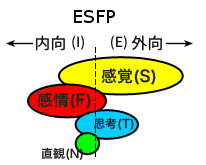
Very good at it /First functionThey are familiar with the real physical space ("what is happening right now") and possess high spatial awareness. - Introverted Feeling/Fi
I'm a little good at it /second functionIf your actions are based on moral reasons aligned with your vision, you can take responsibility for how others feel. - Extraverted Thinking/Te
I'm not very good at it.Third functionI prefer an environment where everyone can feel comfortable. Once an environment is disrupted, it cannot be fixed by avoiding responsibility. - Introverted Sensing/Ni
I'm really bad at it /Fourth functionThey feel anxious and fearful because they don't know what will happen in the future. They are unable to (or do not like) making long-term predictions.
<ESFP's cognitive axis>
List of articles related to ESFP (Entertainer = Optimistic type)
- ESFP psychological functions
↑Learn more↑
List of 16 types (≒MBTI types)
A Collection of Information on the 16 Personality Types – The Little-Known Truths of Each Type (Summary, Illustrations, and Analysis)
- Summary of 16 Personality Type Test Websites
- List of articles categorized by personality type (16 types)
- Compatibility chart for 16 personality types
- Suitable occupations, ideal jobs, and dream jobs for each of the 16 personality types
- Nicknames (names) for each of the 16 personality types
- What if there were a country with 16 personality types...?
- The relationship between national characteristics around the world and the 16 personality types
- List of 16 Personality Types Based on Famous Characters
- Detective Conan: A Summary of 16 Personality Types for Each Character
- Percentage of 16 personality types
- Reactions of 16 Personality Types – Heaven and Hell
- To describe the 16 personality types in one word:
- 16 Simple Explanations of Personality Types
- 16 Personality Types: Strengths, Weaknesses, and Ways to Improve Weaknesses
- 16 Personality Types: Preferences and Strengths/Weaknesses in Majors and Subjects
- 16 Personality Types: How to Enjoy Life to the Fullest…?
- 16 Personality Types: Inspiring Quotes from Great Figures
- What if each of the 16 personality types were a murderer?
- How to become an attractive husband or wife based on your personality type (16 types)
- What 16 personality types do after a breakup
- Reasons for fighting according to 16 personality types
- Income by 16 Personality Types - Misconceptions and Truths -
- Characteristics of employees based on 16 personality types
- Potential pathological tendencies of 16 personality types
- Psychological Functions of 16 Personality Types Based on Statistics
- Viewing percentage of the detailed personality pages for each of the 16 personality types
- Summary of the characteristics of the 16 personality types
- 8 psychological functions: "What if I did...?"
- Approaches to tasks based on psychological function: Intuitive (N-type) & Sensing (S-type)
- Social interaction explained by psychological functions
- Understanding Your Financial Habits Through Psychological Functions – Are You a Saver or a Spender?
- Humor (sense of humor) as revealed by psychological functions
- How extroverts (Type E) and introverts (Type I) can get along well
- How Sensing types (S type) and Intuitive types (N type) can get along well
- How Thinking (T-type) and Feeling (F-type) People Can Get Along Well
- How to get along well with Judging (J-type) and Perceiving (P-type) types
- Characteristics of parents with 16 personality types
- Parent-child relationships between extroverts (Type E) and introverts (Type I)
- Parent-child relationships between sensing types (S-type) and intuitive types (N-type)
- Parent-child relationships between thinking types (T-type) and feeling types (F-type)
- Parent-child relationships between judging (J-type) and percepting (P-type) types
- How to identify your partner's personality type: [16 Personality Types]

comment