
Classifying personalities into 16 types16-Type Personality TestCheck which type you are using the following↓↓

↑16-Type Personality Test↑
↑Diagnose↑
This article will cover the following 16 types.Artist type (ISFP) This explains the success of [the company/organization].
youISFP (Adventurer/Artist Type)Then
Share it on social media (tweet it) and let your followers know!
↓↓↓Share on social media (tweet)↓↓↓
↑↑↑Share on social media (tweet)↑↑↑


What does success mean to an ISFP (Artist type)?
ISFPs value creativity and spirituality. Success for ISFPs is based on serving others, expressing their creativity, and thriving in a free and open environment.
They have a strong interest in aesthetics and beauty. They are creative and highly sensitive to their senses. They are interested in what they know and feel directly from their own experiences, and often possess artistic talent and a keen sense of aesthetics. They have a special talent for creating and composing things that strongly influence the senses, and may become artists in some form. For ISFPs, the act of "making" itself is a fulfilling time. They seek freedom and prefer not to be constrained, and tend to choose environments that allow for this.
They are friendly, humble, and emotionally expressive. They rarely try to dominate or control others. They are reserved and quiet, but actually possess great friendship and enthusiasm. They dislike arguments and conflict, and do not force their opinions or values on others. They rarely show their other sides to anyone other than acquaintances and those they trust. They are often misunderstood because they do not like to express themselves directly. However, they are kind and gentle to others.
In relationships with others, you seek harmony, acceptance, and affection. You are warm, empathetic, gentle, and friendly. You genuinely care for others and have a strong desire to please them. You have a deep compassion for those close to you and tend to show love through actions rather than words. You are interested in contributing to people's happiness and well-being, and may take up a job that serves society or people. You are a good listener and often genuinely want to listen to someone's troubles and help them.
You are sensitive to criticism and easily hurt. You tend to be overly sensitive to your own emotions and the emotions of others. You value harmony among people and tend to avoid conflict, so when conflicts with others deepen, you may cut off the relationship rather than try to resolve the problem. Because you are easily hurt by rejection and criticism, you may turn your love to creatures that love you unconditionally, such as animals or small children. You prefer sincere people who take the time to get to know you and understand your heart, and you value building close relationships.
This person lives life focused on the present and is very action-oriented. They thrive in practical learning environments and may quickly lose interest in traditional educational methods that emphasize abstract thinking. When their mind suddenly takes hold, they can act decisively, like a bulldozer. They quickly identify opportunities and act swiftly to seize them. They prefer to work at their own pace and on their own schedule. They tend not to over-prepare or over-plan, and are good at creating short-term plans. However, this doesn't mean they constantly push forward towards their next goal; they take things at a relaxed pace. They cherish the present moment and prefer to savor it, so a fast-paced environment may not suit this laid-back type.
Strengths that ISFP (Artist type) should develop
- Cherish this moment.
- I prefer a collaborative team approach.
- They have excellent empathy and are good at reading other people's expressions.
- They can deal with the situation and adapt to its demands.
- I'm good at dealing with everyday, practical problems.
- They possess well-honed perseverance.
- To take things seriously
- Trustworthy, sensitive, and kind.
- They have a strong service-oriented spirit and want to be of service to others.
- Flexible, laid-back, and willing to go along with others.
- I prefer praising to criticizing.
- Showing affection through actions
- He has an exceptionally good sense of aesthetics.
- Motivating others through emotional interaction
- They have an original and unconventional side.
Tips for success for ISFP (Artist type)
- Express your feelings and opinions honestly.
Because of your gentle nature, you tend to prioritize relationships with others and bottle up your emotions. However, you shouldn't let them get out of control. Sometimes, it's important to express your opinions and feelings. You should avoid situations that lead to arguments later or where your wishes are not fulfilled at all. - Let's make a long-term plan.
We tend to focus only on the immediate future, which can lead to overspending or making irreversible mistakes. While long-term planning is ideal, if that's difficult, at least take a moment to consider the consequences of your actions. When thinking about long-term plans, one helpful approach is to ask yourself questions like, "What do I want to be like when I turn 30?" - Let's develop our decision-making skills.
ISFPs are flexible and adaptable. However, these strengths can sometimes manifest as indecisiveness. - Let's confront our weaknesses.
Recognize and accept that your characteristics have both strengths and weaknesses. While ISFPs have deep affection for others, they can sometimes have low self-esteem. Instead of attacking yourself, respect your true self and confront your weaknesses. That is the shortest path to growth.
For those who want to learn more about ISFP (Artist type) (compatibility, etc.)
For more information, please see below.Highly recommended (click to open) ↓
Compatibility: You can learn about compatibility and how to interact with other types.
RoadmapYou can learn about personality types and personality theories (MBTI) in a systematic way, from basic to specialized.
Related articlesLearn about the characteristics of each type (take a look at the parts that interest you)
ISFP(Artist type)Compatibility with other types (click to show)
Ideal compatibility type pair
ISFPs are compatible with people who respect each other's freedom and with whom they can have positive experiences.
From an ISFP's perspective...
- INFP (Psychologist type):Fi – NeThey respect freedom and feelings.
- ENFP (Reformer type):Ne – FiThey respect individuality
- ISFJ (Parental Type):Si – FeThey treat you with consideration.
- INTP (Researcher Type):Ti – NeWe can share ideas and exchange information.
Type pairs that are prone to conflict
ISFPs tend to clash with overbearing people who don't respect their individual choices and actions.
From an ISFP's perspective...
- ESTJ (Responsible type):Te – SiThey criticize me and try to control me.
- ENTJ (Leader type):Te – NiHe is very logical, meticulous, and rational, but his demands are intense, making him difficult to be around.
Romantic compatibility type pair
ISFPs are most compatible in romantic relationships with people who offer positive experiences and who can provide reassurance during difficult times.
From an ISFP's perspective...
- ENFJ (Collaborator Type):Fe – NiThey make you feel safe and comfortable.
- INTJ (Strategist type) :Ni – Te, wisely prepare for the future and give you peace of mind
- ENFP (Reformer type):Ne – FiThey create a friendly and comfortable environment and understand your feelings.
- ISTJ (Hardworking Type):Si – TeIt reassures you even in difficult situations.
*The pairs that tend to clash and the pairs that have good romantic compatibility may overlap. This is because while people may dislike those who are the complete opposite of themselves due to disagreements, they may also be attracted to those who appear mysterious because they are different. However, it seems that these relationships often end up breaking down.
(Advice for those dating an ISFP)
ISFPs are very empathetic in relationships and often make concessions to others. Many struggle to express their feelings or assert their demands, so it's important to make an effort to understand them. When making decisions, listen to the ISFP's perspective and respect their feelings equally.
ISFP (Artist type)Roadmap (Click to open)
ISFP (Artist type)To truly understand this,Psychological functions (cognitive functions)* is important ↓
*Generally in cognitive science,Cognitive functions「The function by which living organisms actively collect external information, perceive and remember it, and then process it by adding reasoning and judgment in order to acquire knowledge about their subject.It is defined as "
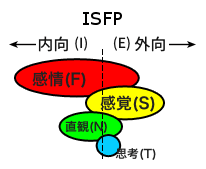
- Introverted Feeling/Fi
Very good at it /First function: Decide what you believe is right for you, what is morally right within your worldview, and what you should do according to your personal values. - Extroverted Sensing/Se
I'm a little good at it /second function: To make good use of physical space and create positive experiences for people, whether material or sensory. - Introverted Sensing/Ni
I'm not very good at it.Third functionBecause they believe they know what is right for them, they can get irritated when told what to do by others. - Extraverted Thinking/Te
I'm really bad at it /Fourth functionThey fear and worry about what others think of them. They are unable (or unwilling) to organize their thoughts rationally and logically.
<ISFP's cognitive framework>
By reading the following roadmap, you can learn about cognitive functions.ISFP (Artist type)You can understand it in an orderly manner ↓
- Roadmap – ISFP (Artist type) –
- Introduction – What is MBTI?
- Summary of my personality
- Cognition is
- Type-specific cognitive characteristics
- Four personality indicators (psychological tendency axes)
- Conflicts over personality indicators
- “The meaning of the four letters "ISFP"
- First character:Introvert (type I) or extrovert (type E)
- Second character:Intuitive type (N type) or Sensing type (S type)
- Third character:Feeling type (F type) or thinking type (T type)
- 4th character:Perceiving type (P type) or Judging type (J type)
- About psychological functions (cognitive functions)
- What are psychological functions (cognitive functions)?
- The eight psychological functions (cognitive functions)
- Decision-making (judgment) function
- Information gathering (perceptual) function
- Understanding your own psychological functions (cognitive functions)
- The developmental process of psychological functions (cognitive functions)
- ISFP's psychological functions (cognitive functions)
- First function:Introverted Feeling (Fi)
- Second function:Extroverted Sensing (Se)
- Third function:Introverted Intuition (Ni)
- Fourth function:Extraverted Thinking (Te)
- Making good use of psychological functions (cognitive functions)
- Strengths and weaknesses of the ISTP (Practitioner type)
- Make the most of your strengths
- Reasons for focusing too much on the advantages
- How to improve your weaknesses
- If you are alone
- In a team setting: Have others compensate for your weaknesses (fourth function).
ISFP (Adventurer/Artist Type) – A Comprehensive Guide with Links
- Explanation of ISFP
- ISFP Personality Traits 01
- ISFP Personality Traits 02
- ISFP hobbies
- Things that ISFPs dislike
- Advantages and disadvantages of ISFP
- Suitable occupations for ISFPs
- ISFP Leadership
- Compatibility of ISFP with other types
- ISFP Relationships and Romance
- How ISFPs Set Goals and Gather Information
- ISFP decision-making methods
- ISFP parent-child relationships
- How ISFPs can succeed
- ISFP psychological functions
- “The meaning of the four letters "ISFP"
- ISFP's psychological functions (cognitive functions)
- Integration of ISFP's second and third functions
- The difference between introverted feeling (Fi) and extroverted feeling (Fe)
- The difference between extroverted thinking (Te) and introverted feeling (Fi)
- To train your extroverted thinking (Te)
↑Click to open↑
youISFP (Adventurer/Artist Type)Then
Share it on social media (tweet it) and let your followers know!
↓↓↓Share on social media (tweet)↓↓↓
↑↑↑Share on social media (tweet)↑↑↑

comment