16-Type Personality TestIt is very accurate.Personality testIt is known as such, but each person has their own strengths (things they use often)Psychological functions (cognitive functions)It is believed that there are some. One of them is"Introverted Intuition (Ni)"So, people who are good at this feature,They have a long-term perspective and high predictive ability.It is a trend.
As shown in the diagram below,Introverted Intuition (Ni)Development and flow from the past to the futureRead on to understand psychological functionsI'm good at predicting and preparing for how things will turn out in the future.
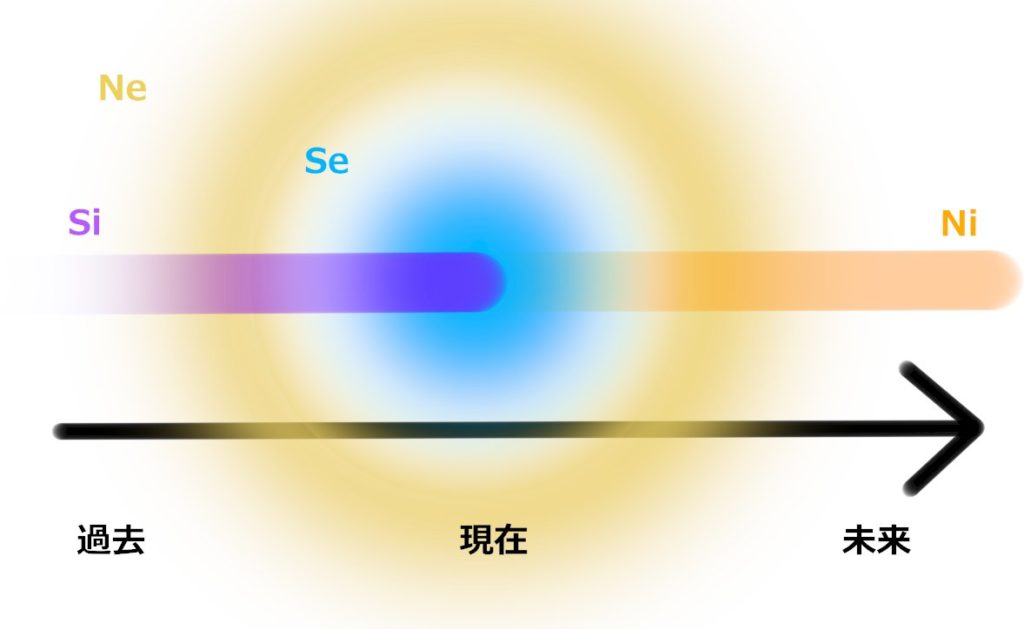
Introverted Intuition (Ni)The type that is strong is,INFJ (Empathy Type), INTJ (Strategist type), ENFJ (Collaborator Type), ENTJ (Leader type)such asNJIt's my type.
↓Click here if you want to find out your personality type from the 16 personality types↓
↑Try taking the 16-type personality test↑
16-Type Personality TestIf you are not yet familiar with this topic, please refer to the article below.

Also, in advanceFour psychological tendency axesKnowing the following will also help you understand morePsychological functions (cognitive functions)You can understand this.


Introverted Intuition (Ni)
Extroverted Intuition (Ne)Similarly, introverted intuition (Ni) is an intuitive process that explores complex patterns. However, it is an introverted process, an inward process of recognizing patterns within the mind. Therefore, it is difficult to explain, and even Ni users seem to have difficulty putting their own process into words.
There are as many patterns in our minds as there are people on Earth. However, these patterns also have their own patterns, and people with a dominant introverted intuition (Ni) naturally enjoy exploring the various ways in which people interpret reality.
If you strongly resonate with the function of introverted intuition (Ni), you have likely stepped back or detached yourself from your own perspective, even from a young age. By doing so, you were able to observe how your mind connected. And as you observed how your mind connected, you began to see patterns. Everyone creates their own patterns of how they experience the world. By observing others create the same patterns that you form in your own mind, you began to understand that those patterns also have patterns.
People who utilize their Introverted Intuition (Ni) function naturally shift their perspective and way of thinking until a solution becomes clear in order to solve a problem. Mastering Ni may allow you to infer other people's moods, problems, and ways of thinking. Others may be surprised by the accuracy of these inferences, and may feel as if the person with dominant Introverted Intuition (Ni) is using some kind of superpower.
For people with a dominant introverted intuition (Ni), it's natural for them to find meaning in things that might be purely coincidental and to experience synchronicity.
The ability of introverted intuition (Ni) dominant individuals to recognize and track these internal patterns is sometimes likened to that of a hunting dog with a keen sense of smell. If they lose track of the scent, become distracted, or stray from observing a new discovery, they may lose it forever. For this reason, introverted intuition (Ni) dominant individuals often seek alone time to cultivate their best creative ideas.
Extroverted Sensing (Se)In contrast to those with a dominant Introverted Intuition (Ni), who appear to have an abundance of energy and are constantly seeking opportunities to expend it, those with a dominant Introverted Intuition (Ni) feel they lack energy and are always looking for ways to conserve it. Responding impulsively consumes a lot of energy. People with Ni learn strategies to use mental imagery to predict future outcomes so that they can achieve great results with less energy. They become future-oriented, unconsciously trying to perceive life in a more nuanced way.
Details of Introverted Intuition (Ni)
It captures the commonalities and relationships between multiple events, phenomena, and concepts, and consolidates them into a single symbolic image.
The image itself is simple, but the interpretations and possibilities derived from it are diverse. However, introverted intuition places more emphasis on the convergence of the image than on that diversity.
This allows us to grasp the fundamental elements and reach a profound understanding, even when faced with a world that appears complex at first glance.
Frameworks and models for specific things are repeatedly refined.
This process happens unconsciously, and inspiration strikes suddenly. It's not the kind of thing that can be guided by conscious effort.
This flash of insight gives the person experiencing it an inexplicable sense of anticipation or premonition, and those who believe in it can gain confidence in what they should do and what their next course of action should be. It provides a long-term vision.
keyword
Flash of insight, inspiration, impression, image, concentration, origin, simple mind, insight, speculation, introspection, internal model and its refinement, paradigm shift, transcendence, relationship, recognition of interaction, recognition of influence, interpretation of phenomena, meaning-making of experience, symbol, core, conviction, paradox, integration, convergence, idea, concept, abstract, theoretical, generalization, universality, law, big picture, comprehensive, understanding of a system, metaphor, pattern recognition, trend recognition, premonition, expectation, long-term perspective, vision, enlightenment, reform
Types whose primary psychological function is introverted intuition,INFJ (Empathy Type), INTJ (Strategist type)is.
For types whose second psychological function is introverted intuition,ENFJ (Collaborator Type), ENTJ (Leader type)is.
This psychological function is extremely difficult to explain for those who do not utilize it. Furthermore, because it is an introverted psychological function, individuals often struggle to articulate it.
Sometimes, when thinking about how to solve a problem, simply explaining, analyzing, and organizing things in words is often insufficient. However, it is true that this can be easily accomplished using images and symbols.
Those who utilize introverted intuition are well aware of this and wait for a vision to naturally emerge regarding their concerns. Once they arrive at that vision, they trust it with confidence.
Introverted intuition is a psychological function involved in receiving information, and it occurs naturally within consciousness. It gives us premonitions and visions, but because it cannot provide a clear reason for them, it appears to be a mystical ability.
Those with a dominant introverted intuition tend not to pay much attention to the details of their external environment. Even if they observe their subjects accurately and in detail, it is often limited to a specific scope. It is noteworthy that this aligns with meditation in that it limits the information received through the five senses, focuses attention, and maintains a receptive attitude to gain inspiration beyond the five senses.
Through various experiences, we unconsciously gather information from our five senses, and it is believed that an integrated process takes place in our subconscious. Then, when needed, visions emerge.
These can be mere premonitions or clear visual visions. They may also appeal to the senses of hearing or touch.
These experiences may feel very real to the person experiencing them, but in most cases, they are distinguishable from reality. In fact, they may often surface into consciousness later, over time, rather than during the experience itself.
They excel at pattern recognition, uncovering underlying forces, hidden meanings, and connections between events. They grasp what can be gleaned from events and people's actions, and predict what might happen next.
Such symbolic signals are often overlooked by other types, but those who utilize this psychological function can reach conclusions even from subtle signals.
Such foresight can sometimes serve as a warning not only to oneself but also to others. And, when necessary, it may motivate people to enlighten and encourage change.
They are not particularly interested in individual, specific facts, but rather in recognizing universal laws and abstract theories.
When a clear understanding suddenly comes to mind, even if the person doesn't say it out loud, they might be shouting internally, "That's it! I get it!" or "I see!"
Once this introverted psychological function of information reception has reached a certainty, the psychological function of interacting with the outside world will strongly desire the realization of this vision.
Then, we begin to tackle the challenges that need to be addressed, but this is sometimes far more difficult than when we first created the vision. If we become too engrossed in this psychological function, our interests narrow, and we neglect to make the effort to recognize reality.
Once one becomes convinced of something, there is a tendency to become reluctant to observe new facts or changing realities. A potential drawback of this is that one may become trapped in an unrealistic worldview.
Images and symbols have the power to integrate things that seem disparate, paradoxical, or even contradictory. In this respect, they differ from analytical thinking. This allows for a new level of understanding. Even with complex systems and theories, we can focus our attention on a few key aspects, recognizing the differences, similarities, and relationships between concepts, and striving to arrive at a more unified and universal understanding.
The Big Five personality traits and introverted intuition (Ni)
The Big Five personality model is considered the most reliable personality analysis in the world, and was proposed by Lewis R. Goldberg, an American psychologist and professor emeritus at the University of Oregon. As the name suggests, the Big Five classifies a person's personality into five factors.
Explanation of the five personality traits (factors) of the Big Five personality model ← Tap
- Neurotic tendencies: A tendency towards emotional instability, such as being prone to depression.。I tend to get into negative moods.
- Relationship with the 16 personality types: This factor is not measured by the 16 personality types.
- High scoreThey are prone to stress, impulsive, and anxious. Keywords: anxiety, irritability, depression, low self-esteem
- Low score: Stress-resistant and emotionally stable
This property (when scoring high)...- Positive aspects: Ability to be cautious and make an effort
- Negative aspects: Increased anxiety and susceptibility to depression
- Biological mechanism: Response to threat (amygdala and limbic system, serotonin)
- Extraversion (E): One's attention and energy are directed towards other people or things.。It's easy to feel positive.
- Relationship with the 16 personality types:A high score indicates an extroverted (Type E) personality.、A low score indicates an introverted (Type I) personality.
- High score (Extroverted/E): Sociable and passionate about things. Keywords: proactive, sociable, active, adventurous, cheerful
- Low score (introvert/I): distant and quiet
This property (when scoring high)...- Positive aspects: High motivation to seek rewards and achieve results, and a willingness to take on challenges.
- Negative aspects: Often puts oneself in danger. Difficult to build stable relationships.
- Biological mechanism: Response to reward (midbrain dopamine reward system)
- Openness (N): Receptiveness to new cultural, aesthetic, and intellectual experiences. Having an open mind.
- Relationship with the 16 personality types:High scores indicate an intuitive (N-type) personality.、A low score indicates a sensory type (S-type).
- High score (Intuition/N): Highly original and creative, unconventional. Wants to encounter, explore, and experience beautiful and intellectual things. Keywords: curiosity, imagination, aesthetic sense, broad interests
- Low score (perception/S): To think realistically, to adhere to tradition
This property (when scoring high)...- Positive aspects: High artistic sensitivity and the ability to think in a divergent manner.
- Negative aspects: Prone to holding abnormal beliefs and having psychotic tendencies.
- Biological mechanisms: The expansion of mental associations
- Cooperativeness (F): Able to act with the needs of others in mind, rather than just oneself.
- Relationship with the 16 personality types:High scores indicate an emotional type (F type).、A low score indicates a thinking type (T-type).
- High score (emotion/F)They are trusting and highly empathetic. Keywords: Compassionate and trusting, altruistic, kind, obedient, modest.
- Low score (Thinking/T)Uncooperative and hostile
This property (when scoring high)...- Positive aspects: It can smooth interpersonal relationships and stabilize society as a whole.
- Negative aspect: (Being too considerate of others) reduces your own profits or share.
- Biological mechanism: Consideration for others (theory of mind, empathy element)
- Conscientiousness (strong judgment function*): Able to plan towards goals, discipline oneself, and work diligently with a sense of responsibility without giving up.
- Relationship with the 16 personality types:A high score indicates strong judgment function.、A low score indicates strong perceptual function.
- High score (strong judgment ability)Competent and self-disciplined. Keywords: self-discipline, perseverance, deliberation, patience, grit, careful consideration, effort to achieve.
- Low score (strong perceptual function)They are often careless and impulsive.
This property (when scoring high)...- Positive aspects: You can make plans, discipline yourself according to them, and easily achieve your goals.
- Negative aspect: Inability to act flexibly according to the situation at hand, lack of flexibility.
- Biological mechanism: Response inhibition (dorsolateral prefrontal cortex)
*A strong judging function means that the primary function is either thinking (T) or feeling (F), while a strong perceptual function means that the primary function is either intuitive (N) or sensing (S).
The relationship between the Big Five personality traits and the 16 personality types has been investigated, and the table below shows the correlations. By comparing which personality traits and their sub-traits (facets) each psychological function correlates with, you can gain a more detailed understanding of the tendencies of each psychological function.

Introverted Intuition (Ni) has three attributes: introversion (I), intuition (N), and perceiving (N or S). The Big Five personality traits corresponding to each attribute are as follows:
- Introvert (I) → extraversion (low)
- Intuitive type (N) → Openness (high)
- Perceptual function (Ni) → Conscientiousness (low)
Below is a list of high-scoring and low-scoring characteristics for each sub-characteristic ↓
List of sub-characteristics of the five Big Five personality traits (factors) ← Tap
Neurotic tendencies ↓
| 低 | 高 | |||
| explanation | words | Lower characteristics | words | explanation |
| I don't get angry very often. | mild | anger | passionate | Especially when things don't go as planned, Emotions become intensely heightened. |
| They tend to be calm and confident. | I am confident | anxiety | worrier | things that might happen I tend to worry about a lot of things. |
| I'm generally satisfied with myself. | satisfaction | melancholy | pessimistic | I often think about uninteresting things. |
| My desires aren't particularly strong. You can control your desires. | Self-control | selfish | Hedonism | They feel desires intensely and are easily tempted by them. |
| There is almost no chance of being confused. In most cases, they are full of confidence. | Confident | Overly self-conscious | Self-awareness | They are sensitive to what others think of them. |
| Deal with unexpected situations calmly and effectively. | Strong under pressure | Easily damaged | Low stress tolerance | They are prone to succumbing to stressful situations. |
Extraversion ↓
| 低 | 高 | |||
| explanation | words | Lower characteristics | words | explanation |
| I like a relaxed pace of life. | leisurely | Activity level | energetic | I prefer having a busy schedule filled with many appointments. |
| Especially within a group, I prefer listening to talking. | Modest | self-assertion | Strong self-assertion | Clearly state your opinion and take control of the situation. I find satisfaction in leading the group. |
| He's always serious and doesn't tell many jokes. | steep | clarity | Cheerful | A fun person who shares that fun with others. |
| They prefer quiet, calm, and safe environments. | Seeking peace | stimulation seeking | Seeking stimulation | I get excited about taking risks. I get bored if nothing exciting happens. |
| Introverted and doesn't easily open up to people. | Hesitant | Approachability | extraversion | I make friends easily and feel satisfied when I'm with people. |
| I strongly desire to dedicate time to myself. | Independent | sociability | Good at socializing | Enjoy being with other people. |
Openness↓
| 低 | 高 | |||
| explanation | words | Lower characteristics | words | explanation |
| I feel comfortable with routines I'm familiar with. They don't like to deviate from that. | steady | adventure | adventurous | I am eager for new experiences. |
| Compared to most people, artistic activities and They have little interest in creative activities. | Indifferent to art | Artistic interest | He has an eye for art. | I like beautiful things, I am seeking creative experiences. |
| Thinking about my own feelings, They rarely show their emotions. | Calm | Emotionality | Aware of emotions | Being aware of one's own emotions, They know how to express their emotions. |
| Prioritize facts over imagination. | Grounded | imagination | fanciful | They have a rich imagination. |
| I prefer to see the world as it is. I rarely engage in abstract thinking. | concrete | intelligence | philosophical | Open to new ideas, I am interested and want to know more. |
| Follow tradition and maintain stability. They like to maintain things. | Respect for power | liberalism | Challenging authority | Challenging power and traditional values I want to bring about change. |
Cooperation↓
| 低 | 高 | |||
| explanation | words | Lower characteristics | words | explanation |
| I'd rather do things for myself than spend time on other people. | self-centered | altruism | altruistic | I find fulfillment in helping others. To serve others. |
| Don't shy away from contradicting others. | Stubborn | cooperativeness | tolerance | They actively try to avoid conflict. |
| They respect themselves and are content with themselves. | Arrogance | Humility | Modest | I feel uneasy when I'm the center of attention. |
| I will use any means necessary to achieve my goals. | Unjust and immoral | Morality | indomitable | I believe it is wrong to use people for the sake of career advancement. |
| People generally do not depend on others, I believe it's something I should do myself. | ruthless | Empathy | Kindness | They are sensitive to other people's feelings and have compassion. |
| Be wary of people's intentions and don't trust them easily. | Be wary of people | credibility | Trust people | They believe in people's good intentions and trust people easily. |
Honesty ↓
| 低 | 高 | |||
| explanation | words | Lower characteristics | words | explanation |
| I am satisfied with the level I have achieved. I don't feel the need to set ambitious goals. | satisfaction | effort to achieve | ambitious | Set high goals for yourself, We will work diligently to achieve that. |
| Rather than being cautious and spending time making a decision, I will execute it immediately. | bold | Caution | Careful | Think carefully before making a decision. |
| Ignore rules and obligations, and do what you want to do. | Relaxed | Loyalty | Obedient | Even if rules and obligations are inconvenient, follow them diligently. |
| I don't dedicate a lot of time to the organization in my daily life. | unorganized | orderliness | organized | I strongly feel the need for organizational structure in my daily life. |
| I can't stick with difficult things for a long time. | interruption | self-control | Sustain | I face difficult challenges head-on and never give up. |
| I often doubt my own ability to achieve my goals. | I lack confidence. | Self-efficacy | I am confident | I feel I can succeed at anything I set my mind to. |
Both extroverted intuition (Ne) and introverted intuition (Ni) have high openness scores and low conscientiousness scores, which can be considered characteristics of the intuition (N) function.
The best book for understanding introverted intuition (Ni)
Introverted Intuition (Ni)If you want to understand it further,Yuval Noah HarariThe bestselling book written bySapiens: A Brief History of Humankind"and"Homo DeusYou might want to read "[Title of the book]".
Harari's current specialties are world history and macrohistory.The study of Ni, which seeks to explore the ultimate laws of history and identify long-term, macroscopic trends, is absolutely essential.) andSapiens: A Brief History of Humankind"and"Homo Deus'The History of Humankind' is a monumental work that thoroughly addresses such themes as "the history of humankind and the future of humankind."
Introverted Intuition (Ni)What isThe ability to predict development and trends from the past to the future.In short, it's a method of predicting the future based on past and present information.Sapiens: A Brief History of Humankind"and"Homo DeusThis book is indeed a book that discusses the future of humanity based on past history.Introverted Intuition (Ni)This is the perfect book for understanding it.
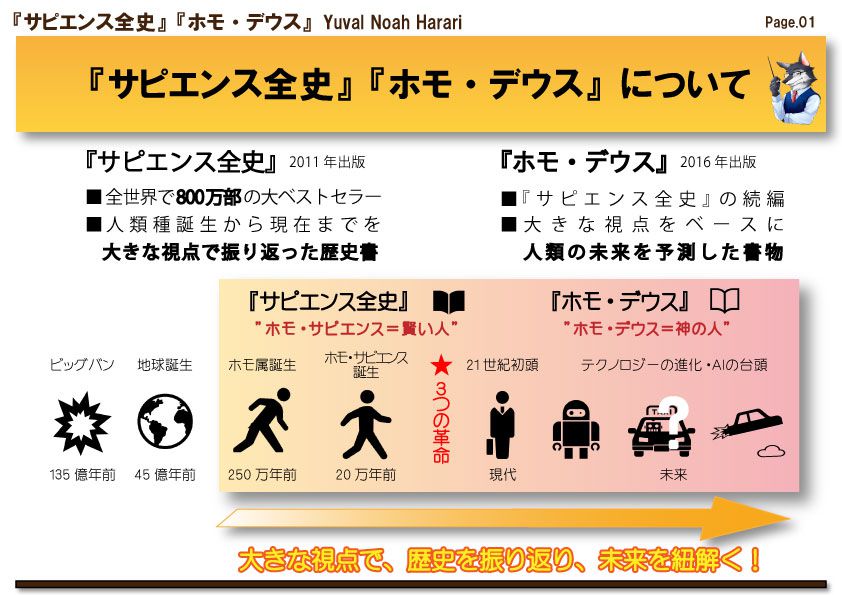
Main contents of Sapiens: A Brief History of Humankind (Volume 1)
- Chapters 1-4 (Cognitive Revolution)
- Chapters 5-13 (Agricultural Revolution)
- Chapters 14-18 (Scientific Revolution)
- Chapters 19-20 (What is Human Happiness?)
Homo Deus
Next up, I'd like to introduce Harari'sA broad overview of history – the creation and recording of humanity's heritage"tooIntroverted Intuition (Ni)This is the perfect book for understanding [the topic].5,000 years of history in one bookI'm putting it all together.
The future never happens by chance; it has always been created.
『A broad overview of history – the creation and recording of humanity's heritageWill Durant, author of '
‘',
‘Introverted Intuition (Ni): "A person who looks to the future."
.jpg)
comment