
16-Type Personality TestIt is very accurate.Personality testIt is known that each person has their own strengths (things they use often)Psychological functions (cognitive functions)It is believed that there are some. One of them is"Introverted Sensing (Si)"So, people who are good at this feature,They have a good memory and are persistent.。
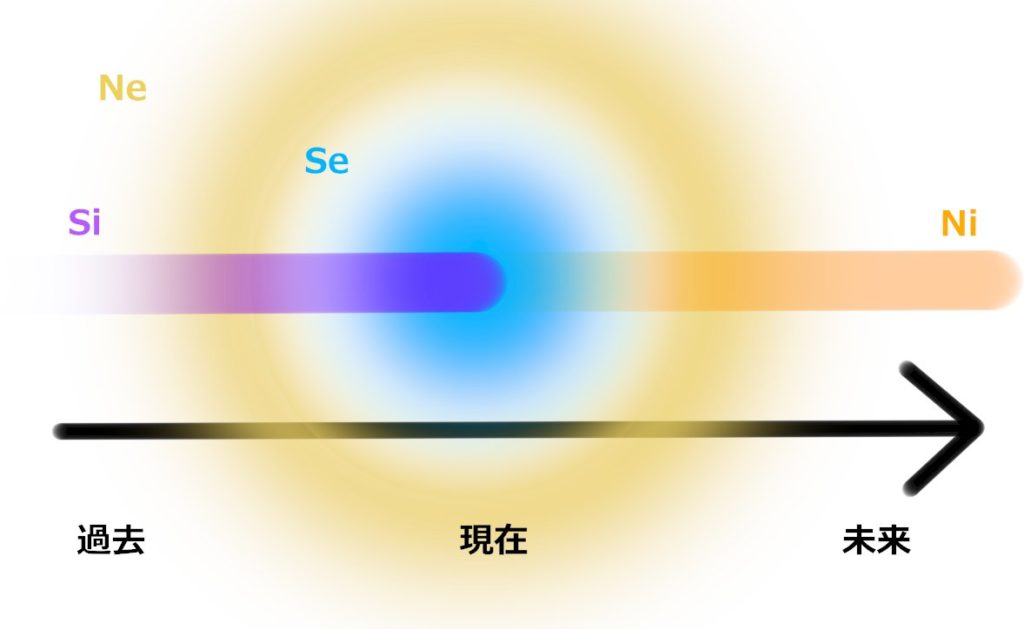
As shown in the diagram below,Introverted Sensing (Si)pastPsychological functions that focus onTherefore, we learn from past experiences and don't repeat the same mistakes.
Introverted Sensing (Si)The type that is strong is,ISFJ (Parental Type), ISTJ (Hardworking Type), ESFJ (Sociable Type), ESTJ (Responsible type)such asSJIt's my type.
↓Click here if you want to find out your personality type from the 16 personality types↓

↑Try taking the 16-type personality test↑
16-Type Personality TestIf you are not yet familiar with this topic, please refer to the article below.

Also, in advanceFour psychological tendency axesKnowing the following will also help you understand morePsychological functions (cognitive functions)You can understand this.


Introverted Sensing (Si)
Extroverted Sensing (Se)Similarly, people with a dominant introverted sensing (Si) prefer reliable information. However, unlike extroverted sensing (Se), who trust information input in real time, introverted sensing (Si) prefers to take in information to review later. There is nothing more reliable than experiencing a situation, carefully reflecting on it, and delving into its personal meaning.
People with a dominant introverted sensing (Si) have always found it very important to do things carefully and correctly. They enjoy taking their time to consider how their current experience is similar to past experiences.
People with a dominant introverted sensing (Si) seek reliable sources of information, but nothing is more reliable than what has already happened. Over time, people with a dominant introverted sensing (Si) can develop an astonishing memory for both the details and impressions of their experiences. When recalling memories, it feels as if the past is happening again. They can reproduce colors, sensations, smells, tastes, and sounds with remarkable accuracy, and these are stored in a large record book (the brain) that can be referenced when needed.
Furthermore, people with a dominant introverted sensing (Si) are cautious, which manifests as a desire for safety and prioritization. However, since introverted sensing (Si) is a perceptual (information-receiving) function, they do not arrive at conclusions like "this is how it should be." Rather, they are information gatherers, using experts, voters, authority, common sense, and tradition as criteria for judgment. This is because if there is a standard of how things have been done in the past, they can use that as a reference to consider how things should proceed in the future. Because they tend to gather information not for evaluation but for reference, people with a dominant introverted sensing (Si) are skilled at creating procedures and processes for reproduction.
People with a dominant introverted sensing (Si) tend to value reflection on the past and are more interested in the past than the present. While the present is also interesting, they often find it overwhelming.
Typical personality traits of someone with a dominant introverted sensing (Si) function.
A typical person with a dominant introverted sensing (Si) is someone like this:
"I'm a huge Harry Potter fan, and this year I went to the Harry Potter exhibition at Universal Studios Japan in Osaka. The first time, I didn't really enjoy it, and I eventually realized I was quite overwhelmed. I went to another part of the park to get a drink and relax for a few minutes. About an hour later, I wanted to see it again. It was just that the initial impression was too strong, but once I was able to internalize that impression, it became familiar and I felt a sense of closeness, and I was able to blend in with the atmosphere of the place."
People with a dominant introverted sensing (Si) recognize that not everyone processes and interprets information in the same way. In particular, they are quite open to the individuality that people cultivate through their unique experiences. One introverted sensing person said, "You can tell a lot about a person by the family they grew up in," and for them, that's absolutely true. Memories are made up of familiar things, and based on childhood memories, they tend to become experts in niche information and eccentric collections.
People with a dominant introverted sensing (Si) have a remarkable talent for acceptance. True acceptance means letting go of judgment and blame (including on oneself), and instead facing situations with tolerance and forgiveness, finding peace in one's heart.
Detailed explanation of Introverted Sensing (Si)
We receive external information through our five senses—sight, hearing, smell, taste, and touch—via our eyes, ears, nose, tongue, and skin. We also receive various information from within our bodies, becoming aware of our own physical existence. Furthermore, we remember our experiences.
This memory is necessary when comparing current experiences with related past experiences. The current experience is immediately linked to the previous experience, and similarities and differences are newly memorized and organized.
By repeatedly comparing experiences and memories at different points in time, our image of this world becomes clearer and broader. Memories accumulated through personal experiences become a source of knowledge and remind us of what we "should do" on a daily basis.
keyword
Habits, familiarity, history, tradition, culture, existing, norms, trust, perseverance, getting the job done, details, memory, association, reality, image, experience, not repeating mistakes, careful, avoiding errors, cautious, looking closely at data, saving, prepared, reserves, stability, nostalgia, longing, the same old way, sturdy and robust, duty, honesty, loyalty, obedience, protection, defense, safety, guidelines, old friend, bodily sensation, sense of self
Types whose primary psychological function is introverted sensing are:ISFJ (Parental Type), ISTJ (Hardworking Type)is.
For types whose second psychological function is introverted sensing,ESFJ (Sociable Type), ESTJ (Responsible type)is.
Introverted sensing perceives information from within the body. It is highly sensitive to internal sensations, such as pain, hunger, thirst, body temperature, and muscle tension. It is easy to imagine that being sensitive to these physical sensations and noticing bodily abnormalities was extremely important for maintaining life.
Medicine and sports that focus on the internal workings of the body have developed particularly in the East. This type of person is often interested in and practices such traditional health methods.
The primary function of introverted sensing is the maintenance and utilization of memories.
For living beings, memories such as knowing which foods cause stomach aches and should be avoided, which places are dangerous when it rains and should be kept away, or where food is hidden are all important pieces of information.
Past experiences and learnings are stored as memories, and from time to time, we receive that information from our brains.
Internally stored data and memories are compared and examined with each experience before being re-stored. Individuals with well-developed introverted sensing have excellent memories and are able to neatly classify and organize detailed data. Furthermore, when they encounter an event that reminds them of a past memory, past memories resurface one after another.
Introverted sensing is a psychological function of information reception, and therefore it is not something that is actively activated but occurs naturally. As a result, memory recall and associations sometimes appear uncontrollably and without any conscious effort.
We often find ourselves with large amounts of data without any meaningful interpretation.
The valuable information accumulated by others is also a source of knowledge. Therefore, I often read books, research literature, and pay close attention to even the smallest details. I also have an interest in history.
For students and white-collar workers whose learning is primarily based on memorization, this ability to remember things well is a valuable asset. Therefore, they can excel on tests and become reliable colleagues at work.
On the other hand, because they recall things concretely as they are, without finding connections or assigning meaning, they are not interested in abstract and vague ideas or stories based on such ideas. Also, they sometimes fail to consider the underlying meaning.
Through repeated comparisons and learning from experience, an attitude of learning from experience is established. The more it is repeated, the more familiar it becomes, and the more trust is built. Through repeated comparison and examination, attention can be extended to even the smallest details. Once the process of a particular task is mastered, it can then be repeated persistently without straying from the path. Because one is attentive to detail, has a good memory, and is determined to complete tasks to the end, one becomes highly reliable.
Their appearance and eating habits tend to be simple and unchanging. They are unlikely to be interested in novelty items. When they buy things, they are careful, choosing only what they truly need and refraining from buying things out of curiosity. As a result, their overall lifestyle is not extravagant. They value saving money and prepare for emergencies.
I trust habits and prefer established methods because I believe they are proven effective and practical based on extensive experience.
They highly value long-standing relationships and established methods. On the other hand, they can be reluctant and closed-minded in accepting new relationships and alternative procedures, failing to consider new possibilities and their impact. In such cases, they may be perceived as stubborn and lacking in flexible thinking.
They embrace norms, traditions, and rules, and trust in things that can be expected to last, such as historical values, customs, and mature cultures. This leads them to be drawn to stable methods, organizations, and systems, and to take on the role of supporting and maintaining them.
The Big Five personality traits and introverted sensing (Si)
The Big Five personality model is considered the most reliable personality analysis in the world, and was proposed by Lewis R. Goldberg, an American psychologist and professor emeritus at the University of Oregon. As the name suggests, the Big Five classifies a person's personality into five factors.
Explanation of the five personality traits (factors) of the Big Five personality model ← Tap
- Neurotic tendencies: A tendency towards emotional instability, such as being prone to depression.。I tend to get into negative moods.
- Relationship with the 16 personality types: This factor is not measured by the 16 personality types.
- High scoreThey are prone to stress, impulsive, and anxious. Keywords: anxiety, irritability, depression, low self-esteem
- Low score: Stress-resistant and emotionally stable
This property (when scoring high)...- Positive aspects: Ability to be cautious and make an effort
- Negative aspects: Increased anxiety and susceptibility to depression
- Biological mechanism: Response to threat (amygdala and limbic system, serotonin)
- Extraversion (E): One's attention and energy are directed towards other people or things.。It's easy to feel positive.
- Relationship with the 16 personality types:A high score indicates an extroverted (Type E) personality.、A low score indicates an introverted (Type I) personality.
- High score (Extroverted/E): Sociable and passionate about things. Keywords: proactive, sociable, active, adventurous, cheerful
- Low score (introvert/I): distant and quiet
This property (when scoring high)...- Positive aspects: High motivation to seek rewards and achieve results, and a willingness to take on challenges.
- Negative aspects: Often puts oneself in danger. Difficult to build stable relationships.
- Biological mechanism: Response to reward (midbrain dopamine reward system)
- Openness (N): Receptiveness to new cultural, aesthetic, and intellectual experiences. Having an open mind.
- Relationship with the 16 personality types:High scores indicate an intuitive (N-type) personality.、A low score indicates a sensory type (S-type).
- High score (Intuition/N): Highly original and creative, unconventional. Wants to encounter, explore, and experience beautiful and intellectual things. Keywords: curiosity, imagination, aesthetic sense, broad interests
- Low score (perception/S): To think realistically, to adhere to tradition
This property (when scoring high)...- Positive aspects: High artistic sensitivity and the ability to think in a divergent manner.
- Negative aspects: Prone to holding abnormal beliefs and having psychotic tendencies.
- Biological mechanisms: The expansion of mental associations
- Cooperativeness (F): Able to act with the needs of others in mind, rather than just oneself.
- Relationship with the 16 personality types:High scores indicate an emotional type (F type).、A low score indicates a thinking type (T-type).
- High score (emotion/F)They are trusting and highly empathetic. Keywords: Compassionate and trusting, altruistic, kind, obedient, modest.
- Low score (Thinking/T)Uncooperative and hostile
This property (when scoring high)...- Positive aspects: It can smooth interpersonal relationships and stabilize society as a whole.
- Negative aspect: (Being too considerate of others) reduces your own profits or share.
- Biological mechanism: Consideration for others (theory of mind, empathy element)
- Conscientiousness (strong judgment function*): Able to plan towards goals, discipline oneself, and work diligently with a sense of responsibility without giving up.
- Relationship with the 16 personality types:A high score indicates strong judgment function.、A low score indicates strong perceptual function.
- High score (strong judgment ability)Competent and self-disciplined. Keywords: self-discipline, perseverance, deliberation, patience, grit, careful consideration, effort to achieve.
- Low score (strong perceptual function)They are often careless and impulsive.
This property (when scoring high)...- Positive aspects: You can make plans, discipline yourself according to them, and easily achieve your goals.
- Negative aspect: Inability to act flexibly according to the situation at hand, lack of flexibility.
- Biological mechanism: Response inhibition (dorsolateral prefrontal cortex)
*A strong judging function means that the primary function is either thinking (T) or feeling (F), while a strong perceptual function means that the primary function is either intuitive (N) or sensing (S).
The relationship between the Big Five personality traits and the 16 personality types has been investigated, and the table below shows the correlations. By comparing which personality traits and their sub-traits (facets) each psychological function correlates with, you can gain a more detailed understanding of the tendencies of each psychological function.

Introverted Sensing (Si) has three attributes: introversion (I), sensing (S), and perceiving (N or S). The Big Five personality traits corresponding to each attribute are as follows:
- Introvert (E) → extraversion (low)
- Sensory type (N) → Openness (low)
- Perceptual function (Si) → Conscientiousness (low)
Below is a list of high-scoring and low-scoring characteristics for each sub-characteristic ↓
List of sub-characteristics of the five Big Five personality traits (factors) ← Tap
Neurotic tendencies ↓
| 低 | 高 | |||
| explanation | words | Lower characteristics | words | explanation |
| I don't get angry very often. | mild | anger | passionate | Especially when things don't go as planned, Emotions become intensely heightened. |
| They tend to be calm and confident. | I am confident | anxiety | worrier | things that might happen I tend to worry about a lot of things. |
| I'm generally satisfied with myself. | satisfaction | melancholy | pessimistic | I often think about uninteresting things. |
| My desires aren't particularly strong. You can control your desires. | Self-control | selfish | Hedonism | They feel desires intensely and are easily tempted by them. |
| There is almost no chance of being confused. In most cases, they are full of confidence. | Confident | Overly self-conscious | Self-awareness | They are sensitive to what others think of them. |
| Deal with unexpected situations calmly and effectively. | Strong under pressure | Easily damaged | Low stress tolerance | They are prone to succumbing to stressful situations. |
Extraversion ↓
| 低 | 高 | |||
| explanation | words | Lower characteristics | words | explanation |
| I like a relaxed pace of life. | leisurely | Activity level | energetic | I prefer having a busy schedule filled with many appointments. |
| Especially within a group, I prefer listening to talking. | Modest | self-assertion | Strong self-assertion | Clearly state your opinion and take control of the situation. I find satisfaction in leading the group. |
| He's always serious and doesn't tell many jokes. | steep | clarity | Cheerful | A fun person who shares that fun with others. |
| They prefer quiet, calm, and safe environments. | Seeking peace | stimulation seeking | Seeking stimulation | I get excited about taking risks. I get bored if nothing exciting happens. |
| Introverted and doesn't easily open up to people. | Hesitant | Approachability | extraversion | I make friends easily and feel satisfied when I'm with people. |
| I strongly desire to dedicate time to myself. | Independent | sociability | Good at socializing | Enjoy being with other people. |
Openness↓
| 低 | 高 | |||
| explanation | words | Lower characteristics | words | explanation |
| I feel comfortable with routines I'm familiar with. They don't like to deviate from that. | steady | adventure | adventurous | I am eager for new experiences. |
| Compared to most people, artistic activities and They have little interest in creative activities. | Indifferent to art | Artistic interest | He has an eye for art. | I like beautiful things, I am seeking creative experiences. |
| Thinking about my own feelings, They rarely show their emotions. | Calm | Emotionality | Aware of emotions | Being aware of one's own emotions, They know how to express their emotions. |
| Prioritize facts over imagination. | Grounded | imagination | fanciful | They have a rich imagination. |
| I prefer to see the world as it is. I rarely engage in abstract thinking. | concrete | intelligence | philosophical | Open to new ideas, I am interested and want to know more. |
| Follow tradition and maintain stability. They like to maintain things. | Respect for power | liberalism | Challenging authority | Challenging power and traditional values I want to bring about change. |
Cooperation↓
| 低 | 高 | |||
| explanation | words | Lower characteristics | words | explanation |
| I'd rather do things for myself than spend time on other people. | self-centered | altruism | altruistic | I find fulfillment in helping others. To serve others. |
| Don't shy away from contradicting others. | Stubborn | cooperativeness | tolerance | They actively try to avoid conflict. |
| They respect themselves and are content with themselves. | Arrogance | Humility | Modest | I feel uneasy when I'm the center of attention. |
| I will use any means necessary to achieve my goals. | Unjust and immoral | Morality | indomitable | I believe it is wrong to use people for the sake of career advancement. |
| People generally do not depend on others, I believe it's something I should do myself. | ruthless | Empathy | Kindness | They are sensitive to other people's feelings and have compassion. |
| Be wary of people's intentions and don't trust them easily. | Be wary of people | credibility | Trust people | They believe in people's good intentions and trust people easily. |
Honesty ↓
| 低 | 高 | |||
| explanation | words | Lower characteristics | words | explanation |
| I am satisfied with the level I have achieved. I don't feel the need to set ambitious goals. | satisfaction | effort to achieve | ambitious | Set high goals for yourself, We will work diligently to achieve that. |
| Rather than being cautious and spending time making a decision, I will execute it immediately. | bold | Caution | Careful | Think carefully before making a decision. |
| Ignore rules and obligations, and do what you want to do. | Relaxed | Loyalty | Obedient | Even if rules and obligations are inconvenient, follow them diligently. |
| I don't dedicate a lot of time to the organization in my daily life. | unorganized | orderliness | organized | I strongly feel the need for organizational structure in my daily life. |
| I can't stick with difficult things for a long time. | interruption | self-control | Sustain | I face difficult challenges head-on and never give up. |
| I often doubt my own ability to achieve my goals. | I lack confidence. | Self-efficacy | I am confident | I feel I can succeed at anything I set my mind to. |
Introverted Sensing (Si) types tend to focus on the details of things rather than abstract or imaginative concepts, and they base their actions and guidance on experiences rather than personal ideals or principles.
A low score in the Big Five personality traits indicates a preference for facts over imagination (a grounded way of thinking) and a tendency to perceive the world as it is. A low score in conscientiousness indicates a lack of predetermined goals and a contentment with completing basic tasks. This aligns with the characteristics of introverted sensing (Si).

comment