
Reference: 16 Personality Type Theory (modified)
- ESTJ & ISTJ
- ENTJ & INTJ
- ESFJ & ISFJ
- ENFJ & INFJ
- ESTP & ISTP
- ENTP & INTP
- ESFP & ISFP
- ENFP & INFP
The psychological functions used are all the same. However, due to the difference between extroversion and introversion, the order of these psychological functions differs, resulting in both similarities and differences.
They often find common ground and empathy, which frequently leads to a rapid closeness and intimate relationship.
For this relationship, exchanging advice and ideas through conversation would be very constructive.
Here, as an example, we will show the psychological functions of ESTJ and ISTJ and their order.
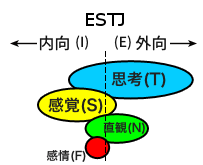
- Extraverted Thinking/Te
Very good at it /First functionThey are skilled at objectively grasping specific facts using inductive reasoning (practical observation that leads to immediate conclusions). - Introverted Sensing/Si
I'm a little good at it /second function: To bear the responsibility and obligations to society, discipline, loyalty, and honor. - Extroverted Intuition/Ne
I'm not very good at it.Third functionThey aim for their actions and procedures to be effective in the future, but they can become neurotic if things don't go their way. - Introverted Feeling/Fi
I'm really bad at it /Fourth functionI feel anxious or afraid that I am not moral. I don't know how to confront (or don't want to confront) my own moral values.
<The cognitive axis of ESTJ>
- Introverted Sensing/Si
Very good at it /First functionThey are adept at matters of loyalty to others and themselves, and have a precise understanding of their position and civic duties. - Extraverted Thinking/Te
I'm a little good at it /second function: You are responsible for understanding and observing methodologies and systems, and for knowing whether what is currently being done is efficient in completing the action. - Introverted Feeling/Fi
I'm not very good at it.Third functionThey believe they possess the most correct ethical values. When challenged, they become rigid, arrogant, and stubborn. - Extroverted Intuition/Ne
I'm really bad at it /Fourth functionThey feel fear or anxiety towards novelty and unpredictability. They don't know how to take new measures that involve a certain degree of risk (or don't like taking them).
<ISTJ Cognitive Aspects>
Si – Ne: Accumulate sensory information to survive in a chaotic world.
Te – Fi: To show an effort to gain recognition.

You can see that not only the first and second psychological functions, but also the third and fourth psychological functions are in a different order. Because of this, the psychological commonalities are surprisingly small.
This corresponds to a relationship that becomes more active for a relationship type prone to conflict. Or, similarly, it corresponds to a relationship type prone to conflict for a relationship type that becomes more active.
In reality, problems often arise when people try to work together.
Introverts tend to be cautious and limit their activity. Conversely, extroverts encourage taking the lead, being out in the open, and being active, preventing idleness. Each has its advantages, but they often fail to understand each other's strengths and weaknesses, leading to irritation.
Furthermore, the third psychological function is the desire to be supplemented by others, but in this relationship, the other person suppresses this as their fourth psychological function, so it cannot be fulfilled.
The challenge for each individual is to balance their second and third psychological functions. However, this challenge is not the same for everyone.
What one person considers their primary psychological function is often the other's secondary function. Therefore, there is much to learn from each other's primary psychological functions. It's natural to show more interest in what one person recognizes as a potential strength.
However, when you're together, you tend to unilaterally assert your own strengths and try to attract the other person's attention.
It's only when we're alone that we can truly appreciate each other's good qualities.
In this relationship, the introverted type can come across as somewhat distant and stiff. The extroverted type, on the other hand, doesn't have a very good impression of this, becoming overly worried and suspicious. However, in reality, the introverted type doesn't have any particularly malicious intent.
End of quote
*This compatibility explanation is,16-Type Personality TestThis was created based on the theory of [the subject].
A Collection of Information on the 16 Personality Types – The Little-Known Truths of Each Type (Summary, Illustrations, and Analysis)
- Summary of 16 Personality Type Test Websites
- List of articles categorized by personality type (16 types)
- Compatibility chart for 16 personality types
- Suitable occupations, ideal jobs, and dream jobs for each of the 16 personality types
- Nicknames (names) for each of the 16 personality types
- What if there were a country with 16 personality types...?
- The relationship between national characteristics around the world and the 16 personality types
- List of 16 Personality Types Based on Famous Characters
- Detective Conan: A Summary of 16 Personality Types for Each Character
- Percentage of 16 personality types
- Reactions of 16 Personality Types – Heaven and Hell
- To describe the 16 personality types in one word:
- 16 Simple Explanations of Personality Types
- 16 Personality Types: Strengths, Weaknesses, and Ways to Improve Weaknesses
- 16 Personality Types: Preferences and Strengths/Weaknesses in Majors and Subjects
- 16 Personality Types: How to Enjoy Life to the Fullest…?
- 16 Personality Types: Inspiring Quotes from Great Figures
- What if each of the 16 personality types were a murderer?
- How to become an attractive husband or wife based on your personality type (16 types)
- What 16 personality types do after a breakup
- Reasons for fighting according to 16 personality types
- Income by 16 Personality Types - Misconceptions and Truths -
- Characteristics of employees based on 16 personality types
- Potential pathological tendencies of 16 personality types
- Psychological Functions of 16 Personality Types Based on Statistics
- Viewing percentage of the detailed personality pages for each of the 16 personality types
- Summary of the characteristics of the 16 personality types
- 8 psychological functions: "What if I did...?"
- Approaches to tasks based on psychological function: Intuitive (N-type) & Sensing (S-type)
- Social interaction explained by psychological functions
- Understanding Your Financial Habits Through Psychological Functions – Are You a Saver or a Spender?
- Humor (sense of humor) as revealed by psychological functions
- How extroverts (Type E) and introverts (Type I) can get along well
- How Sensing types (S type) and Intuitive types (N type) can get along well
- How Thinking (T-type) and Feeling (F-type) People Can Get Along Well
- How to get along well with Judging (J-type) and Perceiving (P-type) types
- Characteristics of parents with 16 personality types
- Parent-child relationships between extroverts (Type E) and introverts (Type I)
- Parent-child relationships between sensing types (S-type) and intuitive types (N-type)
- Parent-child relationships between thinking types (T-type) and feeling types (F-type)
- Parent-child relationships between judging (J-type) and percepting (P-type) types
- How to identify your partner's personality type: [16 Personality Types]

comment