
↑The right person for the right jobMBTI (16 Personality Types) CompatibilityQuoted from '
Reference: 16 Personality Type Theory (modified)
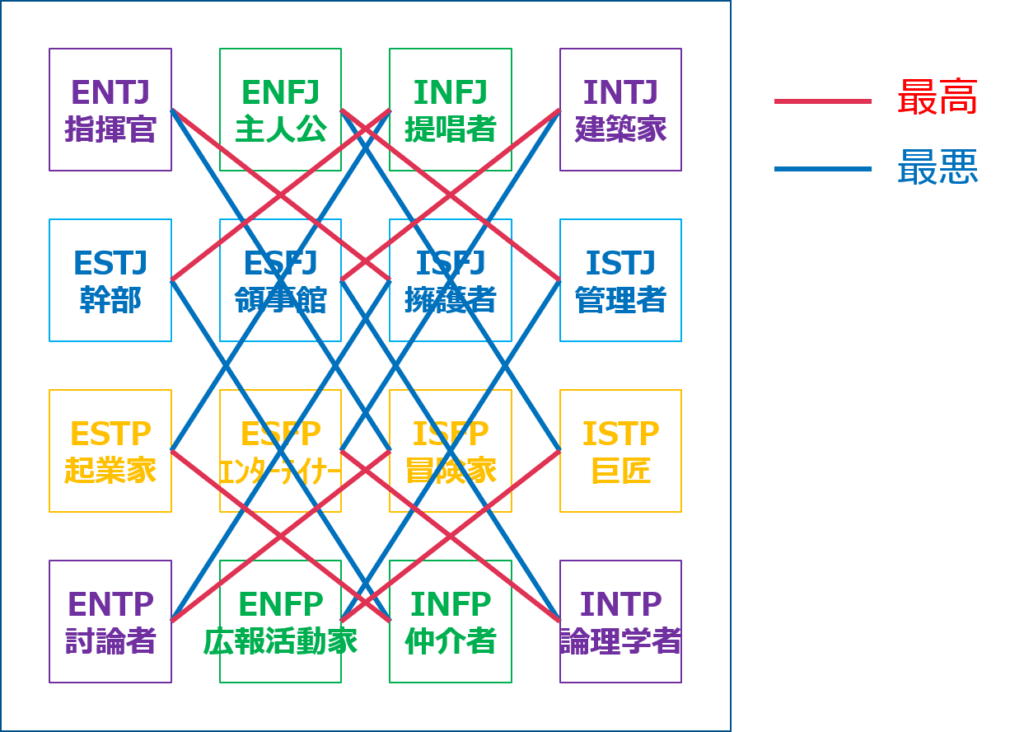
- ESTJ & INFJ
- ENFP & ISTP
- ENTJ & ISFJ
- ESFP & INTP
- ESFJ & INTJ
- ENTP & ISFP
- ENFJ & ISTJ
- ESTP & INFP
A dual relationship is one in which a pair constructs a complete world together. There is no need to force yourself to conform to the other person or pretend to be someone you're not; you can interact naturally. Yet, there is a mutual understanding, making it the best kind of relationship that can solidify a strong bond.
The dual type corresponds to the active relationship from the perspective of the mirror image type. Or, similarly, it corresponds to the mirror image relationship from the perspective of the active relationship.
Mirror-image types share similar interests and major goals, but differ in attitude and approach. Active types constantly exchange insights and can enjoy stimulating and exciting times. While there may be some psychological barriers between these types, good relationships can usually be built.
Those who have good relationships with such types will also have good relationships with those types, and this is considered the ideal dual relationship.
However, at first glance, it might seem that types that are dual to each other have considerable differences in their interests, concerns, and psychological attitudes. Indeed, only the letter P or J in the four letters that represent the types are the same. Therefore, at first, you might feel that "something is different" about the other person. In fact, you may often find yourself in tense situations.
The time you spend before meeting someone has firmly established your way of thinking and feeling, and this greatly influences your relationships. Therefore, it may take time for adults to readily recognize each other's good qualities and the quality of the relationship. However, this is only temporary. Gradually, you will begin to understand the good qualities of the relationship and you will start to hit it off.
Although seemingly contradictory at first glance, their cognitive patterns and rhythms align. They can likely understand each other's intentions without needing many words. They naturally complement each other's weaknesses and protect one another. And because they can honestly appreciate each other's good points, they won't feel the need to expect anything in return.
Conflicts are rare, if any at all. Even if they do occur, you'll naturally be able to restore a good relationship.
Unfortunately, it's rare to find a compatible partner as an adult. This is because, as time passes, people tend to choose different communities or professions due to differing interests. Therefore, it's preferable to meet such a partner while young, when psychological barriers are lower. However, even as an adult, it might be possible to meet one if you have the opportunity to participate in a community and interact with a diverse range of people.
When a group works together to accomplish something significant, a dualistic relationship often naturally develops. This is because it is socially meaningful and what is needed.
As mentioned earlier, it's difficult to recognize a good relationship at first. If you easily drift apart at this point, you'll miss the seed of a potentially wonderful relationship. That would be a great shame. This relationship is also necessary when you find the ultimate four types of relationships, so be careful not to let it go.
As time passes, the relationship between them deepens.
This natural, complementary, and ideal relationship will be invaluable when building a family, establishing trusting relationships with colleagues, or navigating challenging environments.
End of quote
*This compatibility explanation is,16-Type Personality TestThis was created based on the theory of [the subject].
A Collection of Information on the 16 Personality Types – The Little-Known Truths of Each Type (Summary, Illustrations, and Analysis)
- Summary of 16 Personality Type Test Websites
- List of articles categorized by personality type (16 types)
- Compatibility chart for 16 personality types
- Suitable occupations, ideal jobs, and dream jobs for each of the 16 personality types
- Nicknames (names) for each of the 16 personality types
- What if there were a country with 16 personality types...?
- The relationship between national characteristics around the world and the 16 personality types
- List of 16 Personality Types Based on Famous Characters
- Detective Conan: A Summary of 16 Personality Types for Each Character
- Percentage of 16 personality types
- Reactions of 16 Personality Types – Heaven and Hell
- To describe the 16 personality types in one word:
- 16 Simple Explanations of Personality Types
- 16 Personality Types: Strengths, Weaknesses, and Ways to Improve Weaknesses
- 16 Personality Types: Preferences and Strengths/Weaknesses in Majors and Subjects
- 16 Personality Types: How to Enjoy Life to the Fullest…?
- 16 Personality Types: Inspiring Quotes from Great Figures
- What if each of the 16 personality types were a murderer?
- How to become an attractive husband or wife based on your personality type (16 types)
- What 16 personality types do after a breakup
- Reasons for fighting according to 16 personality types
- Income by 16 Personality Types - Misconceptions and Truths -
- Characteristics of employees based on 16 personality types
- Potential pathological tendencies of 16 personality types
- Psychological Functions of 16 Personality Types Based on Statistics
- Viewing percentage of the detailed personality pages for each of the 16 personality types
- Summary of the characteristics of the 16 personality types
- 8 psychological functions: "What if I did...?"
- Approaches to tasks based on psychological function: Intuitive (N-type) & Sensing (S-type)
- Social interaction explained by psychological functions
- Understanding Your Financial Habits Through Psychological Functions – Are You a Saver or a Spender?
- Humor (sense of humor) as revealed by psychological functions
- How extroverts (Type E) and introverts (Type I) can get along well
- How Sensing types (S type) and Intuitive types (N type) can get along well
- How Thinking (T-type) and Feeling (F-type) People Can Get Along Well
- How to get along well with Judging (J-type) and Perceiving (P-type) types
- Characteristics of parents with 16 personality types
- Parent-child relationships between extroverts (Type E) and introverts (Type I)
- Parent-child relationships between sensing types (S-type) and intuitive types (N-type)
- Parent-child relationships between thinking types (T-type) and feeling types (F-type)
- Parent-child relationships between judging (J-type) and percepting (P-type) types
- How to identify your partner's personality type: [16 Personality Types]

comment