
_手術体験談04_【後悔含む体験談詳細あり】.jpg)
Intraocular contact lens (ICL) surgery is a procedure that involves inserting a small lens to improve uncorrected vision.
とは?.jpg)
In any surgery, complications and side effects are never completely absent. ICL is no exception. It is important to have the surgery performed by the most skilled surgeon possible, and it is crucial to consider whether the clinic will provide proper aftercare if any problems arise.
but,I actually underwent ICL surgery, and as a result of the iris thinning, I was left with complications such as glare and a white haze in my right eye, and the aftercare I received afterward was also unsatisfactory.
*While viewing this articleOphthalmologists (and lawyers)If there is anyone available, I would like to ask for their help.I would like to know how to treat this glare and white haze, and how I should complain to the hospital.I cannot accept that there is no compensation for iris damage, even though I may be sensitive to bright light for the rest of my life.I need someone's help.If you could, I would be very grateful if you could share this article (on Twitter, etc.) for my sake and for the sake of those who are planning to take the exam.
If you have any information to share, please do so.This is the inquiry page.It would be very helpful if you could send it via [this method].
The previous article can be found here.
_手術体験談01_【後悔含む体験談詳細あり】.jpg)
-手術体験談02-【後悔含む体験談詳細あり】.jpg)
-手術体験談03-【後悔含む体験談詳細あり】.jpg)


If you color your iris with Lumigan, will it make you less sensitive to bright light?
I consulted with an ophthalmologist on Twitter and other platforms about treatment options for people experiencing glare due to thinning of the iris. Someone told me that using glaucoma eye drops can sometimes color the iris, which may reduce glare.
Therefore, I researched glaucoma eye drops through academic papers and other sources.
Then I found the following paper.
Iris and periorbital side effects of bimatoprost in Japanese patients with glaucoma or ocular hypertension. Clinical Ophthalmology (Auckland, New Zealand). 6.111-6.10.2147/OPTH.S27489. A prospective study of the side effects of bimatoprost in Japanese patients with glaucoma or ocular hypertension. Patient attitudes towards side effects were also examined through questionnaires.
Fifty-two Japanese patients with glaucoma or ocular hypertension were enrolled. Photographs of the iris, eyelids, and eyelashes were taken before and 6 months after bimatoprost treatment. Eyelid pigmentation, iris pigmentation, eyelash growth and bristles, and increased vellus hair on the eyelids were evaluated from the photographs. Patient questionnaires provided insights into subjective judgments of side effects.
Following bimatoprost administration, increases in eyelashes (53.81 TP3T), iris pigmentation (50.01 TP3T), eyelash growth (46.21 TP3T), eyelid vellus hairs (40.41 TP3T), and eyelid pigmentation (7.71 TP3T) were evident. Objective and subjective assessments were consistent regarding increases in eyelash bristles, eyelash growth, and eyelid vellus hairs.
Most patients were aware of these side effects. Before administering bimatoprost, patients should be thoroughly informed about the possible side effects. Careful monitoring is necessary after starting treatment.
Inoue, Kenji & Shiokawa, Minako & Sugahara, Michitaka & Higa, Risako & Wakakura, Masato & Tomita, Goji. (2012). Iris and periocular adverse reactions to bimatoprost in Japanese patients with glaucoma or ocular hypertension. Clinical ophthalmology (Auckland, NZ). 6. 111-6. 10.2147/OPTH.S27489. https://www.researchgate.net/publication/221776019_Iris_and_periocular_adverse_reactions_to_bimatoprost_in_Japanese_patients_with_glaucoma_or_ocular_hypertension I have translated the summary into Japanese.
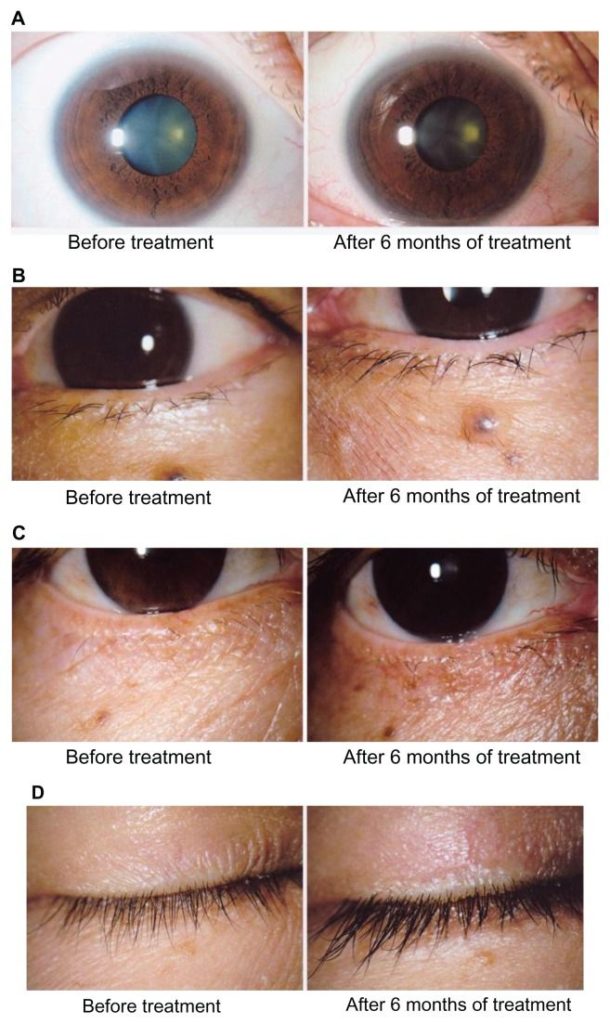
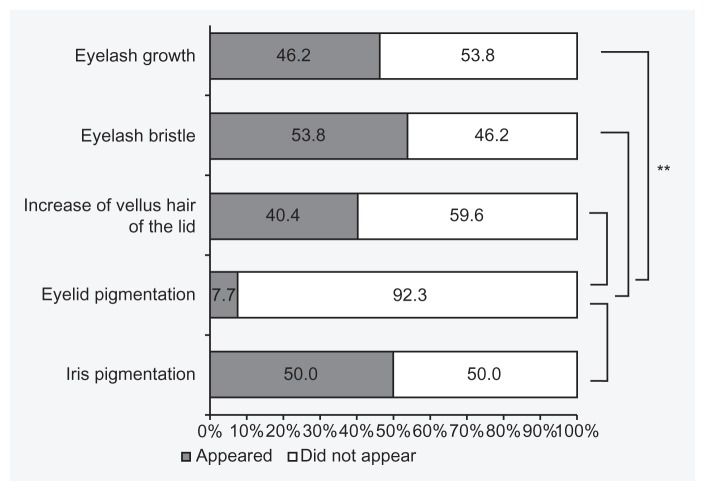
To summarize simply,When bimatoprost eye drops were used in Japanese individuals, iris pigmentation (increased melanin in the iris, causing it to turn black or dark brown) occurred in those using 50%.That's the point. Bimatoprost is also an eye drop for glaucoma.
I also researched the following eye drops for glaucoma.
- Xalatan eye drops 0.005%(Product name)
- Active ingredient: Latanoprost 50 μg (per 1 mL)
- Travatan ophthalmic solution 0.004%(Product name)
- Active ingredient: Travoprost 40 μg (per 1 mL)
- Lumigan 0.03% eye drops(Product name)
- Ingredients: Bimatoprost 0.3 mg (per 1 mL)
- Bimatoprost eye drops 0.03% "Nitto"(Product name)
- Active ingredient: Bimatoprost 0.3 mg (per 1 mL)
Since "Lumigan ophthalmic solution 0.03%" and "Bimatoprost ophthalmic solution 0.03% 'Nitto'" have the same ingredients and proportions, I estimated that the incidence of iris pigmentation would be 50% for both.
I was prescribed Lumigan at Matsumoto Hospital.
When I went to Matsumoto Hospital for my third follow-up appointment after undergoing ICL surgery, Dr. Matsumoto...One possible cause is that the pigment (the brown part) in the iris has faded.That's what I was told. If they knew from the beginning, I wish they had told me during the first or second check-up.
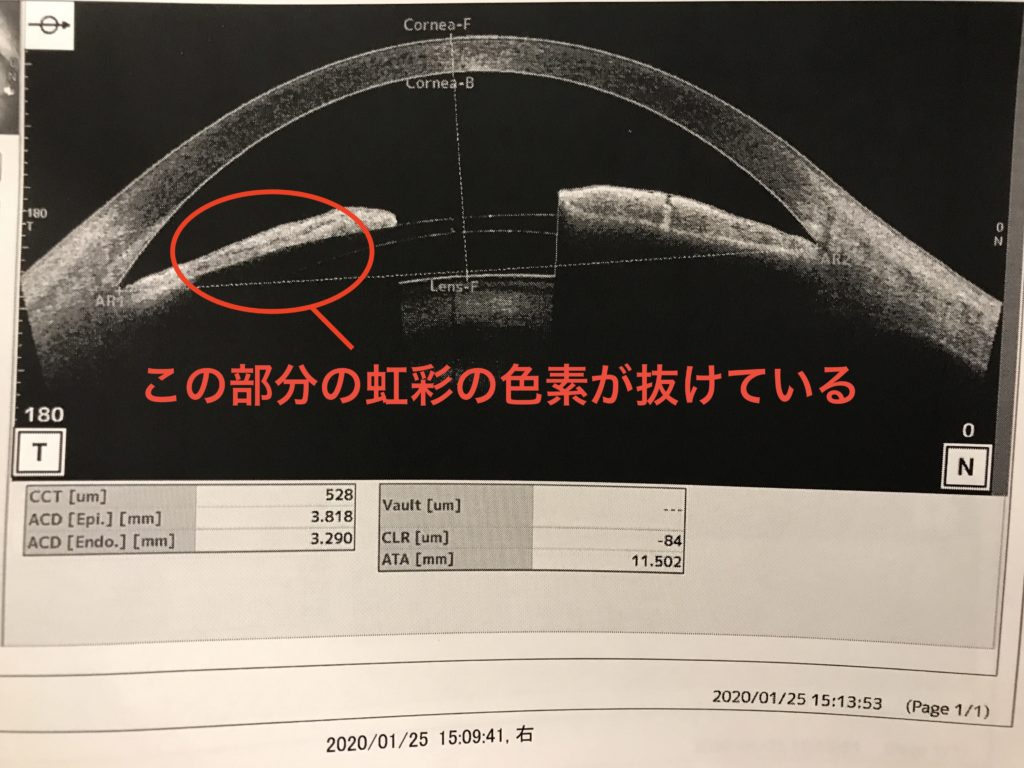
I told Dr. Matsumoto that I wanted a prescription for Lumigan eye drops, which color the iris and eliminate glare. He said it might not be very effective, but he was able to prescribe it for me.
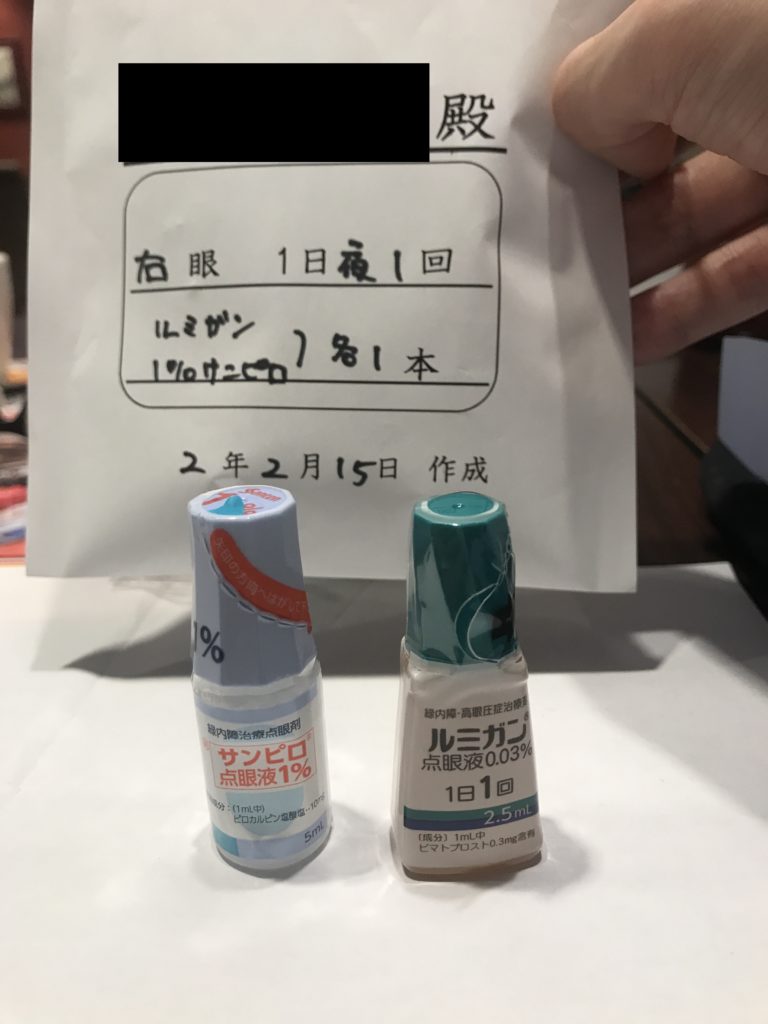
Now, all I can do is use Lumigan for a few months and hope that my irises will darken and the glare will disappear...
If you are considering ICL surgery, we recommend that you carefully consider the risks of complications and long-term side effects before undergoing the procedure.
A summary page of information about ICL risks and experiences.Click here ↓
_情報まとめ_【後悔含む体験談詳細あり】.jpg)
Also,Articles about general healthIt's here ↓
手術での虹彩損傷のリスク.jpg)
comment
I'm T, a woman in my 20s who had ICL surgery at Shinjuku Myopia Clinic 5 days ago.
I have a mix of regret and hope that I've found my way to this blog after surgery.
How effective is Lumigan?
Actually, the same phenomenon is happening to me.
In my case, it's only my left eye, but I'll explain what happened.
I was so tense during the surgery on my left eye that I could even feel it myself, and the surgeon kept telling me to "relax." (He didn't say anything when I had my right eye done.)
At my follow-up appointment shortly after the surgery, I was told something like, "Your left eye may be blurry due to a white haze, but this is because the implant was inserted from the top of the eye, causing bleeding or other fluids to get inside and make it appear blurry. It will get better, so don't worry." At that point, I was wondering if it was really okay that only my left eye was blurry, but since it was the surgeon who said it and not me, I thought for the time being, "Well, I guess it's okay, and I have another check-up tomorrow."
At the follow-up examination one day after the surgery, the phenomenon had remained largely unchanged. While it had certainly improved, the entire field of vision in my left eye was still faintly white, and there was a rainbow-colored diffused light around bright objects, day and night.
The doctor who performed the check-up was not the surgeon, and when I told him that, he thought for a moment and then told me to come back in a week for a check-up.
After that, I found bright places like electronics stores and offices with rows of fluorescent lights, as well as the way sunlight reflected off white walls, to be bothersome. I resumed work, but the difference in vision between my left and right eyes made it difficult to concentrate, and I was overcome by a vague sense of anxiety.
(I had only heard that halo glare occurs at night, so I wondered if something else was happening?)
My friend who had ICL surgery didn't experience anything like that, and it's a symptom that's hard to find information about even when I search online (when I search for "visual changes," there are a lot of results for cataracts and glaucoma, which makes me even more anxious...). As I researched further, I came across this blog through information that said "there is a possibility that the iris may protrude during surgery due to nervousness" and "there is a possibility that the iris may be damaged during surgery due to the surgeon's lack of skill."
And, the iris may never heal completely...
Based on circumstantial evidence, I've come to believe that the surgeon was aware of the problem and understood it, which is why he made comments like, "Please relax," and "Your left eye is the only one that's difficult to see with."
It's still unclear, and in my case, it wasn't severe enough to warrant canceling the surgery, but seeing a white haze the moment I open my eyes in the morning is disheartening. Do I have to live with this vision again today?
Judging from the author's feelings, I imagine they were experiencing a lot more anxiety, regret, and frustration. I am grateful that I was able to find this information.
I plan to talk to the doctor properly at my follow-up appointment in a week, but...
If it's not too much trouble, I'd like to hear about the author's subsequent progress, recommendations for second opinions, the effectiveness of the medication, and any associated costs.