

This article discusses things you think you know but don't.Abenomicsquantitative easingThe mechanismI will explain this in detail. And, in the end, I will also explain whether that mechanism worked properly.
※quantitative easingIf you would like to know more,HerePlease refer to this.


Specific methods of Abenomics
Just to reiterate,The aim of unconventional monetary easing is "Reflationary policies to boost deflation"is.

As for the specific methods of Abenomics,Bank of JapanbyTo conduct large-scale purchases of government bondsThat's it.
but,No matter how much government bonds the Bank of Japan buys from banks, that money simply ends up in the Bank of Japan's current account.The amount of money circulating in the market doesn't increase as easily as one might expect.。The reflationists, as Prime Minister Abe and the new Bank of Japan Governor Kuroda (⇔ former Bank of Japan Governor Shirakawa) have said,The Bank of Japan intends to continue purchasing large quantities of government bonds for an extended period.To make the public think that,They are actually continuing to buy large amounts of government bonds.。 In order to break free from prolonged deflation and ignite inflationary sentimentis.
The mechanism supported by Prime Minister Abe and Bank of Japan Governor Kuroda (who supports reflation)
The mechanism supported by Prime Minister Abe and Bank of Japan Governor Kuroda (who supports reflation) is roughly as follows:Here it is ↓
The central bank has set an inflation target and is showing strong determination.
↓
The central bank buys government bonds and ETFs (which are essentially stocks).
↓
The central bank's balance sheet will see an increase in government bonds and stocks, and its current account will increase.
↓
Private companies expect inflation to occur.
(Self-fulfilling prophecy(To target)
↓
The private sector is increasing borrowing and investing before interest rates rise.
↓
The economy will improve
This means that,There is no indication that this mechanism is working.The only positive outcome was a rise in stock prices.However, this hasn't resulted in a corresponding increase in workers' wages.
The arguments of the anti-reflationists (i.e., those opposed to Prime Minister Abe and Bank of Japan Governor Kuroda)
The arguments of the anti-reflationists (i.e., those opposed to Prime Minister Abe and Bank of Japan Governor Kuroda) are as follows:
Unprecedented government bond purchases
This is considered fiscal financing*, causing long-term interest rates to rise sharply.do
↓
Causes asset inflation*
(*Fiscal finance= The Bank of Japan taking on government debt to cover the budget deficit.Monetization of government bonds (converting government bonds into monetary value)It is also said that this could lead to a loss of fiscal discipline and cause hyperinflation.There is a possibility of extreme price increases = fear of runaway inflation.)
(* Asset inflation=The long-term upward trend in asset prices such as stocks and land.This refers to the situation during the bubble period, when financial institutions drastically increased lending using land as collateral, leading to a surge in land prices.Asset inflationAn incident occurred. After the bubble burst, land prices and stock prices became extremely severe.assetsDeflation occurred.Causes of the long-term economic downturnIt is believed to have become。 )
In other words
The monetary base (simply put, the Bank of Japan's current account) is increasing.
↓
The money supply (money circulating in the private sector) will increase.
VS
Even if the monetary base (simply put, the Bank of Japan's current account) increases, the money supply (money circulating in the private sector) does not increase.
That was the situation.
What were the results of Abenomics?
That was the extent of the debate, but what were the actual results?
As a result, the monetary base (money in the Bank of Japan's current account) While the number of people involved increased rapidly, the money supply (money circulating in the private sector) did not increase as much.In other words,The results are mixed.Here it is. Please see the graph below ↓

↑ Monetary base (money in the Bank of Japan's current account) In response to the surge,
The growth in the money supply (money circulating in the private sector) is subtle.


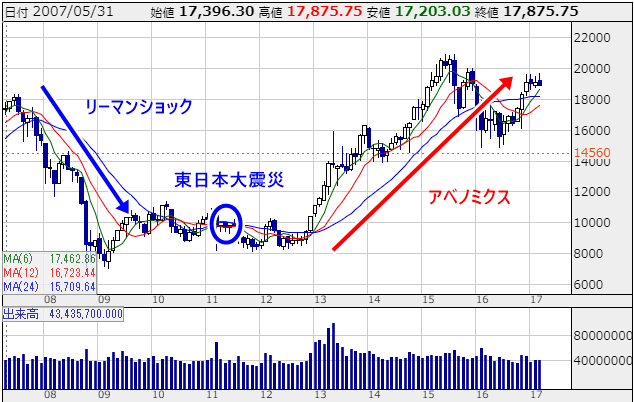
but,The Bank of Japan was also buying stocks in addition to government bonds, so the stock market rose (for example, the Nikkei average), making it appear as if the economy was improving.Therefore, Abenomics appears to have been a success. Those who own stocks have become rich.
but,(Unfortunately) it doesn't really change anything for those who don't have it... it widens the gap and it's sad.
To spread this blogPlease click once.↓

This article,Share on social mediado,Let's share the results of Abenomics with our followers!
Click the button below
↓

comment