
Japanese stock prices (Nikkei average) have been rising sharply recently, finally surpassing 30,000 yen. Japanese people don't invest much money, but one of the reasons why some do is to "support companies."
What exactly does this mean? In this article,This explains how buying stocks can support a company.


How stocks work
First, we need to understand the mechanism, so let me explain it. Companies raise funds by issuing shares. (Primary market = issuance market in the diagram)
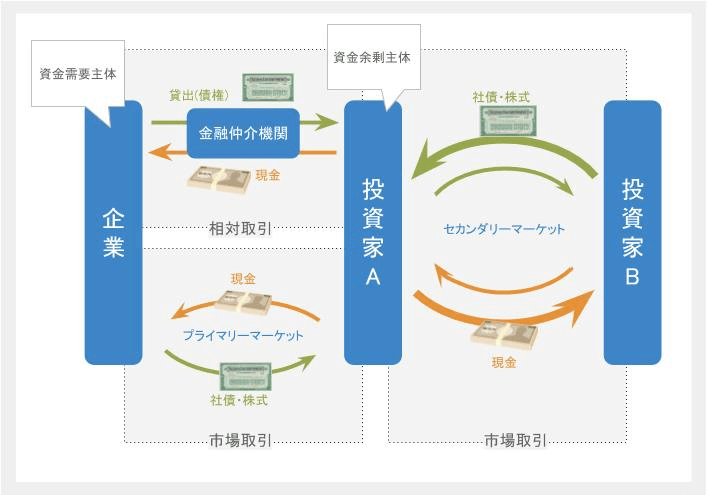
Beyond Finance Beginner Level! Understanding Finance Through Two Markets (Quoted from)
In this situation, it's naturally better if the stock price is high. This is because the funds raised (acquired) at this time do not need to be repaid. Therefore, a high stock price is generally desirable.

What are stocks? Their job is to "gather money." (Quoted from)
So, what does it mean for a company if its stock price rises in the secondary market (i.e., the secondary market)?
In conclusion,There are "no" direct benefits.
Let's use the manga industry as an example to explain this more clearly.
Let's consider the following example.
- Company → Writer
- Stocks → Books
- 1) Purchase in the primary market (= issuance market)
↓
Consumers buy manga on Amazon or at bookstores → manga artists receive royalties.
(= Investors buy shares in the primary market → money goes to the company)
- 2) Purchase in the secondary market (= second-hand market)
↓
Consumers buy manga at used bookstores like Book Off → Manga artists don't receive royalties.
(= Investors buy stocks in the primary market → the company doesn't receive the money)
In this way2) No money goes to the manga artist (or company) through the secondary market.The money only goes to the sellers of used manga and BookOff (a securities company).
Incidentally, to put it in extreme terms,
1) It doesn't matter to the manga artist if, after purchasing the manga, they tear it up and throw it away without reading it.
(This means that the funds a company obtains by issuing shares are unaffected by whether the stock price rises or falls afterward.)
In other words, it's become clear that there is "no" direct profit for the company, right?
The advantages of high stock prices
However, there are also advantages to high stock prices. Let's take the hugely popular manga "Demon Slayer" as an example. What's the point of it being expensive at Book Off (a second-hand store)?
2) The stock price is high in the secondary market (= the secondary market).
↓
The price of "Demon Slayer" is high at used bookstores like Book Off.
(= The stocks investors want are expensive in the primary market)
The price of extremely popular manga rarely drops, even secondhand. That's understandable, given their popularity. As mentioned above, the manga artist doesn't receive a single yen from a secondhand copy, so what's the point of such high prices?
Actually, the process is as follows:
2)
【In the case of Demon Slayer: Kimetsu no Yaiba】
"Demon Slayer" is expensive at secondhand shops.
↓
Highly regarded by publishers (such as Kodansha)
↓
It will be easier to publish and publish the manga again next time.
↓
It becomes easier to receive royalties.
【In the case of stocks】
Stocks are high in the secondary market.
↓
This will make it easier to issue shares at a high price next time as well.
↓
(It becomes easier to make a lot of money.)
Therefore, generally speaking, it's better if stock prices are high. In that sense, buying shares in a listed company can be said to be an indirect way of supporting the company being bought. (However, it's not a direct way of supporting the company.)
In addition, if stock prices are high,
- It becomes more difficult for other companies to acquire the company.
- It becomes easier to acquire other companies.
There is also this advantage: the acquired company must act under the direction of the acquiring company and cannot manage itself freely.
This time, let's use animals as an example.
- High stock price = large lion
- Low stock price = small rabbit
↓ - Rabbits are less likely to be eaten by lions (i.e., less likely to be acquired by other companies).
- Lions are more likely to eat rabbits (meaning they are more likely to acquire other companies).
That's the point.
In this respect, it could be said that there are indirect benefits.


comment