
.jpg)
MBTI(MBTI: Myers-Briggs Type Indicator)It is very accurate.Personality testIt is known that each person has their own strengths (things they use often)Psychological functions (cognitive functions)It is believed that there is a reason for this.
MBTIIf you are not yet familiar with this topic, please refer to the article below.

Also, in advanceFour psychological tendency axesKnowing the following will also help you understand morePsychological functions (cognitive functions)You can understand this.



The eight psychological functions (cognitive functions) are
There are two main types of psychological functions (cognitive functions).
- Judgment function ...How to make a judgment (input)
- Perceptual function ...Method of obtaining information (output)
Judgment function
People acquire information and then make judgments based on it. The way people make judgments and decisions varies from person to person. There are broadly two types of judgment methods.
- Emotional type (F type)...judgment based on how one feels and the harmony of relationships.
- Thinking type (T type)...Is it rational? Is it judged based on objectivity?
The four psychological functions (cognitive functions) used in decision-making
Furthermore, each type is further classified by its "direction of consciousness (extroversion/introversion)."
There are a total of four psychological functions (cognitive functions) used in making judgments:
You can find more details at the link provided.
- Extraverted Feeling (Fe)...emphasizing the feelings of others and overall harmony.
- Introverted Feeling (Fi)...Prioritizing one's own feelings and values
- Extraverted Thinking (Te)...emphasizes societal rules and widely accepted, effective theories.
- Introverted Thinking (Ti)...emphasizing logical consistency and investigating the underlying reasons and causes.
Perceptual function
When people make judgments or decisions, they need information. The way people acquire information varies. There are broadly two types of information acquisition methods.
- Sensory type (S type)...I place importance on specific information based on my own past and present experiences.
- Intuitive type (Type N)...emphasizing information based on commonalities, underlying theories, and future assumptions.
The four psychological functions (cognitive functions) used in perception
Furthermore, each type is further classified by its "direction of consciousness (extroversion/introversion)."
There are a total of four psychological functions (cognitive functions) used for perception:
You can find more details at the link provided.
- Extroverted Sensing (Se)...emphasis on responding according to the current situation.
- Introverted Sensing (Si)...I value the experiences I have had.
- Extroverted Intuition (Ne)...emphasizing the commonalities and derivation of images in things.
- Introverted Intuition (Ni)...Consolidating things into a single image (symbol) and emphasizing the temporal progression of events.
In other words, there are a total of eight psychological functions:
check! The eight psychological functions (cognitive functions) are
| Psychological functions (cognitive functions) | English name | abbreviation | ||
| 知 覚 | 感 覚 | Extroverted Sensing | Extraverted Sensing | Se |
| Introverted Sensing | Introverted Sensing | Si | ||
| 直 観 | Extroverted Intuition | Extraverted Information | Ne | |
| Introverted Intuition | Introverted Institute | Ni | ||
| 判 断 | 思 考 | extraverted thinking | Extraverted Thinking | Te |
| introverted thinking | Introverted Thinking | Ti | ||
| 感 情 | extraverted feeling | Extraverted Feeling | Fe | |
| introverted feeling | Introverted Feeling | Fi |
The following is a quote (with some modifications) from "Let's Look at the World from the Perspective of MBTI Personality Type Theory" (website no longer exists).
People perceive information, make judgments and decisions based on that information, and conversely, select the next information they receive based on their judgments. We believe that differences in this approach to receiving and judging information characterize a person's personality.
When considering psychological tendencies in information reception, we can think of it as an axis with sensation and intuition as the two extremes. When considering psychological tendencies in judgment and decision-making, we can think of it as an axis with thought and emotion as the two extremes.
Psychological tendencies in information reception
Sensing type (S type) <-> Intuitive type (N type)
Psychological tendencies in judgment and decision-making
Thinking type (T type) <—> Feeling type (F type)
It is difficult to satisfy both extremes simultaneously, and in most cases, a person will exhibit a psychological tendency that leans towards one side of this axis.
Furthermore, we consider the psychological functions of extroversion and introversion in each of these senses: sensing, intuition, thinking, and feeling. In other words, there are eight types of psychological functions:
| English name | abbreviation | ||
|---|---|---|---|
| Extroverted Sensing | Extraverted Sensing | Se | |
| Introverted Sensing | Introverted Sensing | Si | |
| Extroverted Intuition | Extraverted Information | Ne | |
| Introverted Intuition | Introverted Institute | Ni | |
| extraverted thinking | Extraverted Thinking | Te | |
| introverted thinking | Introverted Thinking | Ti | |
| extraverted feeling | Extraverted Feeling | Fe | |
| introverted feeling | Introverted Feeling | Fi |
In his theory of personality types, Jung divided personalities into eight types based on this principle. He believed that the most strongly functioning psychological function characterizes a person's personality.
End of quote from "Let's Look at the World from the Perspective of MBTI Personality Type Theory" (website no longer exists) (partially modified)
Recommended books for understanding the eight psychological functions
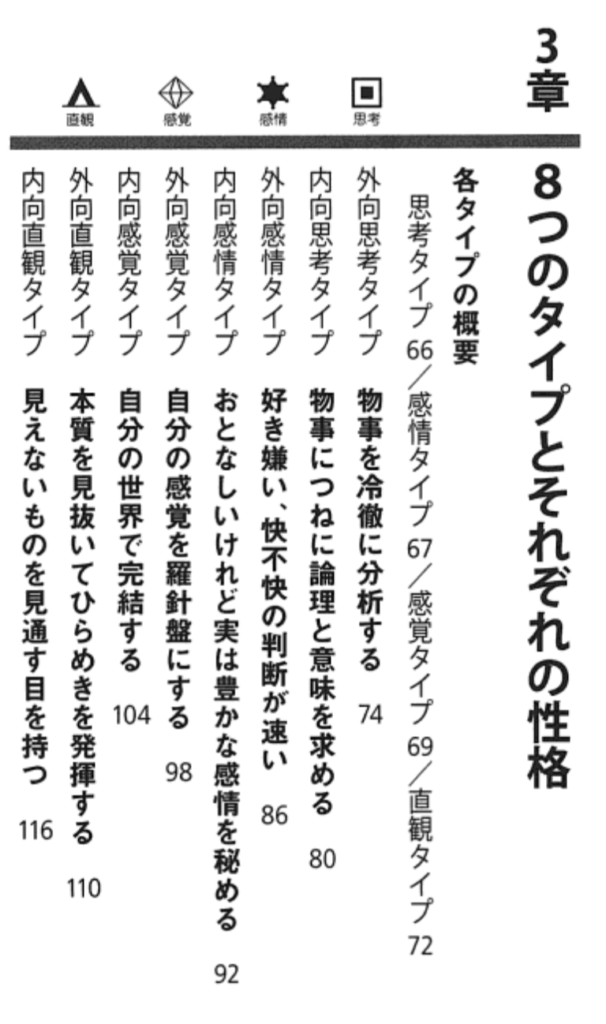
・The "8 Personality Types" as Understood Through Jungian Psychology
16-type personality test (≒MBTI test)teeth,The theory of psychologist JungThis is the basis. Jung said,8 psychological functionsI came up with this idea (see image), and classified people's personalities into eight categories based on which function they excel at.
16-type personality test (≒MBTI test)That8 psychological functionsThis is a combination and further development of that. First, read this book to find out which psychological function you are best at.16-type personality test (≒MBTI test)It is highly recommended because it allows you to understand the diagnostic results more deeply.
belowYou can read a sample by clicking the "View on Amazon" link.So, it might be worth taking a look.
.jpg)
comment