
MBTI(MBTI: Myers-Briggs Type Indicator)It is very accurate.Personality testIt is known for this, but its diagnostic items include,Thoughts and EmotionsThere is such a thing.
MBTIIf you are not yet familiar with this topic, please refer to the following article.


Thinking type (T-type) and Feeling type (F-type) are different types of thinking.
In addition to the inclination to make decisions based on the information gathered, there are also two types of decision-makers: thinking types (T-type) and feeling types (F-type).
PeopleThinking (T) sidetoo,Emotional (F) aspectI own both, but I usually tend to favor one over the other.
How to consider decisions when making value judgments or choices
Thinking type (T type) <—> Feeling type (F type)
Some people base their judgments and decisions on efficiency and rationality, while others base them on emotional harmony and interpersonal relationships.
quotation From "Let's Look at the World from the Perspective of MBTI Personality Type Theory" (website no longer exists)
Thinking type (T type)These individuals value logic, are not swayed by others' opinions, are analytical, and reach conclusions based on objective values. They tend not to be personally involved in group decisions and act with the outcome in mind as much as possible.
They seek justice and clarity, and are often described as stubborn.
Emotional type (F type)People with this trait tend to be easily influenced by subjective perspectives in their relationships. Words like cooperative, compassionate, and emotionally sensitive apply to them. They place importance on the impact their decisions have on others.
They tend to empathize with and be considerate of the pain of others.
Emotional type (F type)The following tweet clearly illustrates this way of thinking:
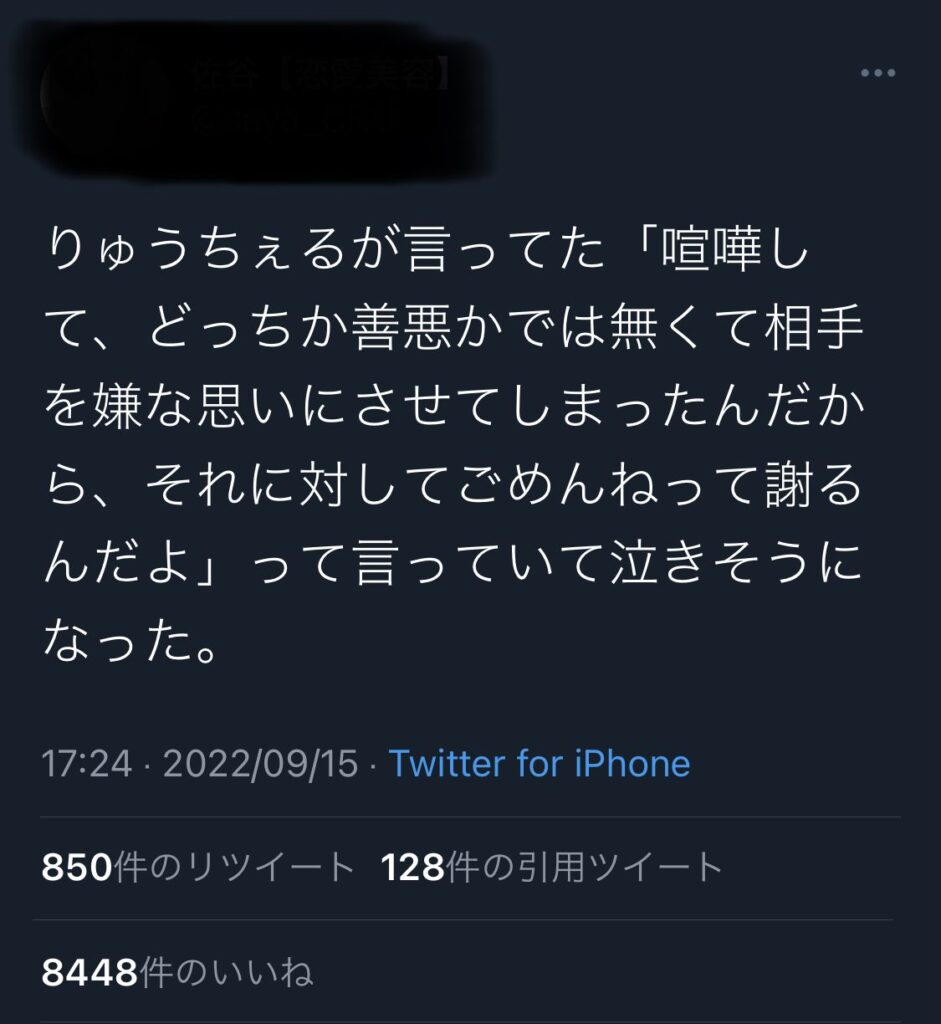
allEmotional type (F type)However, I am not apologizing for the reasons mentioned above, but rather because I am focusing on the other person's feelings.Emotional type (F type)This can be considered a characteristic of [the product/service].
Conversely, being fixated on "good and evil (truth and falsehood)"Thinking type (T type)It seems so.
Characteristics of Thinking Type (T-type) and Feeling Type (F-type)
So, eachFeaturesLet's take a look.
| T (thinking type) | F (emotional type) | |
| Emphasis on fairness | Prioritizing feelings | |
| rational | Compassion | |
| reason | emotion | |
| Respect your rights | Value your values | |
| objective | subjective | |
| Skeptical | trust | |
| analysis | mercy | |
| justice | empathy | |
| to fight | Reconcile | |
| Prioritize solving problems | Prioritizing relationships | |
| Strict | mild | |
| strong will | kind heart |
The table above shows,Derailment from the rails『[MBTI] The Difference Between T (Thinking) and F (Feeling) [16 Personality Types]Created from '
| T (thinking type) | F (emotional type) | |
| strong will | Easily moved by emotion | |
| Respect the rules | Depend on the situation | |
| Justice faction | humane person | |
| Make it clear that it's black and white. | Cooperate | |
| critical | favorable | |
| I will not compromise my principles. | Emphasize social value | |
| Don't be swayed by other people's opinions. | To get involved |
・How Thinking (T-type) and Feeling (F-type) People Can Get Along Well
・Parent-child relationships between thinking types (T-type) and feeling types (F-type)
Thinking (T-type) and Feeling (F-type) values
Thinking types (T-types) assess the value of "things, ideas, and situations," which are indicators unrelated to people, while feeling types (F-types) consider things from a people-centered perspective. Of course, all thinking types (T-types) have feelings, and feeling types (F-types) think as well. Feeling types (F-types) can reach conclusions through analytical and intellectual processes, just like thinking types (T-types). On the other hand, feeling types (F-types) can determine values through emotional thinking.
Feeling types (F-types), like thinking types (T-types), can reach conclusions using analytical and rational processes. On the other hand, thinking types (T-types) can also judge the value of things based on emotions.
There are several straightforward ways to understand how much emotion a Thinking Type (T-type) has towards their values. One is to observe how a Thinking Type reacts when others ignore what they believe to be accurate, effective, true, or real. You can observe whether they become irritated, upset, or intensely indignant. If their values are not respected, it can be a significant emotional burden for a Thinking Type.
Thinking types (T-types) tend to think a lot about data and metrics, so it's natural that they feel more comfortable in situations involving data, resource management, and career relationships.
On the other hand, feeling types (F types) may hide or suppress their emotions in order to stick to what they believe is right. Social considerations are usually important in the values of feeling types (F types), and it is not uncommon for feeling types (F types) to suppress their emotions in order to maintain harmony in awkward situations.
Feeling types (Type F) are interested in warm and humane relationships, and will likely feel more comfortable in expressing their emotions and interacting with others.
Detailed explanation of thinking type (T-type) and feeling type (F-type)
The following is a quote (with some modifications) from "Let's Look at the World from the Perspective of MBTI Personality Type Theory" (website no longer exists).
Here, we will consider the psychological tendencies involved in judgment and decision-making, focusing on thoughts and emotions.
These two are psychological functions of judgment that are actively operated with conscious will.
Thought and emotion are opposing forces, making it difficult to reconcile them simultaneously. However, they are actually complementary, and by balancing and coordinating them, we can arrive at a correct understanding.
Now, let's go over each of them.
This thinking type uses objective and rational criteria for judgment and decision-making.
I am interested in things and events. I try to understand their properties and mechanisms. I am interested in the mechanisms by which they function.
I believe that foundational knowledge is paramount, and I strive to absorb as much knowledge as possible. I aim to be able to proceed with things efficiently and without contradiction.
In reality, we often notice inconsistencies or flaws in plans and explanations. We tend to adhere strictly to conclusions that we believe to be correct, derived from comparison, analysis, and reasoning.
Therefore, you can resist temptation and discipline yourself.
However, in the name of efficiency and rationality, decisions are often made without consideration for one's own feelings or the feelings of others.
And often, people believe that doing so protects their emotions and provides a sense of security.
When the scope of one's thinking is limited to a narrow area around oneself, one becomes selfish.
Furthermore, their insistence on objective correctness can sometimes lead to their frankness being perceived as impolite. This type of person will likely excel when given the opportunity to fully utilize their analytical skills.
Emotional types base their judgments and decision-making on "how they feel."
As people develop an interest in morals and manners, they begin to form values that take into account the impact on others.
They have the ability to be considerate of and empathize with other people's feelings. In fact, they can sense what others are feeling and empathize with them as they are, or they try to cheer them up or boost their morale.
They possess a rich sensibility and feel strongly about a wide range of emotions, from negative ones like anger, sadness, and suffering, to positive ones like joy and love.
And, if possible, I would like to have positive emotions within myself, and I wish to maintain harmony with others and share joy.
Those kinds of things become the basis for judgment based on a moral sense of good and evil.
Furthermore, with their rich sensibility, they are captivated by beauty. They may be deeply moved by the appearance of nature, paintings, sculptures, and works of literature.
In fact, those who possess an aesthetic sense not only appreciate art, but also try to express their own emotions and beliefs through art.
However, prioritizing interpersonal relationships too much often leads to inefficiency, a lack of rationality, and ultimately, losses.
You might try to avoid necessary conflicts, but smoothing things over isn't always the best approach.
Furthermore, strong convictions can sometimes prevent people from accepting objective facts.
They excel at maintaining harmony among people and are well-suited to roles where warmth and kindness can be utilized.
End of quote from "Let's Look at the World from the Perspective of MBTI Personality Type Theory" (website no longer exists) (partially modified)
If you'd like to learn more about thinking types (T-type) and feeling types (F-type), please refer to the article below.

The following are reference articles for each of the psychological tendency axes.



.jpg)
comment