Classifying personalities into 16 types16-Type Personality TestCheck which type you are using the following↓↓

↑16-Type Personality Test↑
↑Diagnose↑
This article will cover the following 16 types.ENFJ (Collaborator Type) This explains the success of [the company/organization].
youENFJ (Protagonist/Collaborator type)Then
Share it on social media (tweet it) and let your followers know!
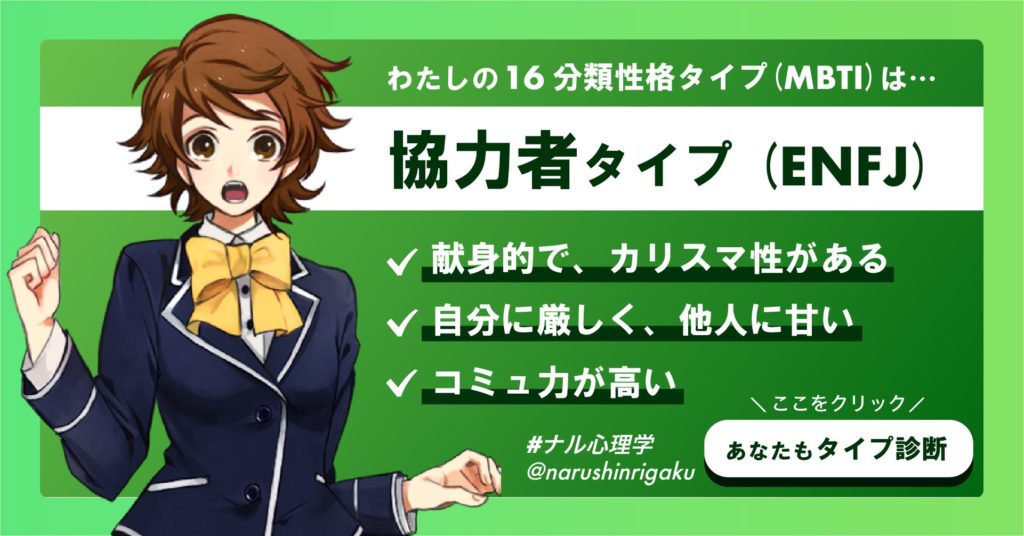
↓↓↓Share on social media (tweet)↓↓↓
↑↑↑Share on social media (tweet)↑↑↑


Success for ENFJs (Collaborators)
ENFJs find success in achieving things for others. They feel successful when their achievements change the lives of those around them. They are compassionate, understanding, supportive, and helpful. They are perceptive, responsible, and conscientious. ENFJs value giving love, support, and having fun with others. They focus on understanding, supporting, and encouraging people. ENFJs find the greatest satisfaction when they feel their efforts have enriched the lives of others.
ENFJs are driven by others. As idealists, they always see the good in others. ENFJs grow when they can "correct things" for others. "Relationships" are often what comes to mind for ENFJs. They realize that the efforts they make for others enrich their own lives. Creating and maintaining meaningful and beautiful relationships is a source of joy in life. They value building and continuously growing high-quality relationships with business people, friends, family, and romantic partners. They can identify people's strengths and abilities, and empower and inspire colleagues, friends, and family.
Tips for success for ENFJs (Collaborators).
- Avoid putting too much pressure on the other person by having excessively high expectations.
You have a talent for discovering the hidden potential and true value in others. However, if you push this too hard on them, you'll only push them away, and ultimately, you won't be able to realize that potential. First, try to understand their anxieties and worries and offer support. It should be easy if you show your compassion and kindness. - Take care of yourself.
Become aware of your own values and desires that you cannot compromise on. First and foremost, you must value yourself; otherwise, you cannot perform at your best. Don't suppress your own desires and wishes too much for the sake of others. If you don't assert yourself, others won't understand your core values and desires. - Express your feelings and desires.
Cherish your own feelings. We often tend to ignore our own desires and emotions. Understand your own feelings. Your feelings are just as important. While it's very important to be considerate of others' feelings, recognize that your own feelings are just as important. It's okay to say no when you want to. And be aware of and cherish what you want to do and your own desires. Taking care of yourself will ultimately lead to the best results. - Let's not forget to be considerate of the other person's feelings.
It's very important to consider other people's perspectives. Even if you think you're right, the other 15 personality types may have a different viewpoint and come up with a different answer.
When conflicts or problems arise in interpersonal relationships or collaborative work, trying to understand the other person's perspective can make it easier to resolve them. Instead of reacting reflexively to viewpoints that are the complete opposite of your own, try listening to what they have to say first. - Don't be afraid to ask questions.
When you need a response or feedback, don't be afraid to ask. A lack of response doesn't necessarily mean a negative reaction. - Don't turn a blind eye to your weaknesses; face them head-on.
Everyone has weaknesses to a greater or lesser degree. First, let's acknowledge that we have both strengths and weaknesses. It's important to accept these weaknesses and take appropriate measures. By doing so, we can overcome them. - Let's not be too afraid of criticism.
Listen carefully to criticism from others without perceiving it as a personal attack. Don't take criticism personally. Instead of trying to gain their agreement by simply agreeing with them, you might discover a shared purpose that you should both truly work towards. When you have a difference of opinion with someone, try to view it as an opportunity to broaden your own values and judgments. It will help you grow. Criticism can be seen as an opportunity for improvement.
For those who want to learn more about ENFJ (Collaborator type) (compatibility, etc.)
For more information, please see below.Highly recommended (click to open) ↓
Compatibility: You can learn about compatibility and how to interact with other types.
RoadmapYou can learn about personality types and personality theories (MBTI) in a systematic way, from basic to specialized.
Related articlesLearn about the characteristics of each type (take a look at the parts that interest you)
ENFJ (Collaborator Type)Compatibility with other types (click to show)
Ideal compatibility type pair
ENFJs are compatible with people who are sociable, understand others' feelings, and respect others.
From an ENFJ's perspective...
- INFP (Psychologist type):Fi – NeThey possess high empathy, the ability to understand other people's feelings, and creative thinking that can be applied in many different ways.
- ENFP (Reformer type):Ne – FiThey have a similar view of the world as I do, and they can understand other people's feelings.
- INTJ (Strategist type) :Ni – TeHaving a progressive vision and being able to translate it into practical, usable ideas.
Type pairs that are prone to conflict
ENFJs tend to clash with people who lack respect or consideration for others, have a different view of society than ENFJs, and are indifferent to social issues.
From an ENFJ's perspective...
- ISTP (Practitioner type):Ti – SeHe has his own unique preferences, is difficult to deal with, doesn't conform to those around him, and is excessively meticulous about minute details.
- INTP (Researcher Type):Ti – NeThey disregard the feelings of those around them and are only willing to follow their own opinions.
- ENTP (Inventor Type):Ne – TiThey are troublesome people who do not follow the common sense of society that should naturally be followed, thus creating conflicts of interest.
Romantic compatibility type pair
ENFJs are compatible with people who share their ideal vision and can reassure them even in difficult situations.
From an ENFJ's perspective...
- INTJ (Strategist type) :Ni – TeIt provides a logical explanation of how things work.
- INFP (Psychologist type):Fi – NeThey can understand other people's feelings and have their own ideals.
- INFJ (Empathy Type):Ni – FeBeing able to understand other people's feelings
- ISFP (Artist type):Fi – SeHe is able to see things realistically and is a charismatic person with a keen aesthetic sense.
*The pairs that tend to clash and the pairs that have good romantic compatibility may overlap. This is because while people may dislike those who are the complete opposite of themselves due to disagreements, they may also be attracted to those who appear mysterious because they are different. However, it seems that these relationships often end up breaking down.
(Advice for those dating an ENFJ)
ENFJs are very sensitive to the feelings of others, so the happiness of their partner is essential to their own happiness. ENFJ partners should express how grateful they are for the support and care their partner provides, and make an effort to reciprocate in the same way, even if their partner doesn't ask for help.
ENFJ (Collaborator Type) Roadmap (Click to open)
To truly understand the ENFJ (Collaborator type),Psychological functions (cognitive functions)This is important ↓
- Extraverted Feeling/Fe
Very good at it /First functionFollow what you deem right for everyone, what is good for the group. - Introverted Sensing/Ni
I'm a little good at it /second function: You are responsible for predicting whether your will, desires, and actions will cause harm in the future. - Extroverted Sensing/Se
I'm not very good at it.Third functionPeople want to stop and listen to what you have to say. Otherwise, they feel stifled, become critical, and tend to try to impose their own opinions and positions on others. - Introverted Thinking/Ti
I'm really bad at it /Fourth functionThey fear and are anxious about things that are not logically correct. They don't know how to thoroughly analyze available information (or are unwilling to do so).
<The cognitive axis of ENFJ>

By reading the roadmap below, you can learn about cognitive functions and gain a systematic understanding of the ENFJ personality type.
- Roadmap – ENFJ (Collaborator Type) –
- Introduction – What is MBTI?
- Summary of my personality
- Cognition is
- Type-specific cognitive characteristics
- Four personality indicators (psychological tendency axes)
- Conflicts over personality indicators
- “The meaning of the four letters "ENFJ"
- First character:Introvert (type I) or extrovert (type E)
- Second character:Intuitive type (N type) or Sensing type (S type)
- Third character:Feeling type (F type) or thinking type (T type)
- 4th character:Perceiving type (P type) or Judging type (J type)
- About psychological functions (cognitive functions)
- What are psychological functions (cognitive functions)?
- The eight psychological functions (cognitive functions)
- Decision-making (judgment) function
- Information gathering (perceptual) function
- Understanding your own psychological functions (cognitive functions)
- The developmental process of psychological functions (cognitive functions)
- ENFJ's psychological functions (cognitive functions)
- First function:Extraverted Feeling (Fe)
- Second function:Introverted Intuition (Ni)
- Third function:Extroverted Sensing (Se)
- Fourth function:Introverted Thinking (Ti)
- Making good use of psychological functions (cognitive functions)
- The strengths and weaknesses of the ENFJ (Collaborator type)
- Make the most of your strengths
- Reasons for focusing too much on the advantages
- How to improve your weaknesses
- If you are alone
- In a team setting: Have others compensate for your weaknesses (fourth function).
ENFJ (Protagonist-Collaborator Type) – A Comprehensive Guide to Links
- Explanation of ENFJ
- ENFJ personality type (protagonist/collaborator type)
- ENFJ (Collaborator Type) Personality Trait 02
- Hobbies of ENFJ (Collaborator type)
- Things that ENFJs dislike
- The strengths and weaknesses of ENFJs
- Suitable occupations for ENFJs
- ENFJ leadership
- Compatibility between ENFJ and other personality types
- ENFJ Relationships and Romance
- How ENFJs set goals and gather information
- ENFJ's Decision-Making Methods
- ENFJ parent-child relationships
- ENFJ's Talents and How to Utilize Them
- For ENFJs to succeed
- ENFJ psychological functions
↑Click to open↑
From the following Amazon link,ENFJ characters (Master Roshi, Tanjiro Kamado)You can read a sample of the manga featuring this character, so please check it out if you're interested ↓
youENFJ (Protagonist/Collaborator type)Then
Share it on social media (tweet it) and let your followers know!
↓↓↓Share on social media (tweet)↓↓↓
↑↑↑Share on social media (tweet)↑↑↑

comment