
Classifying personalities into 16 types16-Type Personality TestCheck which type you are using the following↓↓

↑16-Type Personality Test↑
↑Diagnose↑
This article will cover the following 16 types.Success for the Adventurer Type (ESTP)I will explain this.
youESTP (Entrepreneur-Adventurer Type) Then
Share it on social media (tweet it) and let your followers know!
↓↓↓Share on social media (tweet)↓↓↓
↑↑↑Share on social media (tweet)↑↑↑


What does success mean to an ESTP (Adventurer type)?
ESTPs often measure success in various ways and have high standards for what they should achieve in life. They crave recognition from loved ones, and this is often how they measure success in life. They work hard to achieve their goals. ESTPs feel successful not only when they can maintain their social life but also when they can advance their careers. ESTPs live in the moment, and for them, success is not a continuous process, but rather the moment of achievement—the moment that brings them victory.
With extroverted sensing (Se) as its primary function and introverted thinking (Ti) as its secondary function, ESTPs have a strong tendency to seek sensory experiences and engagement with their physical environment. ESTPs thrive in situations where they view life as a big game and must quickly utilize their skills to win. And in such situations, ESTPs are likely to be winners because no other personality type is as quick-witted as an ESTP.
ESTPs have the ability to instantly assess and understand people accurately. They also have a strong desire to be in contact with their immediate physical environment. This desire manifests in various ways, most commonly as a love of sports and physical activity, and a constant desire to be doing something. ESTPs are action-oriented. If you want to achieve something quickly, you might want to ask an ESTP for help. With these abilities, ESTPs have a high chance of success as professionals, such as salespeople or professional athletes. Occupations that allow them to leverage their ability to interact with people and the physical world, and where they can receive immediate feedback, are well-suited to ESTPs.
Because ESTPs need interaction with the outside world, achieving "personal" success may be difficult. ESTPs feel happiest when interacting with people and things, but personal success requires knowing their "inner selves." ESTPs tend to expend energy on the "outside" and are not good at introspection. However, it is actually possible to balance the "outside" and the "inside." They can constantly seek new sensory experiences while simultaneously satisfying their desire to think about and reflect on those experiences and impressions. In this way, they can find a deeper level of personal satisfaction than being swayed by the immediate desire for sensory experiences.
However, even ESTPs, who have developed the ability to reflect deeply, always have a strong desire for new experiences and gain a sense of accomplishment from overcoming challenges in their physical environment. Once given an interesting job or discovering something new, they rarely stop giving their all to the challenge, thereby achieving what they consider personal success.
Strengths that ESTP (Adventurer type) should develop
- Live in this moment.
- I want to see immediate results from my actions.
- They possess keen observational skills and can accurately analyze the motivations and thoughts of others.
- Flexible and adaptable
- I like to start things, but I don't necessarily need to see them through to the end.
stomach. - Easygoing and energetic
- Mentally tough
- Being able to adapt to changing circumstances
- It's fun to be with you
- High level of observational skills
- Excellent memory for details
- They like to see the results of their efforts immediately.
- Responding quickly and effectively to emergencies and critical situations.
- They have excellent problem-finding and problem-solving abilities.
- They are highly competitive and strive to win even in difficult situations.
- I like flashy things.
- I'm good at interacting with people.
- To gain extremely detailed and immediate knowledge about the surrounding physical world.
It is possible - I am drawn to adventure and risk.
- I enjoy new experiences and interacting with people.
- They dislike being in structured environments or environments bound by rules.
- Not only how to do something, but also how to make it more valuable.
There are tips that show how to do it in a way that is effective or efficient. - Action-oriented
- Burning in unfavorable situations
- Having the "perseverance" to get things done.
Tips for success for ESTPs (Adventurer types)
- Let others talk about your thoughts.
Typically, ESTPs learn and grow through action (extroverted sensing). However, discussing their ideas and perceptions with others helps develop introverted thinking (Ti), allowing them to grow even without external activities. How well you utilize your auxiliary function, introverted thinking (Ti), is crucial for your overall health and well-being. - Let's respect the need to take action.
To live life to the fullest, understand that you need to actively influence your environment. Don't blame yourself if you can't sit still and read a book or watch a movie. Of course, choose partners and friends who value an active lifestyle, but also take the time to consider how your life might change by incorporating their perspectives. - Let's consider the consequences of the actions we ourselves have taken.
ESTPs are naturally inclined to take risks rather than stay safe, and tend to seek out adventure and dangerous activities. Naturally, this can lead to disastrous consequences. ESTPs are quite confident in their abilities, and these personal assessments are usually accurate, but they would be unstoppable if they learned the importance of spending more time considering the potential consequences of their actions and decisions. - Try to strike a balance between fast and slow tempos.
ESTPs must strive to balance busy and slow periods, emergencies and deadlines with their daily lives. They need to see the whole picture of a project or problem, and its future impact, not just the immediate situation. For ESTPs, jumping from one emergency to the next and putting out each one is easy, even comfortable. However, before moving on to the next task, that task must be completed and finished. - Let's recognize the differences between ourselves and others.
Let's recognize that everyone is different. Everyone has their own place and values. We need to realize that these values and places cannot easily be forced into a single environment. - Let's look inward.
For ESTPs, taking time for self-reflection and introspection is especially beneficial as they get older. Throughout their lives, ESTPs tend to focus on the outside world, constantly responding to their environment and the demands of the moment. Because they are always looking outward, they can become distanced from healthy introspection, overlooking important aspects of their own character and growth, or leaving personal blind spots unaddressed. - Confirm your feelings and express them.
ESTPs may find it difficult to accurately understand how they feel about the people they are involved with. However, understanding this is important. Don't try to lead the relationship just because you feel the same way. If you determine that you care about that person, communicate that to them each time. Doing so will give them a sense of security and lead to a long-lasting relationship. - Try to have the mindset that it's okay to fail.
No matter how hard you try, no matter what skills you use, you can't climb every mountain, and you can't satisfy everyone. Losing is an opportunity to think about what's important and what truly matters in life. Next time, it's important to challenge yourself with something that's more in line with your abilities and that will be valuable to others. - Let's cultivate your strengths.
Give yourself every opportunity to showcase your innate abilities. If you're not currently in a relationship or job that allows you to do so, it might be time to discover how to change that. Remember that your strengths come from your ability to cope with situations that allow you to accomplish things and a world where opportunities to overcome challenges exist. - Let's think about the future.
Because ESTPs live in the present, they often struggle to effectively plan for the future. However, ESTPs will find it beneficial to create at least loose plans or frameworks. They don't need to follow them strictly, but they can certainly move forward in achieving their personal and professional goals. Helping them develop long-term future plans and time management skills can also be helpful. - Before taking action, please check the rules.
ESTPs follow their own plans, systems, and internal norms. This isn't because ESTPs are "intentionally rebellious" against the rules of the world or existing organizations, but because they "often fail to consider" that there may be rules or established protocols that should be taken into account before proceeding. ESTPs can avoid unnecessary conflict and tension in the workplace if they remember to get their plans approved beforehand.
For those who want to learn more about ESTP (Adventurer type) (compatibility, etc.)
For more information, please see below.Highly recommended (click to open) ↓
Compatibility: You can learn about compatibility and how to interact with other types.
RoadmapYou can learn about personality types and personality theories (MBTI) in a systematic way, from basic to specialized.
Related articlesLearn about the characteristics of each type (take a look at the parts that interest you)
Compatibility between ESTP (Adventurer type) and other types (click to show)
Ideal compatible type pair
ESTPs are most compatible with people who share their realistic and grounded worldview and sense of urgency.
From an ESTP's perspective...
- ESFP (Optimist type):Se – FiThey have high physical abilities and agility, high self-esteem, and a good sense of humor.
- ESTJ (Responsible type):Te – SiThey excel at practical application and are quick to act.
Compatible type pairs that are prone to conflict
ESTPs tend to clash with people who are not athletic, are insensitive, and lack teamwork skills.
From an ESTP's perspective...
- INTJ (Strategist type) :Ni – TeThey are very particular, spend too much time on things, and lack adaptability.
- INFJ (Empathy Type):Ni – FeHe is unrealistic, idealistic, and slow to bring his ideas to fruition.
Romantic compatibility type pair
ESTPs are most compatible in love with someone who can keep up with their pace of action, is captivating and charming, and makes them feel secure.
From an ESTP's perspective...
- ISTP (Practitioner type):Ti – SeThey have a worldview that emphasizes a realistic and practical environment.
- ESFJ (Sociable Type):Fe – SiYou can deepen your relationship quickly and share hobbies.
- INFJ (Empathy Type):Ni – FeIt provides reassurance even in difficult situations.
- INTJ (Strategist type) :Ni – Te, providing a practical environment and reassuring
*The pairs that tend to clash and the pairs that have good romantic compatibility may overlap. This is because while people may dislike those who are the complete opposite of themselves due to disagreements, they may also be attracted to those who appear mysterious because they are different. However, it seems that these relationships often end up breaking down.
(Advice for those dating an ESTP)
ESTPs love excitement and fun, but they quickly get bored with the routine. They don't like long, philosophical discussions, but they enjoy keeping a conversation going by talking about shared interests and passions. If your partner is an ESTP, keep in mind that they like to cherish each day, but they are not good at making long-term commitments, so planning for the future with them may be difficult.
ESTP (Adventurer Type) Roadmap (Click to open)
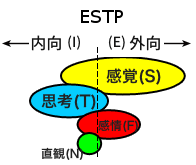
To truly understand the ESTP (Adventurer type),Psychological functions (cognitive functions)This is important ↓
- Extroverted Sensing/Se
Very good at it /First functionThey are familiar with the real physical space ("what is happening right now") and possess high spatial awareness. - Introverted Thinking/Ti
I'm a little good at it /second function: They are responsible for verifying the facts, determining whether statements and findings make logical sense, and what is true or false. - Extraverted Feeling/Fe
I'm not very good at it.Third functionThey want to make people happy and feel positive. When that's not the case, it tends to turn into insults, sarcasm, and imposing a sense of superiority. - Introverted Sensing/Ni
I'm really bad at it /Fourth functionThey feel anxious and fearful because they don't know what will happen in the future. They are unable to (or do not like) making long-term predictions.
<The cognitive axis of ESTP>
By reading the roadmap below, you can learn about cognitive functions and understand ESTP in a logical order ↓
- Roadmap – ESTP (Entrepreneur-Adventurer Type) –
- Introduction – What is MBTI?
- Summary of my personality
- Cognition is
- Type-specific cognitive characteristics
- Four personality indicators (psychological tendency axes)
- Conflicts over personality indicators
- “The meaning of the four letters "ESTP"
- First character:Introvert (type I) or extrovert (type E)
- Second character:Intuitive type (N type) or Sensing type (S type)
- Third character:Feeling type (F type) or thinking type (T type)
- 4th character:Perceiving type (P type) or Judging type (J type)
- About psychological functions (cognitive functions)
- What are psychological functions (cognitive functions)?
- The eight psychological functions (cognitive functions)
- Decision-making (judgment) function
- Information gathering (perceptual) function
- Understanding your own psychological functions (cognitive functions)
- The developmental process of psychological functions (cognitive functions)
- Psychological functions (cognitive functions) of ESTPs
- First function:Extroverted Sensing (Se)
- Second function:Introverted Thinking (Ti)
- Third function:Extraverted Feeling (Fe)
- Fourth function:Introverted Intuition (Ni)
- Making good use of psychological functions (cognitive functions)
- Strengths and weaknesses of ESTPs
- Make the most of your strengths
- Reasons for focusing too much on the advantages
- How to improve your weaknesses
- If you are alone
- In a team setting: Have others compensate for your weaknesses (fourth function).
ESTP (Entrepreneur-Adventurer Type) - A Comprehensive Guide to Links
- Explanation of ESTP
- ESTP personality
- ESTP Personality Traits 02
- ESTP hobbies
- Things that ESTPs dislike
- Strengths and weaknesses of ESTPs
- Suitable occupations for ESTPs
- ESTP leadership
- Compatibility between ESTP and other types
- ESTP Relationships and Romance
- ESTP's Decision-Making Methods
- How ESTPs set goals and gather information.
- ESTP parent-child relationships
- For ESTPs to succeed
- ESTP psychological functions
- “The meaning of the four letters "ESTP"
- Psychological functions (cognitive functions) of ESTPs
- Integration of the second and third functions of ESTP
- The difference between extroverted thinking (Te) and introverted thinking (Ti)
- The difference between introverted thinking (Ti) and extroverted thinking (Te) [Part 2]
- EP Type: A curious challenger
↑Click to open↑
youESTP (Entrepreneur-Adventurer Type) Then
Share it on social media (tweet it) and let your followers know!
↓↓↓Share on social media (tweet)↓↓↓
↑↑↑Share on social media (tweet)↑↑↑

comment