
ESTP (Adventurer type)のHow to set goals and gather informationI will explain this.


Goal setting and information gathering methods for ESTP (Adventurer type)
ESTPs set short-term primary goals and leverage unexpected opportunities to achieve them. Because ESTPs tend to act spontaneously, they may find it difficult to create long-term plans that include specific actions to achieve their goals.
ESTPs would benefit from enlisting the help of more organized friends who can not only help them plan their next steps but also instill a sense of responsibility in them.
Once goals are set and a roadmap is established, the next step is information gathering. ESTPs are very sociable, so the best approach is to reach out to other experts with experience in that field.
For example, an ESTP who wants to become a pilot might want to reach out to flight school instructors, active pilots, or leaders in the aviation industry. This is not only a great way to learn more about the profession, but also a way to get an insider's perspective on the day-to-day responsibilities of a professional before making a final decision on their course of action.
Furthermore, these kinds of conversations can help you identify important steps that you may have overlooked in the initial planning process. If you discover new considerations or necessary actions, you can organize those steps on a timeline. You might realize that even if there are many individual steps that span weeks, months, or even years, only a few tasks need to be focused on at once.
Other types of "goal setting and information gathering methods"If you would like to read more about this,Click here ↓
16Personalities: Goal Setting and Information Gathering Methods by Personality Type
For those who want to learn more about ESTP (Adventurer type) (compatibility, etc.)
For more information, please see below.Highly recommended (click to open) ↓
Compatibility: You can learn about compatibility and how to interact with other types.
RoadmapYou can learn about personality types and personality theories (MBTI) in a systematic way, from basic to specialized.
Related articlesLearn about the characteristics of each type (take a look at the parts that interest you)
Compatibility between ESTP (Adventurer type) and other types (click to show)
Ideal compatible type pair
ESTPs are most compatible with people who share their realistic and grounded worldview and sense of urgency.
From an ESTP's perspective...
- ESFP (Optimist type):Se – FiThey have high physical abilities and agility, high self-esteem, and a good sense of humor.
- ESTJ (Responsible type):Te – SiThey excel at practical application and are quick to act.
Compatible type pairs that are prone to conflict
ESTPs tend to clash with people who are not athletic, are insensitive, and lack teamwork skills.
From an ESTP's perspective...
- INTJ (Strategist type) :Ni – TeThey are very particular, spend too much time on things, and lack adaptability.
- INFJ (Empathy Type):Ni – FeHe is unrealistic, idealistic, and slow to bring his ideas to fruition.
Romantic compatibility type pair
ESTPs are most compatible in love with someone who can keep up with their pace of action, is captivating and charming, and makes them feel secure.
From an ESTP's perspective...
- ISTP (Practitioner type):Ti – SeThey have a worldview that emphasizes a realistic and practical environment.
- ESFJ (Sociable Type):Fe – SiYou can deepen your relationship quickly and share hobbies.
- INFJ (Empathy Type):Ni – FeIt provides reassurance even in difficult situations.
- INTJ (Strategist type) :Ni – Te, providing a practical environment and reassuring
*The pairs that tend to clash and the pairs that have good romantic compatibility may overlap. This is because while people may dislike those who are the complete opposite of themselves due to disagreements, they may also be attracted to those who appear mysterious because they are different. However, it seems that these relationships often end up breaking down.
(Advice for those dating an ESTP)
ESTPs love excitement and fun, but they quickly get bored with the routine. They don't like long, philosophical discussions, but they enjoy keeping a conversation going by talking about shared interests and passions. If your partner is an ESTP, keep in mind that they like to cherish each day, but they are not good at making long-term commitments, so planning for the future with them may be difficult.
ESTP (Adventurer Type) Roadmap (Click to open)
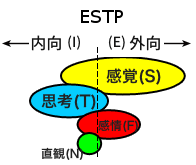
To truly understand the ESTP (Adventurer type),Psychological functions (cognitive functions)This is important ↓
- Extroverted Sensing/Se
Very good at it /First functionThey are familiar with the real physical space ("what is happening right now") and possess high spatial awareness. - Introverted Thinking/Ti
I'm a little good at it /second function: They are responsible for verifying the facts, determining whether statements and findings make logical sense, and what is true or false. - Extraverted Feeling/Fe
I'm not very good at it.Third functionThey want to make people happy and feel positive. When that's not the case, it tends to turn into insults, sarcasm, and imposing a sense of superiority. - Introverted Sensing/Ni
I'm really bad at it /Fourth functionThey feel anxious and fearful because they don't know what will happen in the future. They are unable to (or do not like) making long-term predictions.
<The cognitive axis of ESTP>
By reading the roadmap below, you can learn about cognitive functions and understand ESTP in a logical order ↓
- Roadmap – ESTP (Entrepreneur-Adventurer Type) –
- Introduction – What is MBTI?
- Summary of my personality
- Cognition is
- Type-specific cognitive characteristics
- Four personality indicators (psychological tendency axes)
- Conflicts over personality indicators
- “The meaning of the four letters "ESTP"
- First character:Introvert (type I) or extrovert (type E)
- Second character:Intuitive type (N type) or Sensing type (S type)
- Third character:Feeling type (F type) or thinking type (T type)
- 4th character:Perceiving type (P type) or Judging type (J type)
- About psychological functions (cognitive functions)
- What are psychological functions (cognitive functions)?
- The eight psychological functions (cognitive functions)
- Decision-making (judgment) function
- Information gathering (perceptual) function
- Understanding your own psychological functions (cognitive functions)
- The developmental process of psychological functions (cognitive functions)
- Psychological functions (cognitive functions) of ESTPs
- First function:Extroverted Sensing (Se)
- Second function:Introverted Thinking (Ti)
- Third function:Extraverted Feeling (Fe)
- Fourth function:Introverted Intuition (Ni)
- Making good use of psychological functions (cognitive functions)
- Strengths and weaknesses of ESTPs
- Make the most of your strengths
- Reasons for focusing too much on the advantages
- How to improve your weaknesses
- If you are alone
- In a team setting: Have others compensate for your weaknesses (fourth function).
ESTP (Entrepreneur-Adventurer Type) - A Comprehensive Guide to Links
- Explanation of ESTP
- ESTP personality
- ESTP Personality Traits 02
- ESTP hobbies
- Things that ESTPs dislike
- Strengths and weaknesses of ESTPs
- Suitable occupations for ESTPs
- ESTP leadership
- Compatibility between ESTP and other types
- ESTP Relationships and Romance
- ESTP's Decision-Making Methods
- How ESTPs set goals and gather information.
- ESTP parent-child relationships
- For ESTPs to succeed
- ESTP psychological functions
- “The meaning of the four letters "ESTP"
- Psychological functions (cognitive functions) of ESTPs
- Integration of the second and third functions of ESTP
- The difference between extroverted thinking (Te) and introverted thinking (Ti)
- The difference between introverted thinking (Ti) and extroverted thinking (Te) [Part 2]
- EP Type: A curious challenger
↑Click to open↑

comment