

A personality test that classifies people into 16 personality types.MBTIThere is such a thing, and it has a reputation for being very accurate.

This article will cover the following 16 types.Psychologist type (INFP) I will explain the personality traits of [this person/character].
youINFP (Mediator = Psychologist type)Then
Share it on social media (tweet it) and let your followers know!
↓↓↓Share on social media (tweet)↓↓↓
↑↑↑Share on social media (tweet)↑↑↑


Parent-child relationships for INFP (Psychologist type)
INFPThe parent of the type carefully considers and decides on a few things that are important.
As long as the child respects it, be generous and allow them to do what they want.
INFPParents of this type generally adopt an attitude of actively accepting their children, so children tend to see their parents as friends they can confide in about anything.
INFPIf there is a weakness in the parent of this type,IIt is the surface of the mold.
Even though I recognize my child's good points, I'm hesitant to praise them openly.
INFPChildren of this type often feign a carefree personality, so others perceive them as carefree.
They like to please their parents and crave praise. Generally, they are kind to those around them, sensitive to other people's feelings, and will listen to others even at their own expense.
When such self-sacrifice is not appreciated, or even criticized, they become sulky and take the other person's words more personally than necessary.
He's a good student at school and tries hard to get on the teachers' good side, so he gets good grades.
However, beneath the mask of being a good child, there is always self-doubt and self-criticism. Even when told "you did well," they believe that only they know their true abilities and blame themselves for not being perfect yet.
They repeatedly struggle between self-praise and self-deprecation, and ultimately tend to underestimate themselves.
Characteristics of INFP (Psychologist Type) Parents – Idealistic Parents
INFP parents enjoy instilling their beliefs in their children. They strive to create a warm and open environment for their children to grow. However, INFPs may be too passive as parents and may not be able to discipline properly. In fact, they may even resort to passive-aggressive behavior* when their children misbehave. But generally, they want their children to reach their full potential and become compassionate and moral individuals. They have a natural protective instinct and want their children to grow up freely. This type of parent often creates a warm and loving environment.
*《Psychiatry》 Passive Aggression ◆ A personality defect in which aggression is shown through behaviors such as not engaging in problem-solving, becoming stubborn, or deliberately making things inefficient.
reference Characteristics of 16 types of parents
For those who want to learn more about INFP (psychologist type) (including compatibility, etc.)
For more information, please see below.Highly recommended (click to open) ↓
Compatibility: You can learn about compatibility and how to interact with other types.
RoadmapYou can learn about personality types and personality theories (MBTI) in a systematic way, from basic to specialized.
Related articlesLearn about the characteristics of each type (take a look at the parts that interest you)
Compatibility between INFP (Psychologist type) and other types (click to show)
Ideal compatibility type pair
INFPs are most compatible with people who respect each individual's values.
From an INFP's perspective...
- ISFP (Artist type):Fi – SeThey respect my feelings just as they are.
- INTP (Researcher Type):Ti – NeThey can discuss their ideas and exchange information.
- INFJ (Empathy Type):Ni – Fe, give personal advice
Type pairs that are prone to conflict
INFPs tend to clash with pushy types who don't respect individual values and exert psychological pressure.
From an INFP's perspective...
- ESTJ (Responsible type):Te – SiThey criticize while trying to control you.
- ESFJ (Sociable Type):Fe – SiSometimes they are too meddlesome.
- ENTJ (Leader type):Te – NiHe is very logical, meticulous, and rational, but his demands are intense, making him difficult to be around.
Romantic compatibility type pair
INFPs are most compatible in romantic relationships with people with whom they can easily discuss opinions and who can complement their weaknesses and shortcomings.
Similar to friendships, INFPs can sometimes struggle to get close to potential romantic partners. Once a relationship is established, they are fiercely loyal. However, their romantic views on love can be overly idealistic, leading them to have excessively high expectations of their partner, which can be difficult for the other person to handle. They also tend to take things personally and try to avoid conflict.
From an INFP's perspective...
- ENFP (Reformer type):Ne – Fi, respecting each individual and being able to have productive discussions
- ESTJ (Responsible type):Te – SiIt provides a sense of long-term security.
- ISTJ (Hardworking Type):Si – TeIt allows you to build a stable relationship, and you can trust and feel at ease.
*The pairs that tend to clash and the pairs that have good romantic compatibility may overlap. This is because while people may dislike those who are the complete opposite of themselves due to disagreements, they may also be attracted to those who appear mysterious because they are different. However, it seems that these relationships often end up breaking down.
(Advice for those dating an INFP)
If your partner is an INFP, keep in mind that you may have difficulty getting them to open up, they can be overly sensitive to criticism, and they may prioritize your happiness over their own.
INFP (Psychologist Type) Roadmap (Click to open)
To truly understand the INFP (Psychologist type),Psychological functions (cognitive functions)* is important ↓
*Generally in cognitive science,Cognitive functions「The function by which living organisms actively collect external information, perceive and remember it, and then process it by adding reasoning and judgment in order to acquire knowledge about their subject.It is defined as "
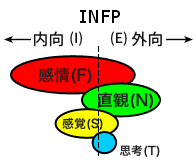
- Introverted Feeling/Fi
Very good at it /First function: Decide what you believe is right for you, what is morally right within your worldview, and what you should do according to your personal values. - Extroverted Intuition/Ne
I'm a little good at it /second functionIt reveals the negative consequences of current actions, future outcomes, and the intentions behind people's actions. - Introverted Sensing/Si
I'm not very good at it.Third functionThey use past experiences to justify their current attitudes. They may also become risk-averse and unable to leave their comfort zone. - Extraverted Thinking/Te
I'm really bad at it /Fourth functionThey fear and worry about what others think of them. They are unable (or unwilling) to organize their thoughts rationally and logically.
<INFP's Cognitive Framework>
By reading the roadmap below, you can learn about cognitive functions and gain a systematic understanding of INFPs ↓
- Roadmap – INFP (Mediator = Psychologist) type –
- Introduction – What is MBTI?
- Summary of my personality
- Cognition is
- Type-specific cognitive characteristics
- Four personality indicators (psychological tendency axes)
- Conflicts over personality indicators
- “The meaning of the four letters "INFP"
- First character:Introvert (type I) or extrovert (type E)
- Second character:Intuitive type (N type) or Sensing type (S type)
- Third character:Feeling type (F type) or thinking type (T type)
- 4th character:Perceiving type (P type) or Judging type (J type)
- About psychological functions (cognitive functions)
- What are psychological functions (cognitive functions)?
- The eight psychological functions (cognitive functions)
- Decision-making (judgment) function
- Information gathering (perceptual) function
- Understanding your own psychological functions (cognitive functions)
- The developmental process of psychological functions (cognitive functions)
- The psychological functions (cognitive functions) of INFPs
- First function:Introverted Feeling (Fi)
- Second function:Extroverted Intuition (Ne)
- Third function:Introverted Sensing (Si)
- Fourth function:Extraverted Thinking (Te)
- Making good use of psychological functions (cognitive functions)
- The strengths and weaknesses of INFPs
- Make the most of your strengths
- Reasons for focusing too much on the advantages
- How to improve your weaknesses
- If you are alone
- In a team setting: Have others compensate for your weaknesses (fourth function).
INFP (Mediator = Psychologist Type) – A Comprehensive Link Guide
- INFP Explanation
- INFP Personality Trait 01
- INFP Personality Traits 02
- INFP Personality Trait 03
- INFP's hobbies
- Things that INFPs dislike
- The strengths and weaknesses of INFPs
- Suitable occupations for INFPs
- INFP leadership
- Compatibility between INFP and other personality types
- INFP Relationships and Romance
- How INFPs can grow and achieve their dreams
- How INFPs set goals and gather information
- INFP's Decision-Making Methods
- INFP parent-child relationships
- For INFPs to succeed
- INFP psychological function
- “The meaning of the four letters "INFP"
- The psychological functions (cognitive functions) of INFPs
- The integration of the second and third functions of the INFP (Psychologist type)
- The difference between introverted feeling (Fi) and extroverted feeling (Fe)
- The difference between extroverted thinking (Te) and introverted feeling (Fi)
- IP Type: People who develop through self-discipline
↑Click to open↑
youINFP (Mediator = Psychologist type)Then
Share it on social media (tweet it) and let your followers know!
↓↓↓Share on social media (tweet)↓↓↓
↑↑↑Share on social media (tweet)↑↑↑

comment