
On this page, we will discuss the 16 personality types,INTP (Logician/Researcher Type)This article explains their personality, characteristics, values, and views on love.
youINTP (Logician/Researcher Type)Then
Share it on social media (tweet it) and let your followers know!
↓↓↓Share on social media (tweet)↓↓↓
↑↑↑Share on social media (tweet)↑↑↑
Classifying personalities into 16 types16-Type Personality TestCheck which type you are using the following↓↓

↑16-Type Personality Test↑
↑Diagnose↑
Your 16-type personality test result is...
"INTP type (Researcher type)"
Detailed diagnosis results ↓
"They may seem a little distant, aloof, and even materialistic, but you'll likely find them intriguing. As the conversation progresses, that intrigue will turn into attraction."
I'm not very good at small talk, but I like to talk and discuss most things."
Let's get straight to your diagnosis results.
Share it on social media (tweet it) and let your followers know!
↓↓↓Share on social media (tweet)↓↓↓
↑↑↑Share on social media (tweet)↑↑↑
Your type,INTP (Researcher Type)This explains their personality, characteristics, values, and views on love.


- INTP (Logician/Researcher Type) Character
- Personality traits of INTPs (Logician/Researcher type)
- INTP's hobbies and interests
- How common is INTP?
- “What do the letters "INTP" stand for?
- Interesting facts about INTPs
- Further characteristics of the INTP (Logician/Researcher type) and compatibility with other types
- Famous INTP (Logician/Researcher) type people and their personalities
- INTP values and motivations
- Similar types to INTPs
- INTP Instruction Manual
INTP (Logician/Researcher Type) Character
first,INTP (Logician/Researcher Type)To give you a sense of what kind of type it is,INTPLet me introduce the characters.

The characters and people are actually INTPs, although the letters are incorrectly written as ENTP.
↓↓
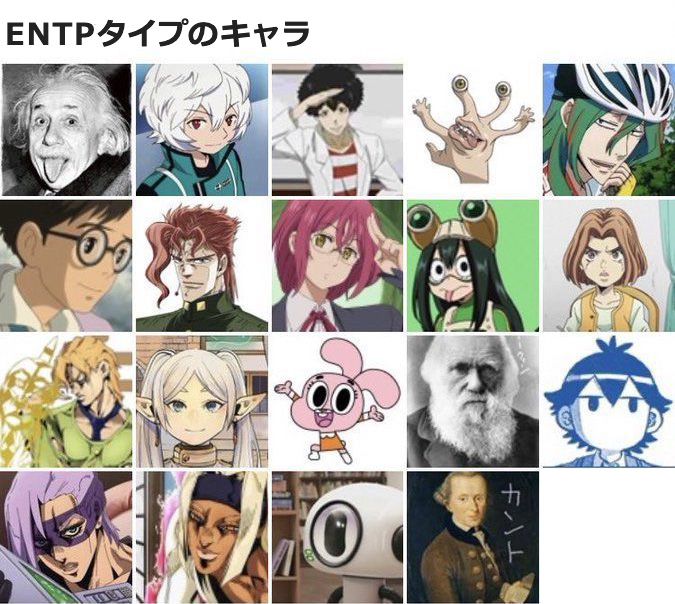
Famous anime characters from Dragon Ball, Studio Ghibli, and more are categorized into 16 personality types!
Let's get a feel for the unique atmosphere of each type ↓
Great figures with the INTP (Logician/Researcher type) personalityClick here ↓


Here is a collection of famous quotes from great figures and celebrities categorized by their 16 personality types.
↓
Personality traits of INTPs (Logician/Researcher type)
INTP (Researcher Type)He is a philosophical innovator fascinated by logical analysis, systems, and design. He immerses himself in theory, seeking the universal laws that underlie everything he sees. He desires to understand the unifying themes of life.
INTPs are independent, analytical observers who become so deeply engrossed in their thoughts that they may seem unaware of the world around them. They spend a great deal of time focused inward, exploring concepts, making connections, and seeking understanding. For INTPs, life is a continuous quest to unravel the mysteries of the universe.
INTPs often become absorbed in their own thoughts, which can make them appear unconventional and unconventional to others.
I am introverted and naturally my interest is drawn to my inner thoughts.Reference links Introvert/I typeAlthough their minds are working very actively, they tend to neglect external details such as appropriate clothing and home decor.
He seems to find small talk and casual conversation tedious, but when it comes to science, mathematics, computers, or grand theoretical topics related to the universe, he suddenly becomes passionate and enthusiastic.
INTPs are often more interested in the theoretical frameworks behind reality than in reality itself.
Furthermore, they are an intelligent type who speaks and uses words precisely on a daily basis, carefully choosing their words to explain their complex thoughts. They readily point out inconsistencies in other people's ideas and theories, and demand intellectual rigor even in casual conversations.
INTPs tend to verify and confirm whether the values, beliefs, and perspectives that people cherish are logically correct, which may sometimes make the person being verified uncomfortable.
For INTPs, who are interested in pursuing logical order and analyzing things through reasoning, social niceties and being good at getting along with people are not important and seem irrelevant.
Strong Points
- The ability to think about things logically and objectively.
- I am good at abstract thinking.
- Having autonomy
- Loyal and loving towards those they cherish
Disadvantages
- (From the perspective of others) they can seem unapproachable.
- They can be insensitive and lack consideration.
- I lack self-confidence and am prone to self-doubt.
- I have trouble following the rules.
- I have difficulty expressing my emotions.
INTP's hobbies and interests
Reading, art, cultural events, chess and other strategic games, writing, hobbies, computers (PC), backpacking, hiking, meditation, etc.
How common is INTP?
INTPs are one of the less common personality types, especially among women. They are the fourth rarest personality type in women.
- 3% of the general population
- Male 5%
- Female 2%
youINTP (Logician/Researcher Type)Then
Share it on social media (tweet it) and let your followers know!
↓↓↓Share on social media (tweet)↓↓↓
↑↑↑Share on social media (tweet)↑↑↑
“What do the letters "INTP" stand for?
INTP is an acronym used to describe one of the 16 personality types created by Catherine Briggs and Isabel Myers.Introverted、Intuition、Thinking、PerceivingIt is an abbreviation for INTP, which means someone who feels better when they spend time alone.Introversion – I), a person who focuses on ideas and concepts rather than facts and details (Intuition - N), a person who makes decisions based on logic and reason (Thinking – T), a person who prefers to be spontaneous and flexible rather than planned and organized.Perception – PThis refers to an INTP. INTPs are sometimes called designers because they can intuitively understand complex systems.
Interesting facts about INTPs
- On a personality trait scale, they are described as frank, original, complex, independent, and rebellious.
- More likely to learn a foreign language than other types
- The most common type of alcohol and drug abuser among university students.
- One of the types of people least likely to believe in spirituality
- Highest level of career dissatisfaction
- At school, I get lower grades than predicted by my aptitude scores.
- More likely than average to take an engineering program.
- Personal values include autonomy, freedom, and independence.
- Common among current MBA students
- Commonly seen in science and technology professions.
Further characteristics of the INTP (Logician/Researcher type) and compatibility with other types
- INTP Personality Traits 02
- INTP Personality Trait 03
- INTP's hobbies
- Advantages and disadvantages of INTPs
- Things that INTPs dislike
- Suitable occupations for INTPs
- INTP leadership
- Compatibility between INTPs and other personality types
- INTP Relationships and Romance
- How INTPs Set Goals and Gather Information
- INTP parent-child relationships
- For INTP to succeed
↓Learn more↓
INTP (Logician/Researcher Type) and Compatibility Chart and Advice for Other Types
Ideal compatibility type pair
INTPs are compatible with people who understand their own arguments and can engage in logical discussions and debates.
From an INTP's perspective...
- INTJ (Strategist type) :Ni – TeThey can exchange information and share ideas.
- ISTP (Practitioner type):Ti – Se, it is possible to exchange specialized information.
Type pairs that are prone to conflict
INTPs tend to clash with people who attack them simply because their thoughts or positions differ from their own, or those who are largely incapable of logical reasoning.
From an INTP's perspective...
- ESFJ (Sociable Type):Fe – SiThey can be illogical and pushy.
- ESTJ (Responsible type):Te – SiThey are negative towards new ideas, controlling, and try to control you.
Romantic compatibility type pair
INTPs are most compatible in romantic relationships with partners with whom they can share ideas and create exciting experiences, as well as partners who can complement their weaknesses.
From an INTP's perspective...
- ENFJ (Collaborator Type):Fe – NiThey are responsible and listen attentively.
- ENFP (Reformer type):Ne – FiWe can share ideas and introduce each other to friends and communities.
- ESTJ (Responsible type):Te – SiThey think about my future stability and give me peace of mind.
- ESFJ:Fe – SiIt compensates for weaknesses and improves the stability of life.
*The pairs that tend to clash and the pairs that have good romantic compatibility may overlap. This is because while people may dislike those who are the complete opposite of themselves due to disagreements, they may also be attracted to those who appear mysterious because they are different. However, it seems that these relationships often end up breaking down.
(Advice for those dating an INTP)
INTPs often become engrossed in thinking things through on their own, which can make them difficult to get close to. In relationships, they tend to remain silent and not take action until they feel the other person is worthy of hearing their deepest feelings.
One thing to remember is that INTPs enjoy relationships based on deep mutual affection, but they don't play games. INTPs are not good at reading other people's feelings, so in this regard, you may need to be direct about what you need and want. Also, INTPs are not good at expressing their own thoughts and feelings, so you may need to pay attention to the subtle signals they give you.
A collection of links explaining the psychological functions of INTPs (Logician/Researcher type) (for those who want to understand how the mind works)
Reading the following roadmap from top to bottom will help you understand the INTP mindset in a logical order ↓
- Roadmap – INTP (Researcher Type) –
- Introduction – What is MBTI?
- Summary of my personality
- Cognition is
- Type-specific cognitive characteristics
- Four personality indicators (psychological tendency axes)
- Conflicts over personality indicators
- “The meaning of the four letters "INTP"
- First character:Introvert (type I) or extrovert (type E)
- Second character:Intuitive type (N type) or Sensing type (S type)
- Third character:Feeling type (F type) or thinking type (T type)
- 4th character:Perceiving type (P type) or Judging type (J type)
- About psychological functions (cognitive functions)
- What are psychological functions (cognitive functions)?
- The eight psychological functions (cognitive functions)
- Decision-making (judgment) function
- Information gathering (perceptual) function
- Understanding your own psychological functions (cognitive functions)
- The developmental process of psychological functions (cognitive functions)
- INTP's psychological functions (cognitive functions)
- First function:Introverted Thinking (Ti)
- Second function:Extroverted Intuition (Ne)
- Third function:内向Sense of sensation (Si)
- Fourth function:Extraverted Feeling (Fe)
- Making good use of psychological functions (cognitive functions)
- Advantages and disadvantages of INTPs
- Make the most of your strengths
- Reasons for focusing too much on the advantages
- How to improve your weaknesses
- If you are alone
- In a team setting: Have others compensate for your weaknesses (fourth function).
To truly understand INTPs (Logician/Researcher types),Psychological functions (cognitive functions)This is important ↓
List of related articles about INTP (Logician/Researcher type)
- INTP psychological functions
- “The meaning of the four letters "INTP"
- INTP's psychological functions (cognitive functions)
- Integration of INTP's second and third functions
- The difference between extroverted thinking (Te) and introverted thinking (Ti)
- The difference between introverted thinking (Ti) and extroverted thinking (Te) [Part 2]
- IP Type: People who develop through self-discipline
- Comparison with other types
↑Learn more↑
Famous INTP (Logician/Researcher) type people and their personalities
Famous INTPs include the following notable figures and characters (estimated by the author):
- Einstein (scientist)
- Hiroyuki (founder of 2channel)
- Nobuo Ikeda (Economist)
- Yukihiro Matsumoto (developer of the programming language "Ruby")
- Dwight D. Eisenhower (President of the United States)
- L (Death Note)
- Ray (The Promised Neverland)
- Killua (HUNTER×HUNTER)
- Shikamaru (NARUTO)
- Jin (BTS)
- Nico Robin (One Piece)
- Yoda (Star Wars)
- Kant (philosopher)
- Neo (The Matrix)
- Marie Curie (scientist)
- Adam Smith (economist)
- Lewis Carroll (author)
- Gauss (mathematician)
- Deng Xiaoping (politician)
(Estimated by the author)
↓Hiroyuki
This article explains, from an economic perspective, why American movies often feature divorced couples reconciling in the end. The fact that it's an analysis without any emotional involvement is typical of an INTP.
↓Nobuo Ikeda
They are criticizing by citing fundamental principles.
Also, if we classify model Karen Takizawa using her MBTI type...Researcher type (INTP)There is a possibility that this is the case.Researcher type (INTP)teeth,The most intelligent type among all types.It is said that...
Another example is L from the manga "Death Note," who is also an INTP type. His exceptional ability to deduce things is a prime example of his INTP characteristics.
INTP values and motivations
While INTPs may appear cool and collected at first glance, they actually possess a passionate drive to pursue innovative and groundbreaking ideas. Rational and analytical, they strive to create a mental framework for unifying and understanding the principles and rules they observe around them. When faced with an interesting and intriguing problem, their minds become highly active, and they will go to great lengths to find a solution.
INTPs are typical "unconventional types" who are not bound by conventional methods, common sense, or traditions. They often prefer to think in their own way rather than conforming to the majority.
INTPs are typical "unconventional types" who are not bound by conventional methods or common sense. Rather than conforming to the majority, they often think and act independently.
When this type questions someone else's assumptions or things that have long been considered true, they will relentlessly try to refute them, regardless of whether everyone else takes it for granted. When an INTP analyzes someone's way of thinking or beliefs, they will not compromise at all, and there are no sacred cows that they will deliberately avoid intruding upon.
Therefore, I am very confused and bewildered by people who think in a way that is not logical.
youINTP (Logician/Researcher Type)Then
Share it on social media (tweet it) and let your followers know!
↓↓↓Share on social media (tweet)↓↓↓
↑↑↑Share on social media (tweet)↑↑↑
Similar types to INTPs
- ENTP: E (extrovert) and I (introvert) But they are different.
- ISTP: N (Intuitive type) and S (Sensing type) But they are different.
- INFP: T (thinking type) and F (feeling type) But they are different.
- INTJ: J (Judgment type) and P (Perception type) But they are different.
If you're not confident that you're an INTP, you might be one of the four types mentioned above. Read the article or take some time to think about it again.diagnosisLet's try it.
INTP Instruction Manual
If your friends, colleagues, or family members are INTPs, there are things you can do to communicate with them more effectively and deepen your relationships with them.
*If you are an INTP, showing this guide to your friends and family may help improve your relationships.
To build good friendships
Sharing common interests is a great way to build friendships with INTPs. INTPs tend to value intellect above all else, and it can take them a long time to form close relationships. As a result, their friendships can sometimes be superficial, but once an INTP becomes friends with someone, they tend to become very close. Remember that while an INTP friend may not be good at dealing with pent-up emotions, they enjoy deepening their bond by having deep conversations about things you're both passionate about.
Learn more ↓
- Relationships and romance for INTPs (Researcher type)
- How extroverts (Type E) and introverts (Type I) can get along well
- How Sensing types (S type) and Intuitive types (N type) can get along well
- How Thinking (T-type) and Feeling (F-type) People Can Get Along Well
- How to get along well with Judging type (J type) and Perceiving type (P type)
To build a good parent-child relationship
If your child is an INTP, it's important to remember that they may respond better to logical and reasoned approaches than emotional ones. While stimulating their intellectual curiosity is crucial, also find an environment where they can develop friendships with other children. Your child may struggle to make friends, but simply exposing them to other children with similar hobbies or interests can be very beneficial.
Learn more ↓
- Parent-child relationships of INTPs (Researcher Type)
- Parent-child relationships between extroverts (Type E) and introverts (Type I)
- Parent-child relationships between sensing types (S-type) and intuitive types (N-type)
- Parent-child relationships between thinking types (T-type) and feeling types (F-type)
- Parent-child relationships between judging types (J type) and perceiving types (P type)
List of 16 Personality Types
A Collection of Information on the 16 Personality Types – The Little-Known Truths of Each Type (Summary, Illustrations, and Analysis)
- Summary of 16 Personality Type Test Websites
- List of articles categorized by personality type (16 types)
- Compatibility chart for 16 personality types
- Suitable occupations, ideal jobs, and dream jobs for each of the 16 personality types
- Nicknames (names) for each of the 16 personality types
- What if there were a country with 16 personality types...?
- The relationship between national characteristics around the world and the 16 personality types
- List of 16 Personality Types Based on Famous Characters
- Detective Conan: A Summary of 16 Personality Types for Each Character
- Percentage of 16 personality types
- Reactions of 16 Personality Types – Heaven and Hell
- To describe the 16 personality types in one word:
- 16 Simple Explanations of Personality Types
- 16 Personality Types: Strengths, Weaknesses, and Ways to Improve Weaknesses
- 16 Personality Types: Preferences and Strengths/Weaknesses in Majors and Subjects
- 16 Personality Types: How to Enjoy Life to the Fullest…?
- 16 Personality Types: Inspiring Quotes from Great Figures
- What if each of the 16 personality types were a murderer?
- How to become an attractive husband or wife based on your personality type (16 types)
- What 16 personality types do after a breakup
- Reasons for fighting according to 16 personality types
- Income by 16 Personality Types - Misconceptions and Truths -
- Characteristics of employees based on 16 personality types
- Potential pathological tendencies of 16 personality types
- Psychological Functions of 16 Personality Types Based on Statistics
- Viewing percentage of the detailed personality pages for each of the 16 personality types
- Summary of the characteristics of the 16 personality types
- 8 psychological functions: "What if I did...?"
- Approaches to tasks based on psychological function: Intuitive (N-type) & Sensing (S-type)
- Social interaction explained by psychological functions
- Understanding Your Financial Habits Through Psychological Functions – Are You a Saver or a Spender?
- Humor (sense of humor) as revealed by psychological functions
- How extroverts (Type E) and introverts (Type I) can get along well
- How Sensing types (S type) and Intuitive types (N type) can get along well
- How Thinking (T-type) and Feeling (F-type) People Can Get Along Well
- How to get along well with Judging (J-type) and Perceiving (P-type) types
- Characteristics of parents with 16 personality types
- Parent-child relationships between extroverts (Type E) and introverts (Type I)
- Parent-child relationships between sensing types (S-type) and intuitive types (N-type)
- Parent-child relationships between thinking types (T-type) and feeling types (F-type)
- Parent-child relationships between judging (J-type) and percepting (P-type) types
- How to identify your partner's personality type: [16 Personality Types]


comment