
Classifying personalities into 16 types16-Type Personality TestCheck which type you are using the following↓↓

↑16-Type Personality Test↑
↑Diagnose↑
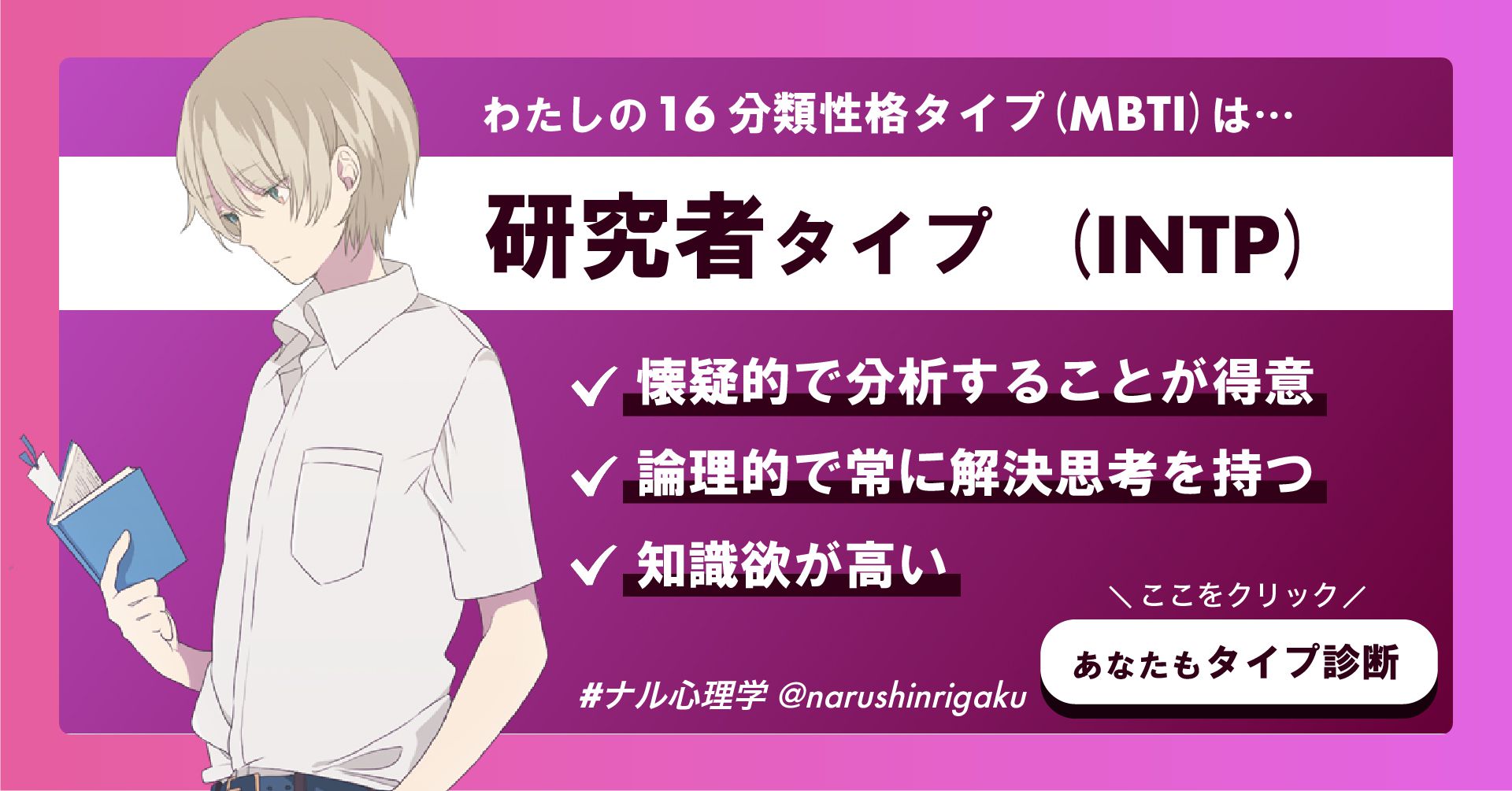
This article will cover the following 16 types.This explains the personality traits of the Researcher type (INTP).
youINTP (Logician/Researcher Type)Then
Share it on social media (tweet it) and let your followers know!
↓↓↓Share on social media (tweet)↓↓↓
↑↑↑Share on social media (tweet)↑↑↑


INTP (Researcher Type) Personality Trait: "They like to solve problems."
INTPs are the epitome of a thoughtful, absent-minded university professor.
Think carefully in your mind (Introvert/I) and,Intuitive type (Type N)When different types of imagination come together, we come up with a variety of possibilities. Objective (Thought/T)Therefore, we analyze that new data and have unlimited flexibility (Perception/PTherefore, they readily incorporate any data. They try to create a complete picture by bringing together various pieces of information such as papers, drawings, plans, proposals, and theories, but they are always discovering new data, and this type of person's complete picture keeps expanding. As a result, no matter how final their ideas, concepts, or plans may seem, they will change them at the last minute if they come across "new data." This is exciting and fun for INTPs, but for others, especially,Judgment type (J type)It's frustrating.
INTPs, no matter how perfect they may appear, are never satisfied and become their own biggest critics, constantly looking for flaws. When their desire to be perfect, competent, and outstanding becomes extreme, it can become a burden, leading to frustration and self-blame.
Conflict arises when an INTP is a woman. This is because the image of a thoughtful university professor has traditionally been more of a male image than a female one, and the "argumentative" quality of digging into conclusions with one's head is often overlooked in men but not so much in women. This leads to at least three problems.
Firstly, women have historically not been seen as having the ability to plan things outside of home and family matters. For INTPs, the natural desire to "make life conform to a logical plan" directly contradicts traditional female roles.
Secondly, original thinking is not traditionally seen as a feminine trait. For example, when asked about time, an INTP might talk about the philosophical meaning of time. While such eccentricities might be seen in men as a sign of being overly intelligent, in women, they are labeled as "insensitive," or even worse, "dull-witted," which is the complete opposite of the INTP's true nature.
Thirdly, the T-shaped aspect manifests in a way that contradicts the traditional image of women as "obedient, gentle, and considerate." When an INTP woman expresses her emotions outwardly, it can sometimes be (Thought/T(As is common with this type of personality) they tend to be too straightforward in their expressions, which can sometimes shock others.
For those who want to learn more about INTPs (researcher type) (compatibility, etc.)
For more information, please see below.Highly recommended (click to open) ↓
Compatibility: You can learn about compatibility and how to interact with other types.
RoadmapYou can learn about personality types and personality theories (MBTI) in a systematic way, from basic to specialized.
Related articlesLearn about the characteristics of each type (take a look at the parts that interest you)
Compatibility between INTPs and other personality types (click to view)
Ideal compatibility type pair
INTPs are compatible with people who understand their own arguments and can engage in logical discussions and debates.
From an INTP's perspective...
- INTJ (Strategist type) :Ni – TeThey can exchange information and share ideas.
- ISTP (Practitioner type):Ti – Se, it is possible to exchange specialized information.
Type pairs that are prone to conflict
INTPs tend to clash with people who attack them simply because their thoughts or positions differ from their own, or those who are largely incapable of logical reasoning.
From an INTP's perspective...
- ESFJ (Sociable Type):Fe – SiThey can be illogical and pushy.
- ESTJ (Responsible type):Te – SiThey are negative towards new ideas, controlling, and try to control you.
Romantic compatibility type pair
INTPs are most compatible in romantic relationships with partners with whom they can share ideas and create exciting experiences, as well as partners who can complement their weaknesses.
From an INTP's perspective...
- ENFJ (Collaborator Type):Fe – NiThey are responsible and listen attentively.
- ENFP (Reformer type):Ne – FiWe can share ideas and introduce each other to friends and communities.
- ESTJ (Responsible type):Te – SiThey think about my future stability and give me peace of mind.
- ESFJ:Fe – SiIt compensates for weaknesses and improves the stability of life.
*The pairs that tend to clash and the pairs that have good romantic compatibility may overlap. This is because while people may dislike those who are the complete opposite of themselves due to disagreements, they may also be attracted to those who appear mysterious because they are different. However, it seems that these relationships often end up breaking down.
(Advice for those dating an INTP)
INTPs often become engrossed in thinking things through on their own, which can make them difficult to get close to. In relationships, they tend to remain silent and not take action until they feel the other person is worthy of hearing their deepest feelings.
One thing to remember is that INTPs enjoy relationships based on deep mutual affection, but they don't play games. INTPs are not good at reading other people's feelings, so in this regard, you may need to be direct about what you need and want. Also, INTPs are not good at expressing their own thoughts and feelings, so you may need to pay attention to the subtle signals they give you.
INTP (Researcher Type) Roadmap (Click to open)
To truly understand INTP (Researcher Type),Psychological functions (cognitive functions)This is important ↓
By reading the roadmap below, you can learn about cognitive functions and gain a systematic understanding of INTPs ↓
- Roadmap – INTP (Researcher Type) –
- Introduction – What is MBTI?
- Summary of my personality
- Cognition is
- Type-specific cognitive characteristics
- Four personality indicators (psychological tendency axes)
- Conflicts over personality indicators
- “The meaning of the four letters "INTP"
- First character:Introvert (type I) or extrovert (type E)
- Second character:Intuitive type (N type) or Sensing type (S type)
- Third character:Feeling type (F type) or thinking type (T type)
- 4th character:Perceiving type (P type) or Judging type (J type)
- About psychological functions (cognitive functions)
- What are psychological functions (cognitive functions)?
- The eight psychological functions (cognitive functions)
- Decision-making (judgment) function
- Information gathering (perceptual) function
- Understanding your own psychological functions (cognitive functions)
- The developmental process of psychological functions (cognitive functions)
- INTP's psychological functions (cognitive functions)
- First function:Introverted Thinking (Ti)
- Second function:Extroverted Intuition (Ne)
- Third function:内向Sense of sensation (Si)
- Fourth function:Extraverted Feeling (Fe)
- Making good use of psychological functions (cognitive functions)
- Advantages and disadvantages of INTPs
- Make the most of your strengths
- Reasons for focusing too much on the advantages
- How to improve your weaknesses
- If you are alone
- In a team setting: Have others compensate for your weaknesses (fourth function).
INTP (Logician/Researcher Type) – A Comprehensive Guide with Links
- INTP explanation
- INTP psychological functions
- “The meaning of the four letters "INTP"
- INTP's psychological functions (cognitive functions)
- Integration of INTP's second and third functions
- The difference between extroverted thinking (Te) and introverted thinking (Ti)
- The difference between introverted thinking (Ti) and extroverted thinking (Te) [Part 2]
- IP Type: People who develop through self-discipline
- Comparison with other types
↑Click to open↑
youINTP (Logician/Researcher Type)Then
Share it on social media (tweet it) and let your followers know!
↓↓↓Share on social media (tweet)↓↓↓
↑↑↑Share on social media (tweet)↑↑↑

comment