

Overseas website http://www.personalitymax.com Since the information provided included data on the population ratio of each type, I used that as a basis to calculate which psychological functions are most commonly used overall, taking into account gender differences.
This is data from overseas, so the situation in Japan might be slightly different, but the qualitative trends may be the same.
First, here is the information that was posted on the aforementioned website.
| type | Male % | Female % | Overall percentage: % | |
|---|---|---|---|---|
| INTP | 4 | 1 | 2.5 | |
| INTJ | 2.5 | 0.5 | 1.5 | |
| ENTP | 6 | 3 | 4.5 | |
| ENTJ | 5.5 | 2.5 | 4 | |
| INFP | 1.5 | 2.5 | 2 | |
| INFJ | 0.5 | 1.5 | 1 | |
| ENFP | 6 | 8 | 7 | |
| ENFJ | 2.5 | 5.5 | 4 | |
| ISFP | 5 | 7 | 6 | |
| ISTP | 8.5 | 3.5 | 6 | |
| ESFP | 8 | 14 | 11 | |
| ESTP | 12.5 | 7.5 | 10 | |
| ISFJ | 4 | 10 | 7 | |
| ISTJ | 10.5 | 6.5 | 8.5 | |
| ESFJ | 7 | 17 | 12 | |
| ESTJ | 16 | 10 | 13 |
| type | Male % | Female % | Total % | |
|---|---|---|---|---|
| SJ | 37.5 | 43.5 | 40.5 | |
| SP | 34 | 32 | 33 | |
| NF | 10.5 | 17.5 | 14 | |
| Windows | 18 | 7 | 12.5 |
There are few NT women and few NF men.
What you'll notice here is that, no matter which type you look at, "there are more men when it's T, and more women when it's F."
Based on this data, I calculated the ratio of the psychological function pairs being used.
| Psychological function pairs | Male % | Female % | |
|---|---|---|---|
| NeSi | 55 | 58 | |
| TeFi | 55 | 51 | |
| Fe La | 45 | 49 | |
| NiSe | 45 | 42 |
It appears that all pairs are used in roughly equal proportions. There doesn't seem to be much difference between men and women in this regard. Women use the NeSi pair slightly more often than the NiSe pair.
Next, we calculated the population ratio of the eight types based on the dominant psychological function, and arranged them in descending order of proportion for both men and women.
First, in the case of men
| Rank | Dominant psychological function | Male % | |
|---|---|---|---|
| 1 | Te | 21.5 | |
| 2 | Se | 20.5 | |
| 3 | Si | 14.5 | |
| 4 | Ti | 12.5 | |
| 5 | Ne | 12.0 | |
| 6 | Fe | 9.5 | |
| 7 | Fi | 6.5 | |
| 8 | Ni | 3.0 |
Next, in the case of women
| Rank | Dominant psychological function | Female % | |
|---|---|---|---|
| 1 | Fe | 22.5 | |
| 2 | Se | 21.5 | |
| 3 | Si | 16.5 | |
| 4 | Te | 15.5 | |
| 5 | Ne | 11.0 | |
| 6 | Fi | 9.5 | |
| 7 | Ti | 4.5 | |
| 8 | Ni | 2.0 |
In the case of menExtraverted Thinking (Te) In first place, for women...External emotions (Fe)This came in first place.
This time, we'll take this a step further and conduct a statistical analysis by "weighting psychological functions." People use their primary function the most. On the other hand, they use their secondary, tertiary, and quaternary functions less and less in that order.
Taking this into consideration, let's perform the following calculation.
Primary psychological function 4 points
Secondary psychological function 3 points
Tertiary psychological function 2 points
Fourth psychological function 1 point
Then, the values are weighted according to the population ratio and added together.
By doing this, we can estimate how much of the psychological functions are being used overall.
First, in the case of men
| Rank | psychological function | male | |
|---|---|---|---|
| 1 | Te | 159.5 | |
| 2 | Si | 150.0 | |
| 3 | Se | 141.5 | |
| 4 | Ne | 125.0 | |
| 5 | Ti | 124.0 | |
| 6 | Fi | 115.5 | |
| 7 | Fe | 101.0 | |
| 8 | Ni | 83.5 |
Next, in the case of women
| Rank | psychological function | woman | |
|---|---|---|---|
| 1 | Si | 165.0 | |
| 2 | Fe | 150.0 | |
| 3 | Se | 135.5 | |
| 4 | Fi | 130.5 | |
| 5 | Ne | 125.0 | |
| 6 | Te | 124.5 | |
| 7 | Ti | 95.0 | |
| 8 | Ni | 74.5 |
From the above, we can see the following:
- Men are more likely toExtraverted Thinking (Te), Introverted Thinking (Ti)I often use
- Women are more likely toExternal emotions (Fe), Introverted Feeling (Fi)I often use
In other words,
The general public's image of a masculine person is either STJ type or STP type.
The general public's image of a woman is based on the SFJ or SFP personality type.
That seems likely.
Certainly, even though there is gender equality in this world
Things that are expected or permitted because you are a man
Being disappointed because he's a man...
Things that are expected or permitted because you are a woman
Being disappointed because you're a woman...
It is true that such a thing exists.
INTP (Researcher Type), ISFP (Artist type), ESFJ (Sociable Type), ENFJ (Collaborator Type) Men,INTP (Researcher Type), ISTP (Practitioner type), ENTJ (Leader type), ESTJ (Responsible type) These women may have aspects that don't align with the generally accepted image of men and women, and may experience internal conflict as a result.
As a result, men may try to develop their cognitive functions earlier, while women may try to develop their emotional functions earlier.
On the other hand, FP and FJ type women, and TJ and TP type men, will likely naturally assume those roles as there is less of a gap between their gender characteristics and their public image.
Men and women are the same human beings and are equal beings.
On the other hand, there are clearly differences in biological characteristics. This includes not only physical appearance and bodily functions, but also differences in the brain (*please note that this is merely a tendency).
However, it is also true and natural that ETJ and ITP type women and EFJ and IFP type men exist. Therefore, when looking at individuals, we should refrain from imposing general societal images or approaching them with preconceived notions.
Regarding the psychological functions of perception and information reception, both men and women,Introverted Sensing/Si, Extroverted Sensing/Se, Extroverted Intuition/Ne, Introverted Intuition/Ni In that order.
This means that Ni is being effectively utilized by only a small number of people. If we cultivate Ni and recognize diverse values, the world may change.
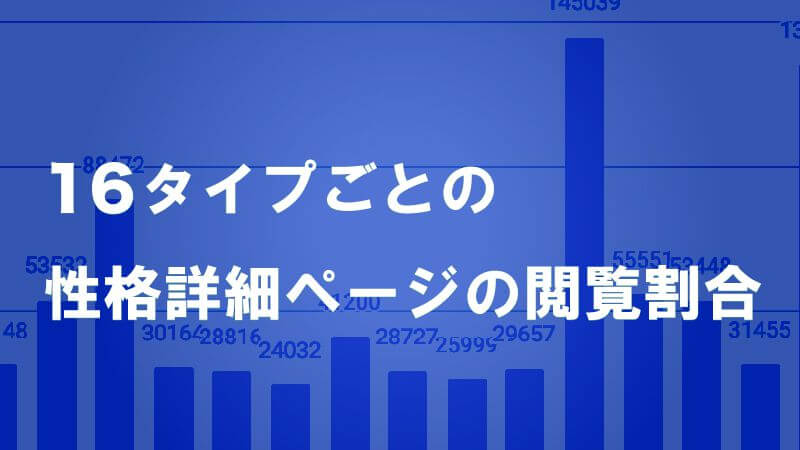
*The data compiled from the number of views of the detailed personality pages for each of the 16 personality types on this site can be found here ↓
This time, we statistically explained the first to fourth psychological functions, but the remaining fifth to eighth psychological functions are explained in the following article ↓
・Shadow Process (Shadow Function): Psychological Functions 5-8
Furthermore, the analysis was based on the axis of psychological function,cultural dimension theoryComparing this to the above will yield even more interesting insights ↓
comment