

Reference: 16 Personality Type Theory (modified)
- INFP & INFJ
- ISFP & ISFJ
- INTP & INTJ
- ISTP & ISTJ
- ENFP & ENFJ
- ESFP & ESFJ
- ENTP & ENTJ
- ESTP & ESTJ
You'll have similar interests, so you'll never be short of topics to discuss and share ideas. Initially, you won't be bothered by each other's shortcomings, and you'll feel comfortable and quickly develop a close relationship.
Although the only difference is judgment versus perception, there are no common psychological functions used by either side. Furthermore, the order in which these psychological functions are used—perception and judgment—also differs. Therefore, their ways of thinking, feeling, and perceiving are quite different. Nevertheless, when the first and second psychological functions work together in balance, their temperament and interests become quite similar.
Let's illustrate this point using the relationship between an INFP and an INFJ as an example.
- Introverted Feeling/Fi
Very good at it /First function: Decide what you believe is right for you, what is morally right within your worldview, and what you should do according to your personal values. - Extroverted Intuition/Ne
I'm a little good at it /second functionIt reveals the negative consequences of current actions, future outcomes, and the intentions behind people's actions. - Introverted Sensing/Si
I'm not very good at it.Third functionThey use past experiences to justify their current attitudes. They may also become risk-averse and unable to leave their comfort zone. - Extraverted Thinking/Te
I'm really bad at it /Fourth functionThey fear and worry about what others think of them. They are unable (or unwilling) to organize their thoughts rationally and logically.
<INFP's Cognitive Framework>
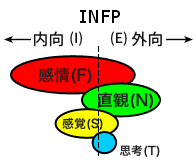
Introverted psychological functions work slowly and steadily within a person, but they are difficult to express and require time. This can cause frustration when interacting with others. Conversely, extroverted psychological functions are quickly expressed and shared with others, even if imperfectly.
When one person can easily express something that the other struggles to express, they both perceive the other as superior.
For example, before an INFJ's introverted intuition has fully matured, an INFP will use their extroverted intuition to see through things and point out possibilities, which can make the INFJ feel envious and frustrated by the INFP's lack of clarity.
While INFPs possess strong inner sensitivity, they often find it difficult to express it outwardly. In contrast, INFJs, through their extroverted feeling, can express their emotions honestly and show consideration appropriately and subtly in any given situation. This can make INFPs envious, while also making them perceive INFJs' expressions as superficial and frivolous.
The above describes the case of INFP and INFJ, but similar things can happen between other types depending on the psychological functions they utilize. And a subtle sense of rivalry can arise.
When you don't fully understand what the other person is saying, you'll likely struggle to reinterpret it in your own way. And often, you end up still not being satisfied.
I get the impression that the other person tends to oversimplify important things and overcomplicate simple things.
This, too, stems from the fact that the introversion and extroversion of the psychological functions being used are reversed.
Ultimately, I can't help but feel that what the other person is saying could be expressed more appropriately.
Sometimes, a lack of understanding can lead to an awkward relationship, but in such cases, one or the other will likely reconcile on their own.
Understanding these differences between P and J will allow you to exchange useful information on shared interests and build good relationships without suffering from pointless discord.
End of quote
*This compatibility explanation is,16-Type Personality TestThis was created based on the theory of [the subject].
A Collection of Information on the 16 Personality Types – The Little-Known Truths of Each Type (Summary, Illustrations, and Analysis)
- Summary of 16 Personality Type Test Websites
- List of articles categorized by personality type (16 types)
- Compatibility chart for 16 personality types
- Suitable occupations, ideal jobs, and dream jobs for each of the 16 personality types
- Nicknames (names) for each of the 16 personality types
- What if there were a country with 16 personality types...?
- The relationship between national characteristics around the world and the 16 personality types
- List of 16 Personality Types Based on Famous Characters
- Detective Conan: A Summary of 16 Personality Types for Each Character
- Percentage of 16 personality types
- Reactions of 16 Personality Types – Heaven and Hell
- To describe the 16 personality types in one word:
- 16 Simple Explanations of Personality Types
- 16 Personality Types: Strengths, Weaknesses, and Ways to Improve Weaknesses
- 16 Personality Types: Preferences and Strengths/Weaknesses in Majors and Subjects
- 16 Personality Types: How to Enjoy Life to the Fullest…?
- 16 Personality Types: Inspiring Quotes from Great Figures
- What if each of the 16 personality types were a murderer?
- How to become an attractive husband or wife based on your personality type (16 types)
- What 16 personality types do after a breakup
- Reasons for fighting according to 16 personality types
- Income by 16 Personality Types - Misconceptions and Truths -
- Characteristics of employees based on 16 personality types
- Potential pathological tendencies of 16 personality types
- Psychological Functions of 16 Personality Types Based on Statistics
- Viewing percentage of the detailed personality pages for each of the 16 personality types
- Summary of the characteristics of the 16 personality types
- 8 psychological functions: "What if I did...?"
- Approaches to tasks based on psychological function: Intuitive (N-type) & Sensing (S-type)
- Social interaction explained by psychological functions
- Understanding Your Financial Habits Through Psychological Functions – Are You a Saver or a Spender?
- Humor (sense of humor) as revealed by psychological functions
- How extroverts (Type E) and introverts (Type I) can get along well
- How Sensing types (S type) and Intuitive types (N type) can get along well
- How Thinking (T-type) and Feeling (F-type) People Can Get Along Well
- How to get along well with Judging (J-type) and Perceiving (P-type) types
- Characteristics of parents with 16 personality types
- Parent-child relationships between extroverts (Type E) and introverts (Type I)
- Parent-child relationships between sensing types (S-type) and intuitive types (N-type)
- Parent-child relationships between thinking types (T-type) and feeling types (F-type)
- Parent-child relationships between judging (J-type) and percepting (P-type) types
- How to identify your partner's personality type: [16 Personality Types]

comment