
In the 16-type personality test, a person's personality isClassifying cognition using a dichotomyYes. In other words, when we perceive something, there is a cognitive tendency called A, andOppositeWe will examine which side (or orientation) A leans towards of cognitive tendency B. A and B are mutualCognitive tendencies with opposite characteristicsIn psychology, the tendency to naturally use (prefer) one of these two is called "DirectionIt is called "". (For example,The concrete reality right before my eyes"and"Things that might happen in the future(It is not possible to focus attention on both at the same time.)
A ← CognitiveHabit(tendency) → B
this is,This is equivalent to determining handedness (right-handed or left-handed).When using your dominant hand, you can handle it naturally and unconsciously, but when you try to do something with your non-dominant hand, you need to be conscious of it and concentrate, which inevitably makes it awkward and unnatural.The 16-type personality test can help you determine your dominant hand in terms of your brain and mind.



Cognitive tendencies (biases) as seen from the personality traits of four pairs
In the 16-type personality test,The dominant hand in relation to the brain and mind”One could say thatCognitive biases (tendency)In order to identify,Personality traits of the four pairsThis is what is defined.
theThe personality traits of the four pairs are "extroversion ↔ introversion" and "sensing".↔︎"Intuition" "Thinking"↔︎Emotions, Perception↔︎"Judgment"And eachComposed of two contrasting personality traits(These will be explained later.)
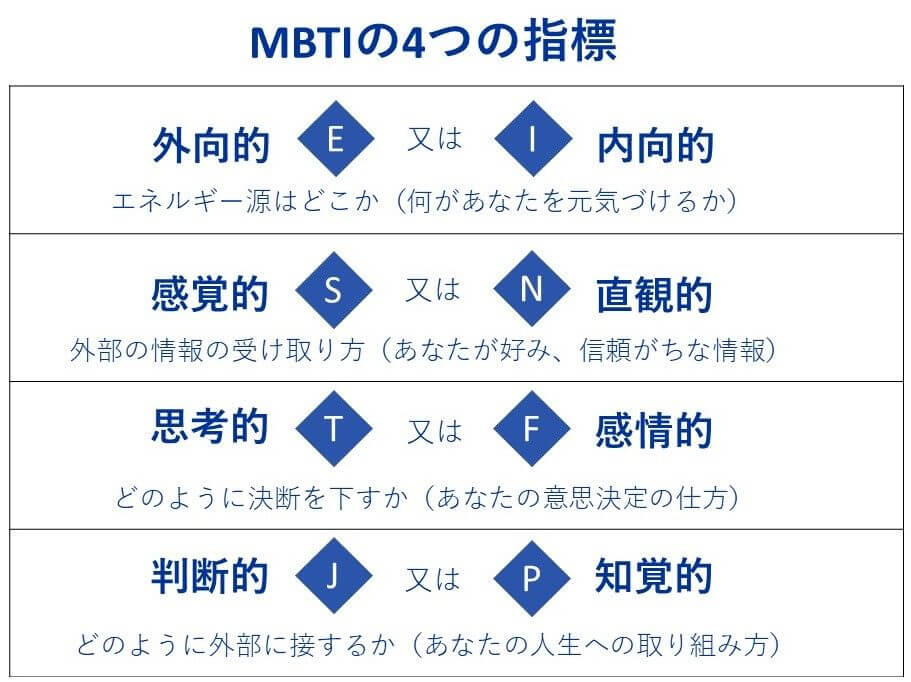
Quoted from "A Summary of the 16 MBTI Personalities" by Tomo Osako, in the Intercultural Space section.
In terms of the personality traits of these four pairs,Which tendency is stronger (= which do you lean more towards)?, and that determines the type (for example,Extroversion and introversionOf these,Outward-orientedetc.).
Conflict of personality traits
The personality traits described above cannot be consciously perceived simultaneously if they are paired (for example, the emotion-thought pair). This is because,There is a limit to what a person can be aware of at once, and it is impossible to be aware of conflicting things simultaneously.When one side is illuminated by the spotlight of consciousness, the other side is hidden in darkness (the unconscious).Conflict of personality traitsI will explain what this is, using concrete examples. Reading through this while considering which of the two opposing viewpoints you yourself lean towards will deepen your understanding.
The conflict between the feeling type (F type) and the thinking type (T type) [decision-making (judgment) function]
Emotional type (F type)とThinking type (T type)You cannot use them simultaneously.
- Decision-making (judgment) psychological function
- Emotional type (F type)←Conflict→ Thinking type (T type)
Making decisions based on emotions or preferences (emotions)とIt is difficult to simultaneously make logical and objective decisions (thinking)..for example,Even if I wanted to eat omurice and a parfait for dessert (emotions)、I'm on a diet right now, so I shouldn't eat (thought).That's the conclusion a thinking type would reach.
As another example,Right now, I should focus on my work because it will lead to my personal growth, so I should distance myself from my boyfriend (thought).But,I choose to be with my partner because I love them very much (emotion).An emotional type might decide that.
Sensing type (S type) and intuitive type (N type) [Information gathering (perceptual) function]
Sensory type (S type)とIntuitive type (Type N)You cannot use them simultaneously.
- Information gathering (perceptual) function
- Sensory type (S type)←Conflict→ Intuitive type (Type N)
It's impossible to focus on the present reality (sensory perception) and imagine the distant future (intuition) at the same time.For example, when a bear attacks in the mountains,I'm desperate to figure out how to break out of this situation (it feels like)、I don't have time to think about what I'll do when I get home (intuition)..Also,When I'm walking and daydreaming about my future (intuition)、You might literally lose all awareness of your surroundings and even bump into a utility pole (that's just my feeling).。
Details of each personality trait are as follows:Personality traits of the four pairsPlease take a look.

comment