

Reference: 16 Personality Type Theory (modified)
- INFP > INTJ > ISTP > ISFJ > INFP
- INFJ > ISFP > ISTJ > INTP > INFJ
- ENFP > ESFJ > ESTP > ENTJ > ENFP
- ENFJ > ENTP > ESTJ > ESFP > ENFJ
This relationship is asymmetrical, with one party always superior to the other, teaching and guiding them. However, it is a very beneficial and meaningful relationship for both parties.
In reality, even those in a superior position have much to learn from their opponents, but it takes considerable maturity to realize this.
Here,
The one who bestows the benefit... Teacher
Those who receive the benefit... students
Let's call it that.
From the very beginning of their acquaintance, students are impressed and amazed when they see their teacher effortlessly accomplish things that they themselves find difficult and tend to overthink. They may even praise their teacher out loud. They are so impressed by how easily their teacher can do these things that their praise may become exaggerated.
Students realize that there is much to learn from their teachers' perspectives, ways of thinking, feelings, and attitudes.
At the same time, students notice the teacher's weaknesses and shortcomings, and want to help. However, the teacher may not consider these points important and refuse to accept the student's help. There's a reason for this.
Let's take the relationship between an ENFJ (teacher) and an ENTP (student) as an example to illustrate this point.
- Extraverted Feeling/Fe
Very good at it /First functionFollow what you deem right for everyone, what is good for the group. - Introverted Sensing/Ni
I'm a little good at it /second function: You are responsible for predicting whether your will, desires, and actions will cause harm in the future. - Extroverted Sensing/Se
I'm not very good at it.Third functionPeople want to stop and listen to what you have to say. Otherwise, they feel stifled, become critical, and tend to try to impose their own opinions and positions on others. - Introverted Thinking/Ti
I'm really bad at it /Fourth functionThey fear and are anxious about things that are not logically correct. They don't know how to thoroughly analyze available information (or are unwilling to do so).
<The cognitive axis of ENFJ>

- Extroverted Intuition/Ne
Very good at it /First functionThey possess a superior ability to see the entire future and foresee various possibilities and destinies. - Introverted Thinking/Ti
I'm a little good at it /second function: They are responsible for verifying the facts, determining whether statements and findings make logical sense, and what is true or false. - Extraverted Feeling/Fe
I'm not very good at it.Third functionThey want to make people happy and feel positive. When that's not the case, it tends to turn into insults, sarcasm, and imposing a sense of superiority. - Introverted Sensing/Si
I'm really bad at it /Fourth functionThey feel anxiety and fear about trying new things and failing. They dislike or are unable to do routine work (simple, repetitive tasks).
<ENTP cognitive axes>
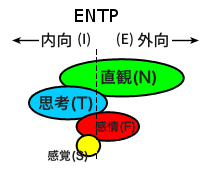
The third psychological function of ENTPs is extroverted feeling, and they value harmony in relationships. However, they often struggle to do so. Their challenge lies in behaving appropriately for the situation, being emotionally expressive, motivating those around them, and building successful cooperative relationships.
On the other hand, the primary psychological function of an ENFJ is extroverted feeling, and they effortlessly handle things that are challenging for an ENTP, which is their strength.
Furthermore, while ENTPs' primary psychological function is extroverted intuition, this has the drawback of being rambling and not getting to the point. However, ENFJs have introverted intuition as their secondary psychological function, allowing them to see the essence of things while still getting to the heart of the matter.
Because ENFJs have introverted intuition as their secondary psychological function, they are unlikely to feel a particularly strong envy towards the intuition of ENTPs. Rather, ENFJs unconsciously tend to suppress the function of their extroverted intuition. As a result, ENFJs tend to overlook the merits of the extroverted intuition that ENTPs use.
As a result, ENTPs often end up learning a lot from ENFJs, albeit unilaterally.
On the other hand, introverted thinking is a fourth psychological function that ENFJs unconsciously suppress.
Introverted thinking and extroverted intuition are strengths of ENTPs, and naturally, these tend to stand out as weaknesses of ENFJs.
However, ENFJs have established ways to get by by utilizing other cognitive functions, so they rarely accept the goodwill of ENTPs. Rather, they may even feel aversion towards ENTPs' detached, cold, and unempathetic attitude.
ENFJs often have difficulty understanding the positive qualities of ENTPs. Needless to say, this doesn't sit well with ENTPs.
The third psychological function of an ENFJ is extroverted sensing, and they desire to learn from and complement others. However, since ENTPs use extroverted intuition, this desire cannot be fulfilled.
In this way, ENFJs become the ones who give benefits to ENTPs, and ENTPs become the ones who receive benefits from ENFJs.
Of course, the same explanation can be applied to other types in this relationship, depending on the psychological functions they utilize.
Teachers are in a superior position to their students. However, they do more than that; they actively try to help students with things they struggle with and protect them from common mistakes. It seems that no one else is capable of doing such things.
Students respect their teachers. Indeed, students can greatly benefit from this relationship and achieve significant personal growth.
Thus, the relationship becomes one of great significance to both parties. Therefore, despite its asymmetrical nature, a very strong bond is formed.
Eventually, students grow up and you start to think there's nothing more to learn. This is also an illusion, but at that point, the relationship gradually begins to cool down.
Conversely, things go wrong when students try to be overly helpful and offer advice to their teachers.
In fact, in this relationship, teachers often learn more from their students.
This is because students utilize the fourth psychological function, which teachers often suppress, as their second psychological function, thereby demonstrating its strengths. There is much to learn from this regarding common mistakes, failures, and weaknesses that teachers tend to fall into.
However, the fourth psychological function only develops and its advantages become apparent after it has matured smoothly. Until then, teachers often fail to realize that they have much to learn from their students.
Understanding and keeping this in mind will allow both parties to build an even better relationship.
End of quote
*This compatibility explanation is,16-Type Personality TestThis was created based on the theory of [the subject].
A Collection of Information on the 16 Personality Types – The Little-Known Truths of Each Type (Summary, Illustrations, and Analysis)
- Summary of 16 Personality Type Test Websites
- List of articles categorized by personality type (16 types)
- Compatibility chart for 16 personality types
- Suitable occupations, ideal jobs, and dream jobs for each of the 16 personality types
- Nicknames (names) for each of the 16 personality types
- What if there were a country with 16 personality types...?
- The relationship between national characteristics around the world and the 16 personality types
- List of 16 Personality Types Based on Famous Characters
- Detective Conan: A Summary of 16 Personality Types for Each Character
- Percentage of 16 personality types
- Reactions of 16 Personality Types – Heaven and Hell
- To describe the 16 personality types in one word:
- 16 Simple Explanations of Personality Types
- 16 Personality Types: Strengths, Weaknesses, and Ways to Improve Weaknesses
- 16 Personality Types: Preferences and Strengths/Weaknesses in Majors and Subjects
- 16 Personality Types: How to Enjoy Life to the Fullest…?
- 16 Personality Types: Inspiring Quotes from Great Figures
- What if each of the 16 personality types were a murderer?
- How to become an attractive husband or wife based on your personality type (16 types)
- What 16 personality types do after a breakup
- Reasons for fighting according to 16 personality types
- Income by 16 Personality Types - Misconceptions and Truths -
- Characteristics of employees based on 16 personality types
- Potential pathological tendencies of 16 personality types
- Psychological Functions of 16 Personality Types Based on Statistics
- Viewing percentage of the detailed personality pages for each of the 16 personality types
- Summary of the characteristics of the 16 personality types
- 8 psychological functions: "What if I did...?"
- Approaches to tasks based on psychological function: Intuitive (N-type) & Sensing (S-type)
- Social interaction explained by psychological functions
- Understanding Your Financial Habits Through Psychological Functions – Are You a Saver or a Spender?
- Humor (sense of humor) as revealed by psychological functions
- How extroverts (Type E) and introverts (Type I) can get along well
- How Sensing types (S type) and Intuitive types (N type) can get along well
- How Thinking (T-type) and Feeling (F-type) People Can Get Along Well
- How to get along well with Judging (J-type) and Perceiving (P-type) types
- Characteristics of parents with 16 personality types
- Parent-child relationships between extroverts (Type E) and introverts (Type I)
- Parent-child relationships between sensing types (S-type) and intuitive types (N-type)
- Parent-child relationships between thinking types (T-type) and feeling types (F-type)
- Parent-child relationships between judging (J-type) and percepting (P-type) types
- How to identify your partner's personality type: [16 Personality Types]

comment