

The Enneagram test results are...
Type 1!
Below are the details of your diagnosis:
Enneagram diagnostic results
Naru Psychology / @narushinrigaku
Diagnosis resultsShare it on social media (tweet it) and let your followers know!
↓↓↓
Enneagram personality testType 1I will explain this.
first,"EnneagramThis is a personality test that divides people into nine personality types.
The Enneagram is a personality type system that describes patterns of how people interpret the world and process emotions. The Enneagram describes nine personality types and explains the relationships between types by mapping each type onto a diagram with nine points.
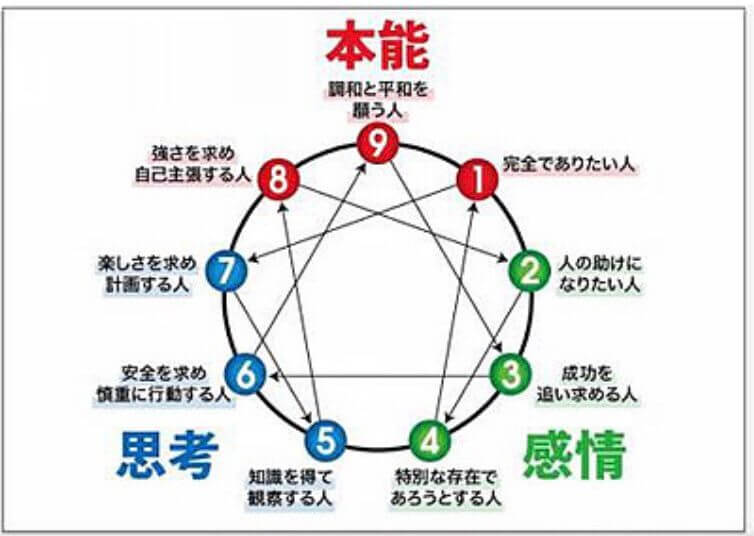
Characteristics and explanations of Enneagram types 1-9! (Quoted from)
↓EnneagramPersonality assessmentLet's try it!! ↓



A brief explanation of Type 1
Type 1 is...
A rational and idealistic type.
They are fair and just, highly purposeful, have excellent self-management skills, and are perfectionists.
- desire"The pursuit of continuous improvement"
- 囚I"No one will love you unless you're perfect."
Enneagram Type 1s are conscientious and ethical, with a strong sense of right and wrong. They prefer to do things precisely and to high standards, adhere to rules, and pay attention to detail. They don't compromise easily and are afraid of making mistakes. To others, they appear perfectionistic, highly responsible, and strict.
People of this type often get irritated when things don't meet their high standards in their work, relationships, or daily life. When stress builds up, it can lead to unhealthy behavior.Type 4They suddenly become ill-tempered or irrational, like this.
However, if we move in the direction of integration (growth), a healthyType 7You will become a more spontaneous and joyful person.
Details of Type 1
Enneagram Type 1s possess a strong sense of mission and, regardless of the extent of their influence, desire to improve the world in various ways. They strive to overcome adversity and bring about change by illuminating the human spirit. They are willing to make great sacrifices to pursue "higher values."
I strive to take practical actions and be helpful in a positive way. Consciously, I feel I have a "mission" to fulfill in life, and I want to do my best to alleviate the disorder I see in my surroundings. I enjoy encouraging and teaching others, I avoid expressing anger, and I believe there is more to be done than what I can do each day.
However, in order to remain true to the principles they have set for themselves, Type 1s avoid being influenced by instinctive impulses and regulate themselves. Their pursuit of their own perfection can lead to self-inflicted stress, and as a result, there is a risk of developing a personality type with problems of repression, resistance, and aggression.
Type 1s are, in a sense, teachers, reformers, and advocates for change. They are orderly, fastidious, and strive to maintain high standards, but they can also be critical and fall into perfectionism. As a result, they may sometimes be overwhelmed by feelings of anger and impatience.
While possessing a strong sense of purpose, I feel compelled to justify my actions to myself and others. I spend a lot of time thinking about the consequences of my actions and how to avoid acting contrary to my beliefs.
Anger and indignation
Type 1s probably feel this way often, don't they? Your feelings of anger and resentment stem from having high expectations of your life. When something doesn't go well, you tend to feel angry and resentful, thinking, "This wasn't supposed to happen." This applies not only to yourself but also to those around you and to other people. However, as a friend, accepting anger is not easy and can be stressful, so please be very careful.
feeling of disappointment, frustration
Similarly, because you strive for perfection, you often find yourself nitpicking or dissatisfied in life. Not only do you vent your anger, but inwardly you experience repeated setbacks and disappointments. These emotions are unhealthy for you and must be dealt with proactively. The most fundamental way is not to try to make yourself better, but to adjust your opinions on everything and face things more easily. Other types may find what I've said above correct.
Interpersonal relationships
As a typical perfectionist, I strive for perfection in everything, which means I rarely praise myself or others, and tend to be critical. Because my standards are so high, I put immense pressure on myself, making it difficult to relax, enjoy myself, or laugh.
Main personality traits
- Fair and just
- The conversation was serious and frank.
- Always strive for improvement
- Strict with oneself and others
- I won't compromise easily.
- Rich in practicality and frugality
- They have strong fixed ideas such as "You should do XX" or "You must do XX."
- Make it clear that it's black and white.
- As an employee, diligent and conscientious
- I enjoy teaching and instructing.
- Dignity
- Seeking perfection
- To see plans and decisions through to completion.
- Pay attention to tidiness and organization.
- Intense concentration
- Weak in the world of emotions
values
- Responsibility and diligence are the core values of Type 1 individuals. They are accountable and evaluate the functionality of various products and systems.
- A desire to improve every aspect of life. They strive to ensure their actions align with their values and principles, and they work very hard to achieve that goal.
- Honesty is a crucial factor in life choices. Loyalty, a sense of justice, and honesty are also core elements that form the Type 1 personality.
Elements that make up Type 1
Basic fear: Degenerate, evil, defective.
They fear being seen as "bad," morally flawed, or otherwise imperfect. To cope with this fear, they are very disciplined and strict with themselves (and often with those around them).
basic needsI want to be kind, honest, and a well-balanced person.
He is a respectable person who corrects mistakes, and I believe that first and foremost, I myself must be meticulous in everything I do.
Main motivationI want to do the right thing, strive higher, improve everything, align with my ideals, justify myself, and avoid being blamed or criticized by anyone.
Tips for growth
- You have a lot to teach others and are probably a good teacher, but don't expect others to change "immediately."Especially for people who aren't used to looking at things objectively, something that seems obvious to you might not be obvious to the other person.
Furthermore, many people, even if they know what's right, can't change immediately for various reasons. Even if someone doesn't change immediately following your advice, that doesn't mean they won't change in the future. Be patient and watch over them. - Your Achilles' heel is self-righteous anger.You get angry easily, and you become upset when others seem to reject what you define as right. Try taking a step back and thinking things through. If you can calm that anger, people will be more willing to listen to what you have to say.
- Try being kind to yourself.When stressed, Type 1s can become hard on themselves and push themselves too hard. Try to think about how to soften the negative self-criticism you have. Consider how you would feel if a close friend criticized you in the same way.
- Learn to relax.Use your time for yourself instead of thinking that everything depends on you or that terrible things will happen if you don't do something. Fortunately, the world doesn't depend on you alone, even if you sometimes feel that way.
- Remember that not everyone is the same as you.It's important to learn to accept people as they are and to pause (or at least restrain yourself) before becoming preachy or nagging.
- It's easy to motivate yourself by focusing on the wrongdoings of others. And it may be true that they are wrong. But what does that mean to you?Getting frustrated with those people won't change anything. Similarly, be careful if you're constantly frustrated with your own "flaws." Does harshly criticizing yourself really help you improve? Or does it simply make you stressed, anxious, and lose confidence?
- Let's be mindful of living a healthy lifestyle.Type 1s possess exceptional focus and a tendency towards workaholism, which can lead to career success. However, it's important for them to remember the need to balance working late into the night with time for relationships, family, health, and their own well-being.
- Learning not to take everything in life too seriously is the path to growth for Type 1s.Take some time to relax and take in the current situation by looking for interesting and quirky things about yourself and the world around you.
The "stages" in the Enneagram
* This chapter is,Stages (Enneagram)This is a quote from "[source]".
3 stages
Healthy (Stages 1-3)
- Problems stemming from obsession, primal fears, and desires.The state in which the problem has been resolved.
- In this state,freedomやsense of freedomYou can feel
Normal (Stages 4-6)
- The so-called "normal" state
- Most of us are in this state.
Unhealthy (Stages 7-9)
- Freedom is restricted,A state of suffering both physically and mentally.
- In other words, "sick"
- Stage 9 is no longerterminal stageThat is
- If you become unhealthy, you either fall even further down or have no choice but to call for help.
Stage 1
healthy
Stage 1: "The Intelligent Realist"
- A person of exceptional character with ample resources.
- "I am always an objective and fair person."By discarding that preconception, one's honest and kind character will come to the surface.
- While retaining his noble and virtuous character, he has acquired an accepting attitude and the capacity to enjoy things.
Stage 2: "A rational person"
- Sublime saint
- "Objective, moderate, and thoughtful"Based on this self-image, one can strive to make it a reality.
- A personification of unconscious conscience and a good life guide.
Stage 3: "A teacher with high moral standards"
- A responsible and upright person
- Self-image reinforcement stage
- To set aside one's own desires for a greater cause and purpose, and to act ethically and clearly toward one's ideals.
usually
Stage 4: "The Idealistic Reformer"
- A serious, fair, and stoic hard worker.
- He is a person of noble character,"What if people aren't interested in my ideals?"I have a slight feeling of unease.
- However, at the same time, they also harbor a desire to persuade others and justify their own opinions for the sake of their ideals, and they try to manipulate those around them.Start evaluating based on your own criteria
Stage 5: "A disciplined person"
- He is a perfectionist and a stoic hard worker, but inflexible.
- My own perspective and attachment to my ideals have grown stronger.
- Therefore, living in accordance with one's own valuesIt becomes extremely difficult to do anything else.
- He is meticulous,Stressful situations often lead to frustration.
Stage 6: "Perfectionists who tend to judge things in terms of good and evil"
- exclusivist/cynic
- People who don't meet my standards or whom I don't likeexclusion isolation
- They become extremely anxious that others will trample on the order and balance they value.
- authenticThey become aggressive and critical, and extremely harsh towards themselves and others.
unhealthy
Stage 7: "Intolerant misanthropy"
- A pessimistic, exclusive, and self-righteous nihilist
- I have lost confidence in my self-image, and because of that...More stubbornIt becomes
- "My opinion is correct."I began to desperately try to convince myself and others of this.
- They are completely trapped by their own opinions, and if anyone raises even the slightest objection, they...Trying to suppress
- Compromise and negotiationThere is absolutely no room for error.
- Making scathing sarcasm or attacking opposing opinionsrepeat
Stage 8: "A hypocrite trapped by obsessive thoughts"
- A hypocrite who only cares about protecting his own selfish interests.
- When you're pushed to this point, your own ideals are nowhere to be found.
- "A damn, intolerant world"I am fully preoccupied with protecting myself from it.
- Suppressed desires explode,"The pleasure of a fleeting moment"や"Forbidden Games"Run to places likeBecoming self-destructivebut,They fall into the contradiction of imposing extremely noble ideals on others.
- If you don't control othersRestless
Stage 9: "The Punitive Avenger"
- A loser who thinks, "It's no good, it's all over."
- "No."And to my own desires that I had suppressed,I will lose...This is an unbearable pain for Type 1s.
- However, recovering on your own isAbsolutely impossible
- I think I've let myself become a worthless person.Desperate to remove everything, if it gets worseRepeated suicide and self-harmIt can also become like this.
Celebrities of Type 1
- Confucius
- Plato
- Mahatma Gandhi
- Pope John Paul II
- Margaret Thatcher
- Prince Charles
- Michelle Obama
- Hillary Clinton
- Noam Chomsky
When a Type 1 person takes a 16-type personality test...
A Type 1 person,16-Type Personality TestIf you receiveINTJ (Strategist type)、ISTJ (Hardworking Type)This often applies to people of this type. Common characteristics of this type include a strong sense of responsibility, perfectionism, and good planning skills.
↓Click here if you want to find out your personality type from the 16 personality types↓

↑Try taking the 16-type personality test↑
Related articles ↓
List of Enneagram types (click to view)
Click here to see other types! ↑

comment