
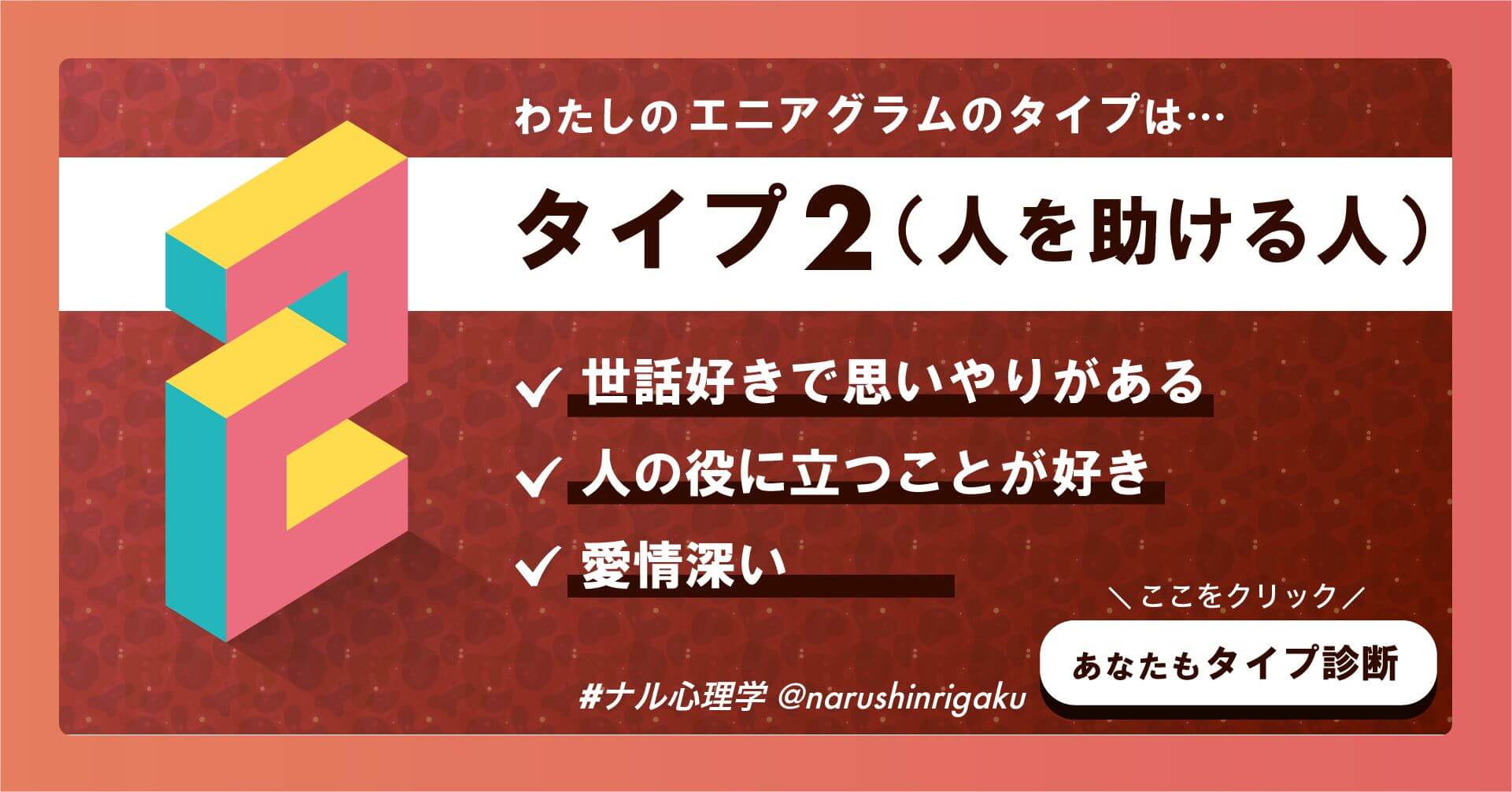
The Enneagram test results are...
Type 2!
Below are the details of your diagnosis:
Enneagram diagnostic results
Naru Psychology / @narushinrigaku
Diagnosis resultsShare it on social media (tweet it) and let your followers know!
↓↓↓
Enneagram personality testType 2I will explain this.
first,"EnneagramThis is a personality test that divides people into nine personality types.
The Enneagram is a personality type system that describes patterns of how people interpret the world and process emotions. The Enneagram describes nine personality types and explains the relationships between types by mapping each type onto a diagram with nine points.
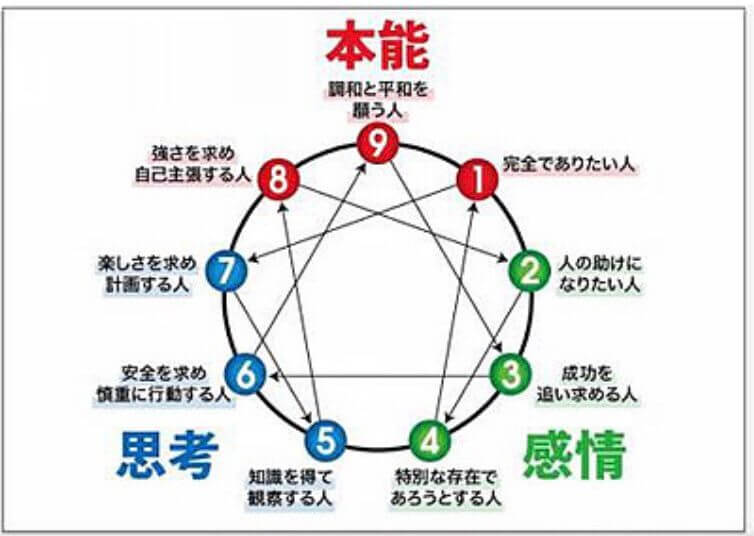
Characteristics and explanations of Enneagram types 1-9! (Quoted from)
↓EnneagramPersonality assessmentLet's try it!! ↓



A brief explanation of Type 2
Type 2 is...
A caring and considerate type
They are thoughtful, warm-hearted, tolerant, and sincere.
- desire"The pursuit of service and helping others"
- 囚I"If I don't help others, no one will love me."
Simple explanation
Enneagram Type 2s have a strong desire to belong to a group and to be loved by others. They are empathetic, sincere, and very warm-hearted. They rarely refuse to help others when asked.
When stress builds up, it can lead to unhealthy behaviors.Type 8They can also suddenly become aggressive and domineering, as in this case.
However, if we move in the direction of integration (growth), a healthyType 4As a result, they become more self-centered and aware of their own emotions. When this type matures, they become selfless, altruistic, and possess unconditional love for others.
Details of Type 2
Type 2 individuals possess high levels of empathy and compassion, prioritizing the needs of others over their own. They have intuitive abilities, allowing them to anticipate and support others' emotional gaps. They find their lives most fulfilling and meaningful through generous actions for others. They find great joy in what they can do, offering encouragement and sharing in tears. Even in difficult situations, they cherish their colleagues and friends. This is motivated by a desire for recognition from others.
When a Type 2 is healthy and balanced, they are truly loving, kind, generous, and compassionate. Their inner radiance warms those around them. They energize those around them with gratitude and consideration, and help others recognize their own strengths that they may not have noticed before. They embody the ideal "good parent" that everyone desires.
A mature Type 2 sees you for who you are, understands you with immense compassion, helps you with boundless patience, encourages you, is always there to lend a hand, and knows exactly when and how to let go. This type opens our hearts.
However, the inner development of Type 2s can be limited by their "dark side," which includes pride, self-deception, a tendency to be overly involved in others' lives, and a tendency to manipulate others to satisfy their own emotional needs. Transformation requires confronting this darker side, which can be painful.
Type 2,Type 3、Type 4They all fear having no value. Therefore, they feel they must become something special or do something extraordinary in order to gain love and acceptance from others.
Type 2 individuals often grow up in environments where their basic emotional needs are not met during childhood. As a result, they learn early on how to meet others' expectations and develop the ability to suppress their own desires in order to help others.
Mentally healthy Type 2s project an image of being very generous and selfish, expecting nothing in return for their efforts, but in reality, they may harbor excessive expectations and unconscious emotional needs towards those they serve.
Average to unhealthy Type 2s try to gain validation for themselves by sacrificing themselves for others. They believe that to be loved, they must always put others first, be loving, and selfless. The problem is that "putting others first" is what secretly causes Type 2s anger and resentment, and they desperately suppress or deny their own self-confidence. Nevertheless, these feelings eventually erupt in various forms, resulting in strained or even destroyed relationships.
Pride and self-respect
If you're a Type 2, do you think this expression is inappropriate? Do you find it surprising?
In fact, you always express the joy of helping others because you are eager to help people, affirm yourself, and want your friends to acknowledge and appreciate you. That's why you feel happy, proud, and honored when a friend asks for your help, because you feel affirmed and satisfied in the process.
Possessiveness and the desire to control
It's natural to want to continue helping others because you derive a lot of satisfaction from it. However, the more time and effort you invest, the more you expect in return. You might want your friends to "cling" to you, or rather, to "cling" to you, to tell you everything, and to share everything with you. This reflects your inner possessiveness, and if your friends don't treat you this way, you'll be disappointed and feel betrayed. Or, you might even put pressure on them to control them. While this certainly doesn't apply to all Type 2s, these tendencies can surface when you're not in the mood. By becoming aware of your emotional reactions, you can control and improve them.
Interpersonal relationships
You love helping others and are spontaneous and generous. You are sensitive to the needs of others, but tend to neglect your own. You rarely ask for help yourself because fulfilling the needs of others is more important to you than your own. In this way, you do not have a strong ego and often need others to affirm you.
Main personality traits
- Approachable and full of kindness
- Seeking love and good relationships
- A warm smile and eyes
- I want to be needed by others.
- Full of volunteer spirit
- Excellent team player
- I want to adapt to other people.
- Compassion and kindness
- Nurturing and patient
- Tendency to neglect oneself
values
- It's important to be accepted by the people you love and to be able to form emotionally close relationships with others.
- They are altruistic and willing to dedicate their time and energy to helping others improve.
- For Type 2s, the shared experience of spending quality time with a loved one is one of the most wonderful emotions in the world.
- Kindness and dedication guide our decisions. Improving someone else's life or mood is immeasurably more rewarding than helping ourselves.
Elements that make up Type 2
Basic fearI feel unwanted, unworthy of love.
They fear being alone or unloved, and they cope with this fear by taking care of others or becoming the center of other people's lives.
basic needsI want to feel loved and needed.
Main motivationI want to be loved, I want to express my emotions for others, I want to be needed, I want to be appreciated, I want others to react to me.
They want to feel loved and appreciated, and to that end, they try to express their love for others through words and actions.
Tips for growth
- When helping someone, be mindful of your own motivations.Doing good for others is certainly admirable, but if you do it expecting them to thank you or do something nice for you in return, you'll likely end up disappointed. Type 2s are at risk of falling into unconscious codependent patterns with their loved ones, which will rarely bring them what they truly desire.
- Helping others is wonderful, but first, let's take care of our own needs.Otherwise, even if you meet the needs of others, you won't be able to resolve problems, deep-seated resentments, or persistent dissatisfaction. Furthermore, if you don't get enough rest and take proper care of yourself, you won't be able to deal with people in a balanced way. It's never selfish to make sure you're okay before taking care of others.
- There are many things you would like to do for others, but it's best to start by asking them what they truly need.You have a talent for accurately reading other people's feelings and needs, but they don't necessarily want things resolved the way you want them to. Communicate your own intentions and be prepared to accept a "no thank you." Remember that just because someone decides they don't need your help doesn't mean they dislike you or are rejecting you.
- When helping someone, be mindful of your own motivations.Doing good for others is certainly admirable, but if you do it expecting them to thank you or do something nice for you in return, you'll likely end up disappointed. Type 2s are at risk of falling into unconscious codependent patterns with their loved ones, which will rarely bring them what they truly desire.
- Helping others is wonderful, but first, let's take care of our own needs.Otherwise, even if you meet the needs of others, you won't be able to resolve problems, deep-seated resentments, or persistent dissatisfaction. Furthermore, if you don't get enough rest and take proper care of yourself, you won't be able to deal with people in a balanced way. It's never selfish to make sure you're okay before taking care of others.
- There are many things you would like to do for others, but it's best to start by asking them what they truly need.You have a talent for accurately reading other people's feelings and needs, but they don't necessarily want things resolved the way you want them to. Communicate your own intentions and be prepared to accept a "no thank you." Remember that just because someone decides they don't need your help doesn't mean they dislike you or are rejecting you.
The "stages" in the Enneagram
* This chapter is,Stages (Enneagram)This is a quote from "[source]".
3 stages
Healthy (Stages 1-3)
- Problems stemming from obsession, primal fears, and desires.The state in which the problem has been resolved.
- In this state,freedomやsense of freedomYou can feel
Normal (Stages 4-6)
- The so-called "normal" state
- Most of us are in this state.
Unhealthy (Stages 7-9)
- Freedom is restricted,A state of suffering both physically and mentally.
- In other words, "sick"
- Stage 9 is no longerterminal stageThat is
- If you become unhealthy, you either fall even further down or have no choice but to call for help.
Stage 2
Click to display ↓
healthy
Stage 1: "A selfless altruist"
- At this stage, Type 2 individuals naturally want to do things for others without expecting anything in return.
- You start to think, "I'm happy if the other person is pleased," but then you begin to think, "There's meaning in doing something for them, regardless of their reaction."
- By repeating this process, you will be able to like yourself more.
- It's not just the words of gratitude themselves, but seeing the person in front of me smiling happily because of something I've given them."This is what I wanted most."This is the stage where Type 2 individuals begin to realize this.
- This is also the moment when Type 2 individuals feel the happiest, freed from stress.
Stage 2: "The caregiver"
- A state in which one can feel that the happiness of others is their own happiness.That is
- They possess excellent empathy, and are in a state where they feel the emotions of others as if they were their own.
- You will be able to interpret everything positively and stop blaming others in your mind.
- Furthermore, you will become more tolerant of people you find physiologically unacceptable or who you want to avoid deep down.
Stage 3: "A helper who nurtures people"
- Good supporter
- You will be able to act for the benefit of others.
- You will truly begin to understand what others want, and your self-centeredness will disappear.
- result,"I did [something] for you, didn't I?"Such attitudes fade away, and people become able to share joy with a variety of others.
- At this stage, instead of feeling the need to be needed, one becomes able to think objectively about "what can I do for them?"
usually
Stage 4: "An overly enthusiastic friend"
- Good personIt appearsBut actually, he's not that nice.isn't it
- When you do something for someone, you also put pressure on them by saying, "I did this for you, didn't I?"
- If a Type 2 person thinks, "This person is too much," they are likely in this Stage 4 state.
- As a result of not receiving the gratitude they expected, they tried to get more attention from others.People are drifting away
- When people start to distance themselves from them, they tend to reconnect with close friends and acquaintances and repeat the same pattern of excessively trying to gain favor from them.
- They try to gain attention from others through words of gratitude, but this comes across too obviously in their attitude.
- Along with that anxiety, their attitude became more aggressive, and the situation only got worse.
Stage 5: "A possessive 'best friend'"
- A state of strong possessiveness
- They devise strategies solely with the desire to have the other person's attention focused only on them.
- "I want to be needed.""I want many different people to see it."Because of this intense feeling, I've lost control of myself.
- I sometimes get irritated and try to relieve that stress by shopping or doing other things.
- "Why shopping?"...because I can't help but imagine the smile on someone's face when they buy that product.
- The desire to attract the attention of others can spiral out of control.
Stage 6: "The Arrogant 'Saint'"
- "You did a good thing!" "You are needed!" "You're working so hard!"A state of advocating self-sacrifice.
- To others it might look like "self-satisfaction," but it just shows how desperate I am.
- Stage 5 is when you go shopping, but in Stage 6...Shopping SpreeCloser to
- The lack of clear purpose or focus makes the behavior seem similar to that of a Type 7 personality.
- The difference is that Type 7s enjoy things naturally, while Type 2s are obsessed with something.
unhealthy
Stage 7: "The Manipulator of Self-Deception"
- No matter what you do, if you try to move or manipulate the other personIn a state of plotting
- They put themselves in a position of superiority over the other person and even go so far as to directly say, "You can't do without me."
- When this happens, you'll usually get a warning from someone,Self-defenseThey will start to do that.
- "It's not my fault! Because..." A lot of excuses come up, which only makes the situation worse.
- In an attempt to protect their fragile self-esteem, they connect with others.AttachmentThey will do it for you
- Sexual urges become more frequent.
Stage 8: "Overbearing Ruler"
- A state of forcibly demanding affection from others.
- They like to say a lot of unreasonable things.
- Sometimes, one will resort to negative tactics, even resorting to schemes to bring the other person down, in order to get their attention.
- In other words,Actions that create a problem and then cause a problem.It can also appear in
- They not only hate everything that doesn't pay attention to them, but they also start to exert more indirect pressure or direct attacks on those who are powerless.
- At this stage, Type 2 individuals are hysterical and unpredictable.
Stage 9: "Victims of psychosomatic illness"
- When this state occurs"He's completely broken."mosquito,"Their mental state is collapsing."
- Even when a helping hand is extended, they don't even realize it.So much so that you don't noticeDown
When a Type 2 person takes a 16-type personality test...
A Type 1 person,16-Type Personality TestIf you receiveESFJ (Sociable Type)、ENFJ (Collaborator Type)This often applies to people of this type. Common characteristics of this type include being willing to work hard for others, being compassionate, and being friendly.
↓Click here if you want to find out your personality type from the 16 personality types↓

↑Try taking the 16-type personality test↑
Related articles ↓
List of Enneagram types (click to view)
Click here to see other types! ↑
comment