
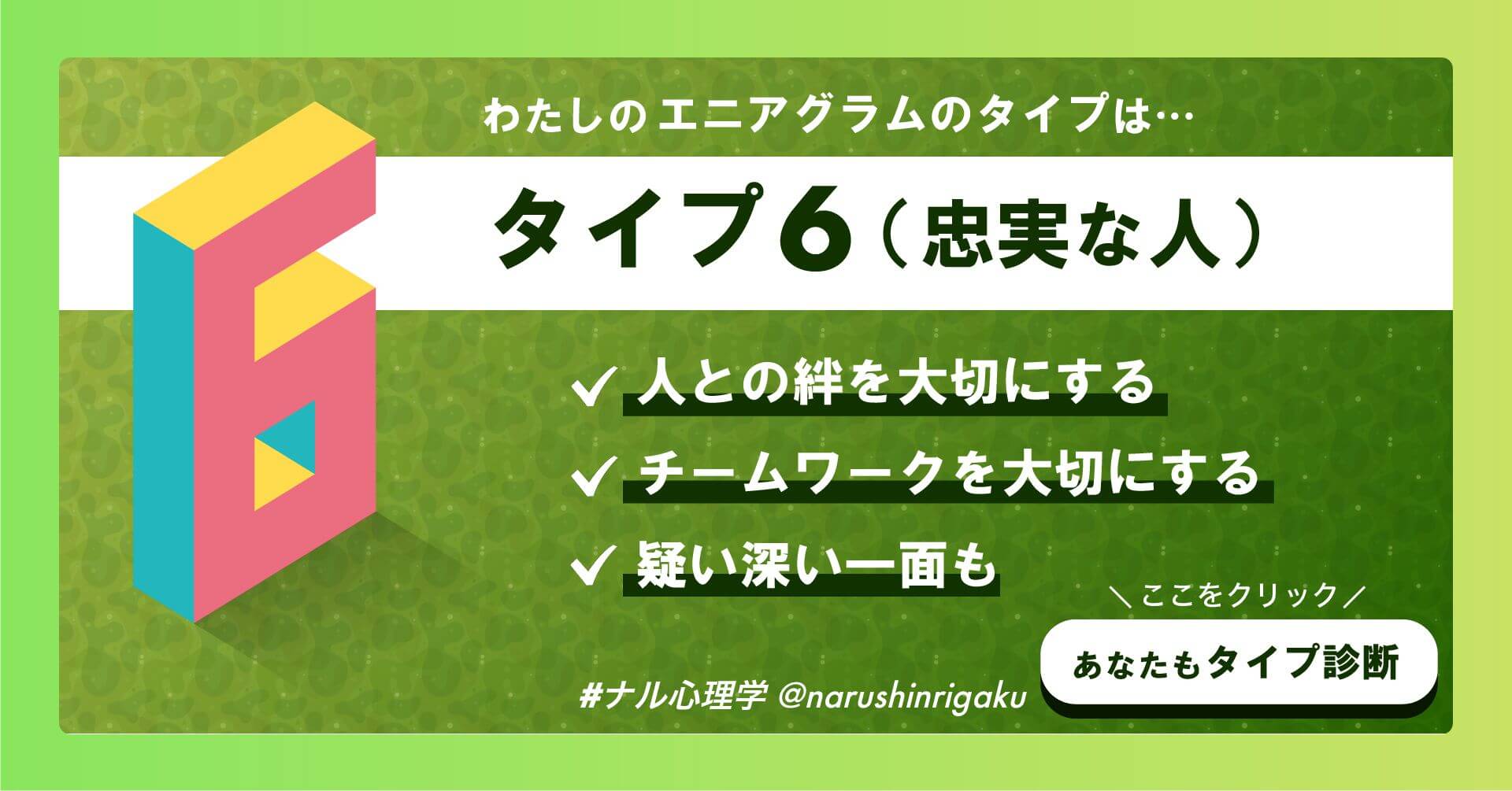
The Enneagram test results are...
Type 6!
Below are the details of your diagnosis:
Enneagram diagnostic results
Naru Psychology / @narushinrigaku
Diagnosis resultsShare it on social media (tweet it) and let your followers know!
↓↓↓
Enneagram personality testType 6I will explain this.
first,"EnneagramThis is a personality test that divides people into nine personality types.
The Enneagram is a personality type system that describes patterns of how people interpret the world and process emotions. The Enneagram describes nine personality types and explains the relationships between types by mapping each type onto a diagram with nine points.
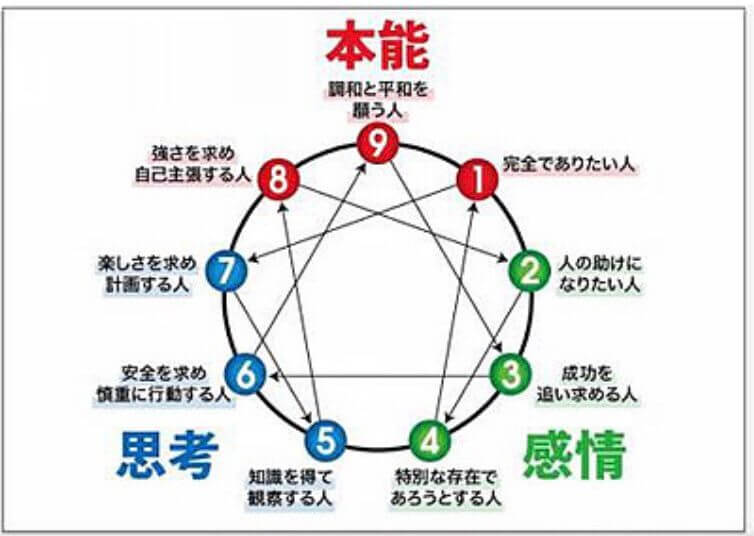
Characteristics and explanations of Enneagram types 1-9! (Quoted from)
↓EnneagramPersonality assessmentLet's try it!! ↓



A brief explanation of Type 6
Type 6 is...
A type that seeks safety and security
They are responsible, diligent, and dedicated. However, they also tend to be anxious and suspicious.
- desire"The pursuit of loyalty"
- 囚I"If you don't obey, no one will love you."
Simple explanation
Enneagram Type 6 individuals anticipate and avoid risks, and seek protection from trustworthy people and organizations. They are highly loyal and trustworthy towards both friends and organizations. While they can be cautious and indecisive, they can also be reactive and rebellious. They may also experience feelings of insecurity and suspicion.
Furthermore, they are highly vigilant, always thinking several steps ahead and preparing for any eventuality. When heading towards collapse (stress), they become unhealthy.Type 3Suddenly, a competitive spirit arises, and one becomes arrogant.
However, if we move in the direction of integration (growth), healthyType 9This helps you relax and become optimistic.
Details of Type 6
Enneagram Type 6 is the most loyal of all Enneagram types to their friends and beliefs. They can "sink with the ship" and maintain all kinds of relationships for much longer than other types. They are also loyal to ways of thinking, systems, and beliefs, questioning and rebelling against all ideas and authority. In fact, not all Type 6s conform to the "status quo." This type's beliefs can be rebellious, anti-authoritarian, or even revolutionary. In any case, they fight harder for their beliefs than for themselves, and they tenaciously defend their community and family than for themselves.
Their loyalty to others stems from a fear of being abandoned or left without support. Thus, a central issue for Type 6s is a loss of self-confidence. They come to believe they lack the strength to cope with life's difficulties and uncertainties on their own, and they increasingly rely on external structures, allies, beliefs, and support as a guide for survival. If the appropriate structure or environment does not exist, they will help create and maintain it.
Type 6s lack confidence in their own hearts and judgments. This doesn't mean they don't think; on the contrary, they think and worry a lot. They also tend to be afraid of making important decisions, but at the same time, they are reluctant to entrust decisions to others. They want to avoid being controlled, but they are afraid of taking responsibility in a way that puts them "on the front lines." (There is a Japanese proverb, "The grass that grows too long is cut down," which is related to this way of thinking.)
They are constantly aware of their anxieties and are always searching for ways to build a "social security" bulwark against them. If they believe they have sufficient backup, they can move forward with a certain degree of confidence. However, if that collapses, they fall into anxiety and loss of confidence, rekindling their "basic fears." So, let's ask a Type 6 the following question: "When will I know I have enough security?" Without essential inner guidance and the deep sense of support it provides, they constantly struggle to find a stable place.
Driven by instability and fear, they strive to build trustworthy networks. Haunted by anxiety, they seek to find or create reasons for it. They may cling to explanations or positions that describe their situation because they want to feel that there is something solid and clear in their lives. Beliefs, trust, conviction, and positions are difficult for these six to achieve and are crucial for gaining stability, so once they establish trustworthy beliefs, they do not easily doubt them.
Furthermore, when a Type 6 feels they can trust someone, they will go out of their way to find a confidant, mentor, or someone who can help regulate their emotional reactions and behaviors in order to maintain that connection. Therefore, they will do everything in their power to maintain their sense of belonging. They feel that "if I can't trust myself, I have to find something to trust in this world."
They are dedicated, responsible, and eager to belong to social groups to find their aptitudes.
Some Type 6s tend to deliberately distance themselves from things that cause them fear, trying to stay out of the radar. They are frank about their vulnerabilities in order to get others to understand their situation and way of thinking. This is a primary defense mechanism to avoid being manipulated.
As a child, they may have grown up in an unsafe environment, had overprotective parents, or experienced traumatic events that shaped their worldview. This type of person views the world as a dangerous place and perceives anything or anyone outside their circle of trust as a potential threat.
They are a very logical type. They are always strategizing and planning for future events and how to protect themselves and their loved ones from harm.
Type 6 is,Type 5、Type 7It belongs to the "thinking style" type. While all of these types deal with fear as a core emotion, no other type confronts fear as directly as Type 6.
A healthy Type 6 is loyal, trustworthy, honest, and protective—someone who wants to be your ally. An unhealthy Type 6 tends to make decisions based on fear or make self-actualization predictions.
Fear, anxiety, hesitation
You are loyal because you are afraid, you worry about many things, and you often think of the worst-case scenario, which makes you very cautious. For the same reason, you are afraid of making the wrong decision, so you almost always hesitate and be cautious when faced with a decision. A moderate amount of worry and anxiety can lead you in the right direction, but be careful not to worry too much, as it can prevent you from moving forward.
Interpersonal relationships
You are a loyal and dedicated person, so you would make a good employee. A sense of security is important to you because encountering new people and situations makes you feel fear and anxiety. Based on this fear and anxiety, you tend to make worst-case scenario plans for everything. In other words, you are pessimistic about people and tend to run away.
Main personality traits
- cautious
- Suspicious
- Organized and well-liked
- Don't trust others easily.
- A strong sense of belonging to a social group
- I like living in groups.
- I like peaceful discussions.
- Skilled in financial management
- I'm good at teamwork.
- Avoid the problem
- I am satisfied with the current situation.
- I find comfort in tradition.
- Working hard for others
- Fear of authority
- I belong to a close-knit group of friends.
- Fear of achievement
- I don't like changing to a new environment.
- Being able to communicate clearly
- Paying attention to every detail, accurately
- I hate being watched.
values
- We value people who seek safety and can reaffirm their own importance and connection to others.
- The driving force behind my actions is a sense of security and connection to the group. I am with people who hold an important place in my heart.
- Trust is the most important value for this type of person. When they are constantly thinking through hypothetical scenarios, knowing that they have someone to support them provides a great sense of security.
- By seeking peace within yourself, and through trial and error, you will gradually build trust and confidence over time, enabling you to effectively deal with any situation.
Elements that make up Type 6
Basic fearConcerns about the lack of support and guidance.
They fear being unprepared or unable to protect themselves from danger. To cope with this fear, they try to prepare for every possible event.
basic needsI want to feel secure and receive support.
Main motivationI want to feel secure, I want to feel supported by others, I want to gain certainty and security, I want to test how others treat me, I want to fight against anxiety and uncertainty.
Their motivation stems from a desire for safety and security. They seek support and reassurance from others and are extremely loyal to people and groups they trust.
Tips for growth
- Let's learn to acknowledge our anxieties, explore them, and come to terms with them.Feeling anxious is not uncommon. Everyone experiences anxiety, and it happens more often than you might think. Try to tackle things without relying on excessive alcohol (or other drugs) to relieve tension. Exercise is important for everyone, but it's particularly effective for focusing on the present and releasing stress. In fact, if you have a grasp of your current situation and are breathing deeply, anxiety can even become energy, boosting your productivity and helping you recognize what you're doing.
- Let's try to unleash our full potential.Type 6s tend to view life not as a journey in which they steer a ship, but rather as a series of events that happen to them. When Type 6s learn to acknowledge and possess their own power, they will be able to present themselves to the world with courage and boldness.
- Beware of your own pessimism.When you're upset or angry, you tend to become irritable, quick-tempered, and blame others for your own actions or the consequences of your actions. You may also become depressed and project negative thought patterns into reality. When you fall into this state of self-doubt, you become your own greatest enemy and may end up hurting yourself more than anyone else.
- Learn to identify what causes you to overreact.When we feel stressed or anxious, we tend to overreact. Also, realize that what you feared is often not happening at all. Even if the situation is worse than you think, fear weakens your power and prevents you from changing things for the better. You can't control what happens in the outside world, but you can control your own thoughts.
- Let's learn to trust people and organizations more.There are bound to be a few trustworthy people who care about you. If not, try to find trustworthy people and become close to them. Understand that not everyone has ulterior motives or is trying to hurt you. Such suspicion can cause problems in healthy relationships. Having faith in people will allow you to build stronger, more meaningful relationships. There is a risk of rejection or having your deepest fears stirred up, but it is a risk worth taking. You have a talent for being liked by people, but you may lack confidence and be afraid to make commitments with others. Let them know how you feel about them.
The "stages" in the Enneagram
* This chapter is,Stages (Enneagram)This is a quote from "[source]".
3 stages
Healthy (Stages 1-3)
- Problems stemming from obsession, primal fears, and desires.The state in which the problem has been resolved.
- In this state,freedomやsense of freedomYou can feel
Normal (Stages 4-6)
- The so-called "normal" state
- Most of us are in this state.
Unhealthy (Stages 7-9)
- Freedom is restricted,A state of suffering both physically and mentally.
- In other words, "sick"
- Stage 9 is no longerterminal stageThat is
- If you become unhealthy, you either fall even further down or have no choice but to call for help.
Stage 6
Click to display ↓
healthy
Stage 1: "Brave Hero"
- Awakening to your true feelings and genuine thoughts
- Say goodbye to the self that "cannot live without the protection of others," and live honestly, with oneself as the new source of support.
- Having gained confidence, they became brave.And, regarding anxietyConfronting head-on
Stage 2: "A friend who attracts people"
- Because they are friendly and sincere, they are very trustworthy people.
- The focus is on those who are well-connected with others, and are adept at interacting with people and giving advice.
- Although they have a solid support system, they do not let their guard down against crises.Solid and stableThere is
Stage 3: "A diligent person who keeps their promises"
- Responsible, moderate, and cooperative with others."A system that is beneficial to everyone"Trying to make
- He is an exceptionally cooperative person who values meticulous attention to detail and coordination, and also possesses a superior ability to foresee potential problems and predict future crises.
usually
Stage 4: "A person who faithfully fulfills their duties"
- A loyal and responsible person
- The dilemma of being caught between independence and anxiety stemming from feelings of inadequacyThis is where it comes to the surface
- I pledge my loyalty to those who help me, but I'm still unsure whether they'll actually help me.
- Strengthening faith in concepts, and rules, ideologies, and philosophies.They begin to ask for help and try to follow it.
Stage 5: "An Ambivalent Misanthrope"
- Becoming defensive, submissive, and exclusive
- To prevent any more pressure from being placed on me,Someone who looks strong/someone who looks like they'll helpto follow
- However, internally, anxiety, suspicion, and pessimistic feelings were swirling around.Impulsiveness and rebellious tendencies often begin to emerge.
- I will follow orders from above for the time being, but deep down I think"I don't think it's possible for us to truly connect with each other's hearts."I'm starting to think that
- As a result, I am not satisfied with it.They may also rebel.
Stage 6: "Authoritarian Rebel"
- Self-anxiety and"I'm worried that the number of people who are willing to help me is actually decreasing."So,It is becoming increasingly authoritarian.
- If one fails to gain the favor of those in power, they are often tormented by anxiety and a desperate need to "do something," leading them to focus on putting on a false front to make themselves look good or spreading slander to belittle their rivals.
- The reactions become exaggerated, even towards others.Increasingly aggressive and mercilessIt becomes
- They attack others by shifting blame, using discrimination and prejudice,I desperately try to suppress my anxiety.
unhealthy
Stage 7: "Overreacting Addict"
- Suspicion explodes, and confidence dwindles rapidly.
- Furthermore, the anxiety is becoming increasingly extreme, bordering on paranoia, and these are about to explode.Prone to panic
- When even blaming others ceases to be a means of escapism, the next thing one turns to is self-punishment.
- "Could it be that my own actions are undermining stability and making my life difficult and dangerous?"I begin to think that way.
Stage 8: "A person suffering from paranoia and hysteria"
- Being too desperate only pushes the stability you originally desired further away.
- "People can destroy even the slightest bit of my own safety."I arrived at this conclusion,paranoia...In other words, it leads to a thought process that is a complete embodiment of paranoia.
- To escape their own immense anxiety and self-punishment, they blame and attack others.An enemy that doesn't actually existThey continue to fight fiercely
- I become fiercely opposed to ideas I dislike or things I don't agree with, to the point where I no longer even know what I want to do myself.They intend to launch a full-scale attack.
Stage 9: "Self-destructive masochist"
- Excessive blame for others will ultimately come back to haunt you.
- "Because of my actions, I will attract the attention of the powerful and be punished."For this typeIt feels like a death sentence.I was made painfully aware of it.
- At this point, the only thing left to attack is...Only me
- Having experienced guilt and self-loathing to an unbearable degree, I begin to punish myself.
- Amidst constant self-destruction and self-punishmentMany people end up committing suicide.
What happens when a Type 6 person takes a 16-type personality test...?
A Type 6 person,16-Type Personality TestIf you receiveISFJ (Parental Type)This often applies to people of this type. Common characteristics of this type include a strong sense of responsibility, dedication, and anxiety.
↓Click here if you want to find out your personality type from the 16 personality types↓

↑Try taking the 16-type personality test↑
Related articles ↓
List of Enneagram types (click to view)
Click here to see other types! ↑
comment