
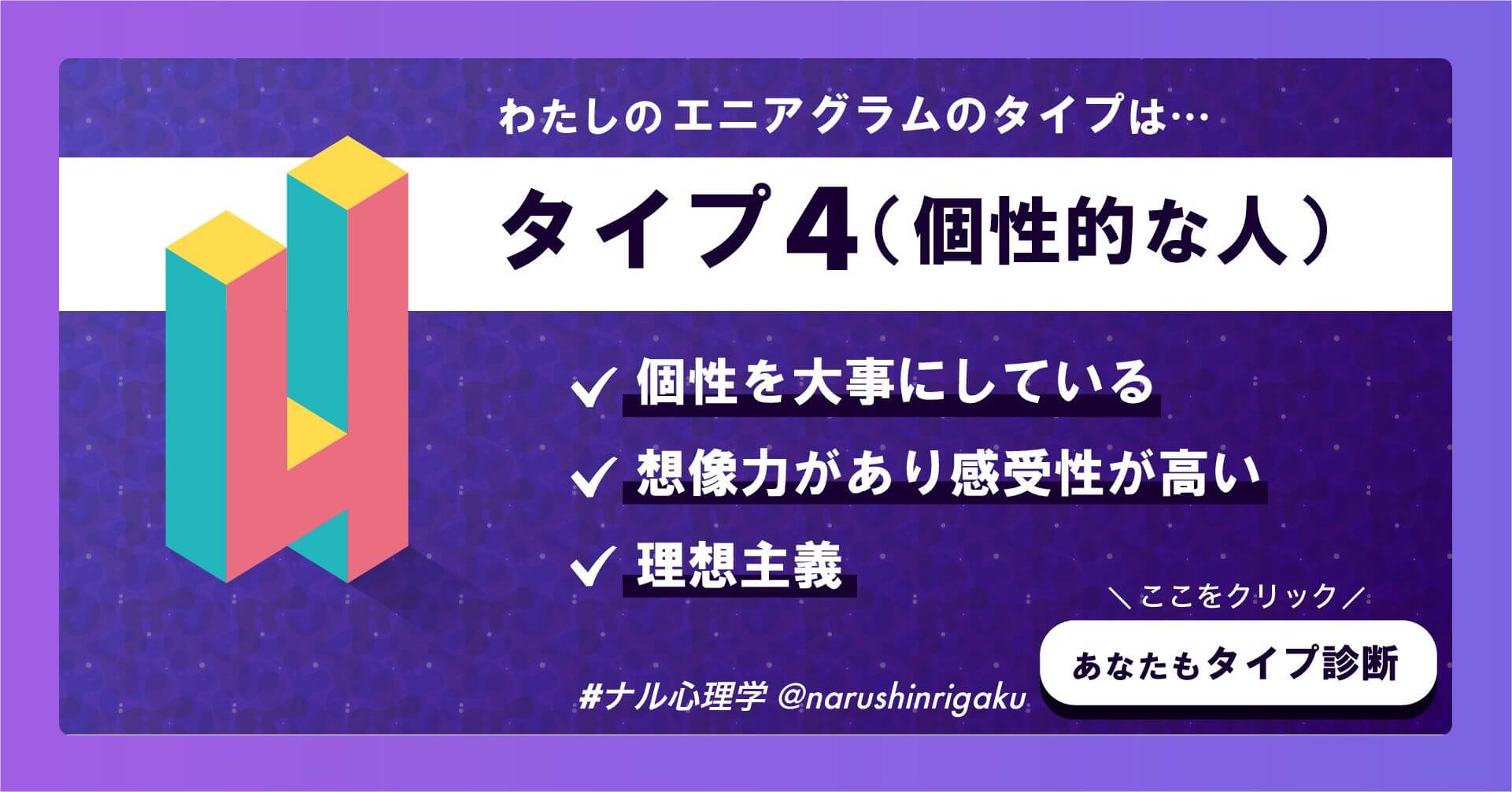
The Enneagram test results are...
Type 4!
Below are the details of your diagnosis:
Enneagram diagnostic results
Naru Psychology / @narushinrigaku
Diagnosis resultsShare it on social media (tweet it) and let your followers know!
↓↓↓
Enneagram personality testType 4I will explain this.
first,"EnneagramThis is a personality test that divides people into nine personality types.
The Enneagram is a personality type system that describes patterns of how people interpret the world and process emotions. The Enneagram describes nine personality types and explains the relationships between types by mapping each type onto a diagram with nine points.
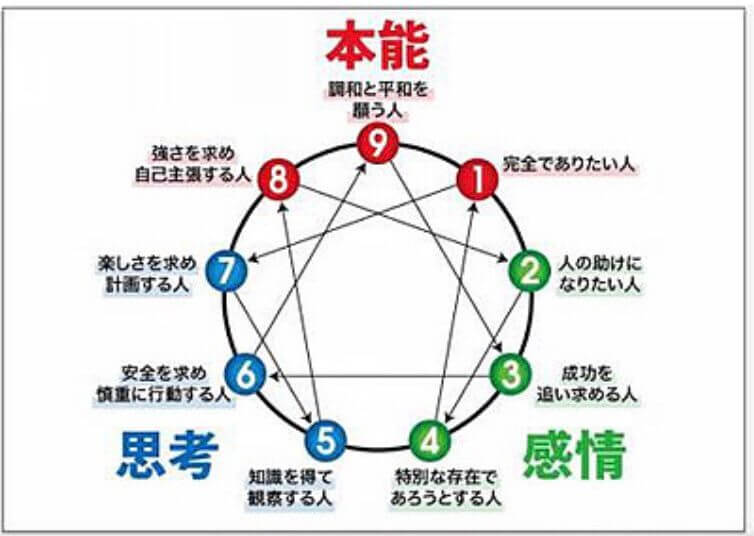
Characteristics and explanations of Enneagram types 1-9! (Quoted from)
↓EnneagramPersonality assessmentLet's try it!! ↓



A brief explanation of Type 4
Type 4 is...
A sensitive type who values individuality.
Expressive, dramatic, self-centered, and capricious.
- desire"Pursuing originality"
- 囚I"If you're not unique, no one will love you."
Simple explanation
Enneagram Type 4 individuals are self-aware, sensitive, and reserved. They are highly creative, compassionate, and self-aware, but can also be moody and overly self-conscious. They have a sense of being unique and different from others.
While I cherish my connections with others, I also struggle with a deep internal conflict: because I feel I'm so different, there are very few people who will see me for who I truly am.
They fear they are flawed and are overlooking fundamental aspects of happiness that others can attain. To cope with this fear, they emphasize their own differences and unique qualities, seeking a niche where they will truly be appreciated.
Details of Type 4
Enneagram Type 4s have an insatiable desire to discover and understand their true selves, the ones deep within their hearts. Creation, not consumption, is the key to their happiness.
They maintain their identity by believing they are fundamentally different from others. However, because they are different, they also feel that no one understands them or loves them enough. They often believe they have special talents and unique abilities that no one else possesses, but at the same time, they also believe they have unique disadvantages or flaws. More than any other type, Type 4s are acutely aware of and focus on their own personal differences and shortcomings.
The four mentally healthy individuals are honest with themselves, fully embrace their emotions, and can confront their motivations, contradictions, and emotional conflicts without denying them. They may not always like what they discover, but they don't try to rationalize their state or hide it from themselves or others. They are not afraid to see their own "bad parts."
Type 2やType 3Similarly, the core emotion for Type 4 is "sadness." All three types—Types 2, 3, and 4—struggle with the feeling that they are not loved for who they are. However, because Type 4s are familiar with their own darker nature, they can easily process painful experiences that would overwhelm other types. Sadness becomes a part of their identity.
Nevertheless, this type often feels that something is missing within themselves, but it may be difficult to pinpoint exactly what that "something" is. Is it willpower? Sociability? Self-confidence? Emotional tranquility?
These are all things that may seem abundant to others. With time and sufficient perspective, you can recognize that you lack confidence in your self-image—that is, in your personality and ego structure itself. You feel that you do not have a clear and stable identity.
It's true that Type 4s often feel different from others, but deep down, they don't want to be alone. They may feel socially awkward and self-conscious, but they strongly desire connections with people who understand them and their feelings. They long for someone to come along who will appreciate the secret self they've secretly cultivated.
If they don't receive that kind of recognition over time, the four begin to build their identity around how different they are from others.
Type 4 individuals typically struggle with a negative self-image and chronically low self-esteem. They try to compensate for this primarily by cultivating an "ideal self-image" constructed in their imagination. One Type 4 individual reportedly listened to classical music whenever he had free time and dreamed of becoming a great concert pianist. Unfortunately, however, his dedication to practice fell far short of his fantasies, and he often felt embarrassed when asked to perform for others.
I feel like I don't know who I really am. The problem is that my identity is primarily based on my emotions. When I look inward, I see a kaleidoscope of constantly changing patterns of emotional responses. By continuing to explore my inner self (the conscious and unconscious parts), I create original works without being influenced by the expectations of others.
Indeed, this type accurately recognizes the truth that human nature is dynamic and constantly changing. However, in their attempt to create a stable and reliable identity from their emotions, they tend to cultivate only certain emotions and reject others. They separate and deny certain emotions as "me" and others as "not me."
One of the biggest challenges Type 4s face is learning to let go of past emotions. They tend to hold onto negative feelings towards people who have hurt them. In fact, Type 4s become so fixated on longing or disappointment that they fail to notice the many treasures in their own lives. Growth for this type comes when they become more open to stepping out of their heads and experiencing true love and acceptance from others.
Jealousy and comparison (with others)
Type 4s have an artistic temperament. They are self-centered and self-centered.憐Remi feels different from others and enjoys her own world of fantasy. Often, Type 4s compare themselves to those around them and think that they are different and therefore not understood by others, or that others have many things that they do not, so they feel dissatisfied with real-world communities and society.
Self-admiration, self-pity
Because they are dissatisfied with real life, Type 4s create their own world in their imagination, creating a moody environment where they can release their emotions. However, this can give others the impression that they are overly emotional and sentimental, leading to misunderstandings and isolation.
Interpersonal relationships
Have you ever been told you have the temperament of an artist? You certainly have the personality of an artist, being sentimental, imaginative, and often engrossed in your own thoughts. On the other hand, you are easily swayed by your emotions, and you may sometimes refuse to work for reasons such as "I don't like it" or "I don't want to take responsibility."
Main personality traits
- Pursuing romance
- Dedicate yourself to self-expression.
- Outstanding artistry
- Quirky and adorable
- I feel misunderstood by others.
- Strong sense of identity
- I sometimes feel a sense of emptiness.
- I am afraid of being rejected.
- Characteristic expressions of inner and outer self
- Possessive
values
- The ultimate goal is for the world to recognize and appreciate my perfectly unique identity.
- I strongly believe that any significant differences between myself and others should always be consistent.
- "Authenticity" and "self-expression" are the reasons for our existence.
- I don't like being swayed by trends.
Elements that make up Type 4
Basic fear: It means that I have no identity or personal meaning.
basic needsI want to find myself and my purpose in life (I want to create my identity).
Main motivationThey want to express themselves and their individuality, maintain a specific mood or emotion, or withdraw to protect their self-image.
The motivation stems from a desire for self-expression and uniqueness. This is achieved through creative efforts and an overemphasis on perceived shortcomings in one's individuality.
Tips for growth
- Let's think about the similarities between yourself and the people around you.Type 4s tend to focus on how they are different from others. Instead, try thinking about connections with people. What do you have in common? Doing so will allow you to build deeper relationships.
- Don't get too caught up in your own feelings.Your own feelings won't truly support you. One of the most important mistakes this type of person makes is identifying themselves with their emotions. Let go of the misconception that you must understand your emotions, especially negative ones, before you can act in order to understand yourself. Always remember that your emotions tell you something about yourself in that moment, and nothing more.
- Try looking at yourself from someone else's perspective.It's good to keep in mind that your emotions are subjective. Emotions are not everything about you, but they are a part of you. Try to look at yourself more objectively. Specifically, focus on your positive traits and concrete achievements.
- Self-esteem and confidence can only be nurtured through positive experiences, regardless of whether you believe in them or not.Type 4s tend to engage in negative self-talk. By focusing on positive thoughts, they can develop a gentler, more positive self-image and mindset. They may feel a lack of confidence or discipline to accomplish things. If they feel overwhelmed by the number of things they want to achieve, break them down into smaller, achievable steps.
- Practice and maintain healthy self-care.Healthy self-management comes from within oneself and does not go against one's freedom or individuality. On the other hand, as you know, sensuality, excessive sexual experiences, alcohol, drugs, sleep, and daydreaming have a debilitating effect on you.
- Avoid long conversations in your imagination.Particular caution is needed if the conversation is negative, resentful, or overly romantic. These conversations are inherently unrealistic and, at best, merely rehearsals for action. However, as you know, we rarely act exactly as we imagine. Instead of spending time imagining your life and relationships, start by living them.
The "stages" in the Enneagram
* This chapter is,Stages (Enneagram)This is a quote from "[source]".
3 stages
Healthy (Stages 1-3)
- Problems stemming from obsession, primal fears, and desires.The state in which the problem has been resolved.
- In this state,freedomやsense of freedomYou can feel
Normal (Stages 4-6)
- The so-called "normal" state
- Most of us are in this state.
Unhealthy (Stages 7-9)
- Freedom is restricted,A state of suffering both physically and mentally.
- In other words, "sick"
- Stage 9 is no longerterminal stageThat is
- If you become unhealthy, you either fall even further down or have no choice but to call for help.
Stage 4
Click to display ↓
healthy
Stage 1: "The Inspired Creator"
- The state at this stage isWhen Type 4 is the least Type 4And from the outside,Type 7It looks like it.
- Breaking free from the shell of individuality and actively engaging with the outside world.
- You will be able to use your keen sensibilities and embody a lifestyle like that of a creator.
- At this time, Type 4 individuals tend to rely more on external inspiration than on internally accumulated anxiety.Influenced
- Without being bound by the idea of being "myself," I feel like I'm living my life to the fullest, 200%, and I feel fulfilled both mentally and physically.
- Their very existence is that of a creator.It would not be an exaggeration to say so.
- However, maintaining this state is quite difficult.
Stage 2: "An intuitive person with self-awareness"
- It's not as bad as stage 1, butA state driven by keen intuition.
- It's not a state of being interested in oneself,You will be able to empathize with others.
- Your mental agility will improve, and your athletic ability will also get better.
- Type 4 in this state isType 2 (People who help others)・Type 7 (The Passionate Person)・Type 8 (The Challenger)likeExtroverted
- Consciousness is directed outward rather than inward.
- While their lifestyle and ideas themselves are creative, Type 4s can maintain this state if they have the tools and skills to express their individuality.It will become possible to maintain it
- A state of being filled with creative desire.And when that desire becomes expressable in some way, Type 4Start living your true life
- Instead of being controlled by individuality and losing one's true individuality, embrace individuality and your true self.A state of being in self-controlIt will
Stage 3: "People who show their true selves"
- A natural and carefree state
- Normally, Type 4s wear a mask and hide their true selves, while enjoying emotional work to discover their true selves. However, in Stage 3...I began to wish I could take off that mask.
- Become empathetic and sociable, listen carefully to others, and share your own stories often.
- While I have a strong sense of individuality, I'm also able to skillfully balance myself and others while interacting with a variety of people.
- While it's in a healthy state, it does have that characteristic floaty feeling of a Type 4.
- Sometimes even minor incidents can cause people to withdraw into their shells.
- Although I am mentally and physically stable.You have to watch where you step.
usually
Stage 4: "A creative aesthetician"
- The desire to express individuality and uniqueness remains the same as in healthy states (stages 1-3).
- I aspire to be a creator, but my Type 4 self-awareness is getting in the way.
- Creativity tends to become self-contained.
- Type 4 in this state isWe can only create something within the given scope.
- Between "the self that can only fit into a mold" and "the self that gets stuck in a mold"Having conflictsIt ends up becoming like that.
- Or, even if you create something, you can feel your own individuality in that work.Unable toIt's like building a plastic model kit while reading the instructions.
- As a result, they try to find their own uniqueness through things that are given to them, such as interior design or fashion collections, but this is a danger sign.
- "Things that are inflicted upon you by others are ultimately created by others, and there is no room for you to intervene."I came to feel that way.feelings of jealousyYou will come to have
- Deep down, I have a desire to create, but I can't bring it to fruition."I don't have the talent to be a creator; I don't have any individuality to begin with."I get stuck in a state where I can't let go of this preconceived notion.
Stage 5: "A self-absorbed dreamer"
- When you fall to stage 5,The energy of Type 4 recedes.
- You start to socialize with people more often.
- By meeting and talking to many people,"Individuality"や"Uniqueness"I got it acknowledged,"I am a unique person."And they begin to desire self-awareness.
- This is the trap that Type 4 falls into,I'm not interested in other people.
- What Type 4 sees is through others."What kind of person am I?" "What kind of story have I gone through to get to where I am today?"It feels like touching myself.
- Even other people,A mirror to see yourselfIt seems that way to me.
- One step away from becoming dependent on counselors and therapy.
- and,Someone who is interested in me and only has eyes for me.[Savior]They will come to seek
- In this state, Type 4 is"I want you to accept my inner self."And they started making demands of the other party.Relationships with the opposite sex become complicated.
- "Verbalization = expression of inner feelings = realization = image"I am afraid of the gap between that and
- If this trend continuesThey become completely absorbed in their own world.
Stage 6: "Exempt 'Exceptions'"
- "Treat me specially, okay?"And they start to demand it.
- Basically, Type 4"The tragic hero/the tragic heroine"They behave like that, and this stage is precisely where that happens.
- But,I am aware that there is no one who will treat me specially.
- Even if you seek an unrestrained "exception," it will not be granted.I realize I've been spoiling myself.
- the result,The reality is that I'm the only one who hasn't grown.The moment I faced it, I realized I had neverA complex that felt comfortable somewhereがA harsh realityIt's starting to become like this
unhealthy
Stage 7: "An alienated person with depression"
- As a result of seeking a way of life that is true to oneself,I didn't get anything.Before I knew itTime just kept passing by...SuchDespairI became devastated.
- "It's not too late, this moment is the youngest you'll ever be."While we should also consider this perspective, Type 4s, whose sense of time is often based on the past, tend to compare themselves to those around them.
- Energy with a positive thinking mindsetNot even one
- A faint light remains in my heartがThe fear that is gradually disappearingEven with it right in front of meMy body won't moveIt becomes a state of simply waiting for time to pass.
- All that remains is a feeling of loneliness in one's heart, despair about the future, and the lingering attachments to the past that cannot be let go.
- When the mind and body are not connected, as time passes...A feeling of losing one's sense of selfYou will get to experience that.
- Before I knew it, I was empty inside.I'm in a state of despair because of myself.
- And that anger is directed towards "others who didn't help them grow," and that continuesfeelings of jealousyIt will become
Stage 8: "People suffering from emotional distress"
- Unable to function normally, I realize I am destined to disappear.With all due respectYou begin to feel fear and despair.
- "It's worthless," "My life has been meaningless," "This is my destiny."Being trapped by the word
- Type 4 at this timeNot normal
- pent up insideEmotional energyall ofIn order to belittle oneselfUse it all up
- This state"A black hole that swallows up all your vitality."It is called
- There is only one way out.To eliminate all suffering consciousnessThat is
- However, it is absolutely impossible to completely eliminate feelings of suffering on one's own, so with the help of someone else...It will take time to recover.
Stage 9: "The Self-Destructive Person"
- The depths of despair
- They will engage in acts that lead to their own downfall.
What happens when a Type 4 person takes a 16-type personality test...?
A Type 1 person,16-Type Personality TestIf you receiveISFP (Artist type)、INFJ (Empathy Type)、INFP (Psychologist type)This often applies to people of this type. Common characteristics of this type include valuing individuality, being imaginative, and being sensitive.
↓Click here if you want to find out your personality type from the 16 personality types↓

↑Try taking the 16-type personality test↑
Related articles ↓
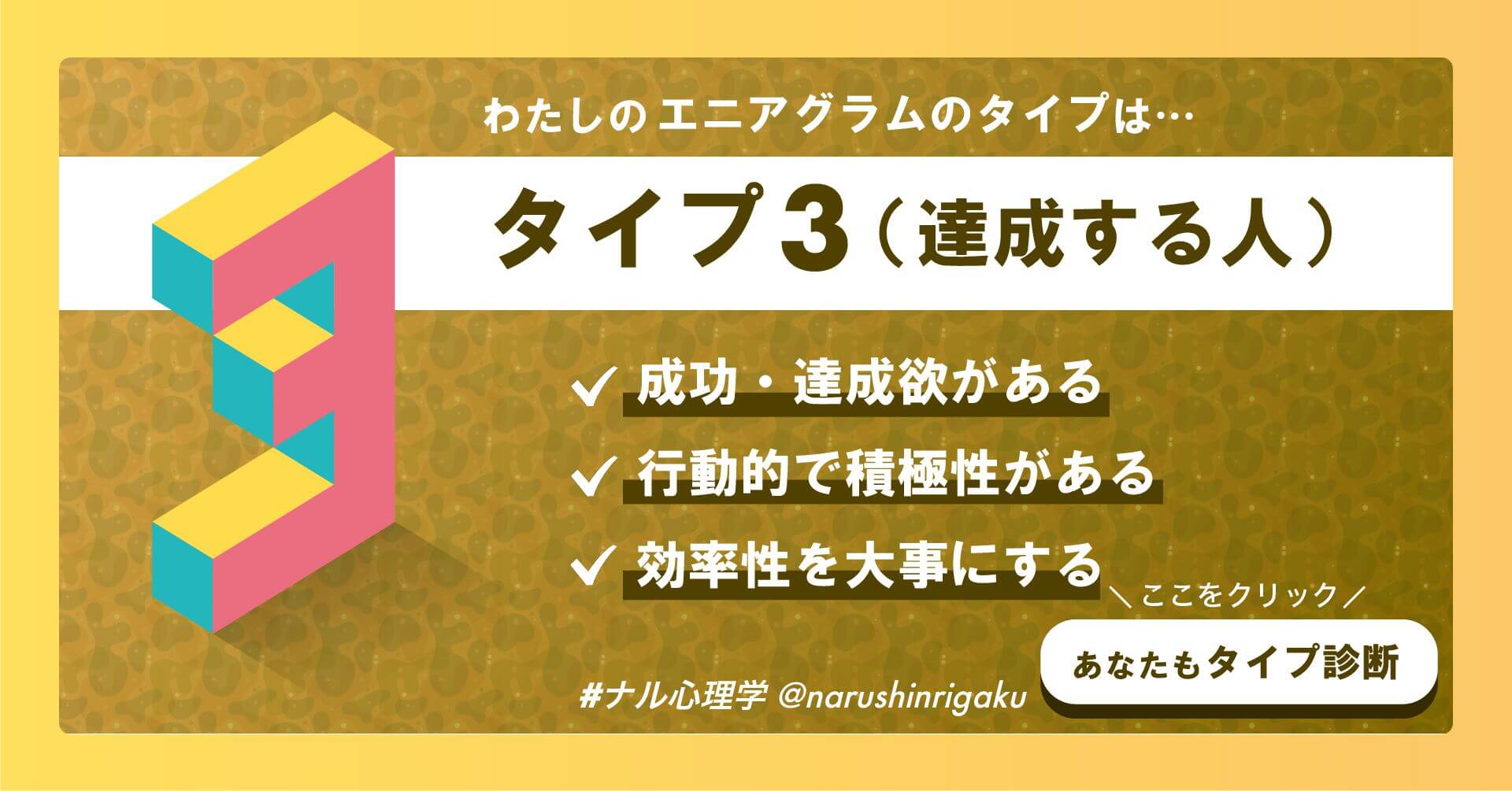
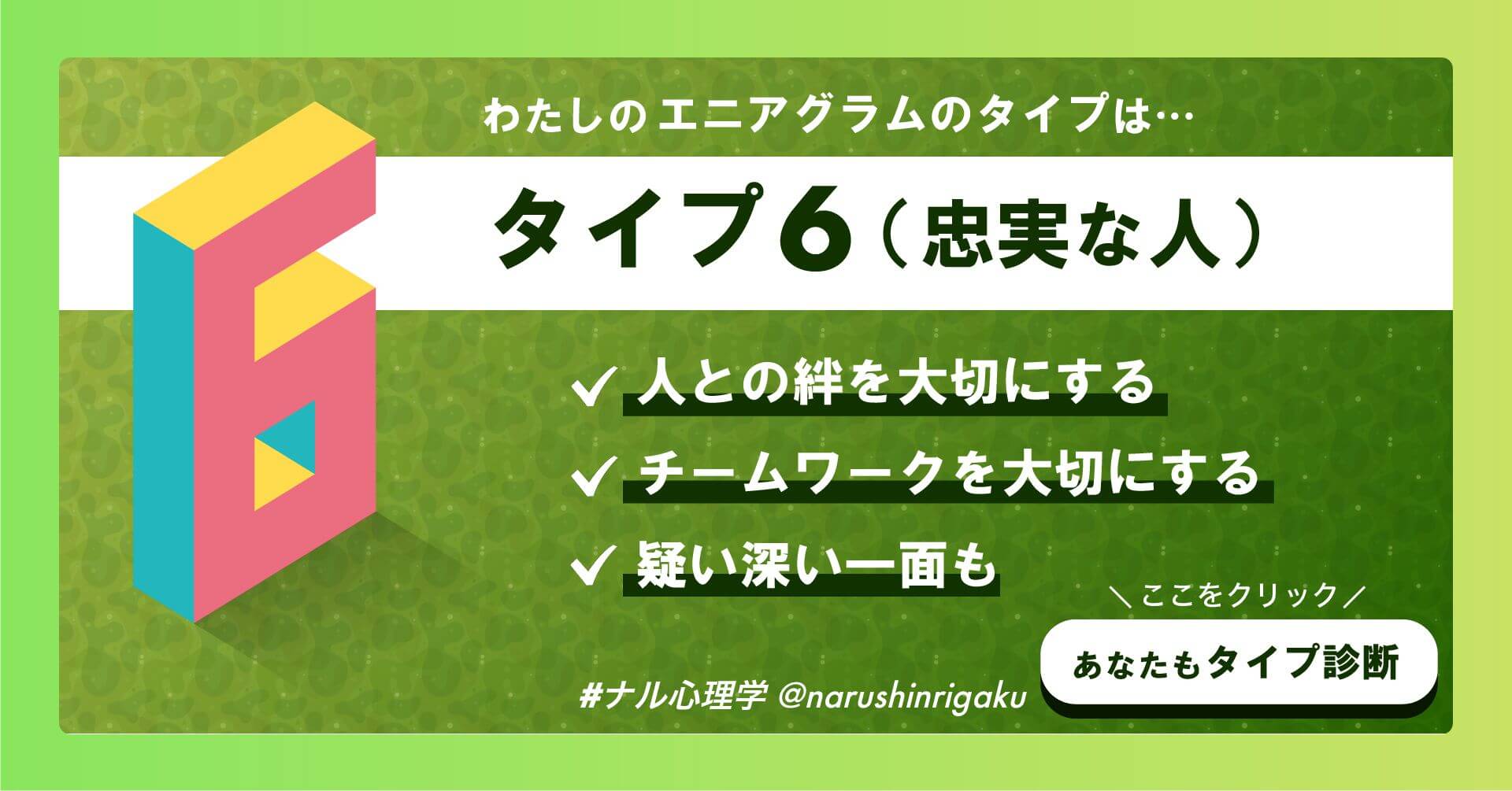
List of Enneagram types (click to view)
Click here to see other types! ↑
comment