
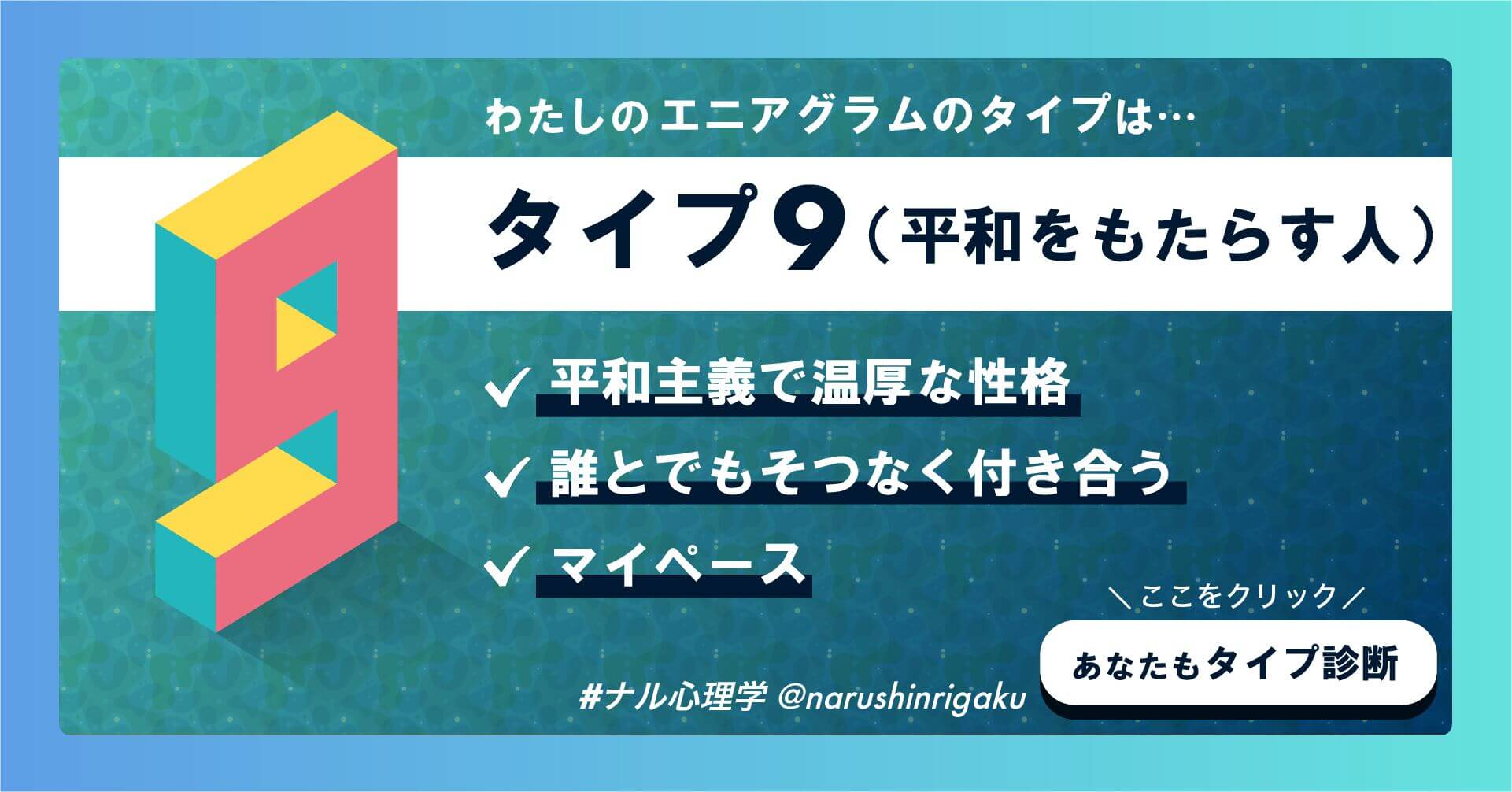
The Enneagram test results are...
Type 9!
Below are the details of your diagnosis:
Enneagram diagnostic results
Naru Psychology / @narushinrigaku
Diagnosis resultsShare it on social media (tweet it) and let your followers know!
↓↓↓
Enneagram personality testType 9I will explain this.
first,"EnneagramThis is a personality test that divides people into nine personality types.
The Enneagram is a personality type system that describes patterns of how people interpret the world and process emotions. The Enneagram describes nine personality types and explains the relationships between types by mapping each type onto a diagram with nine points.
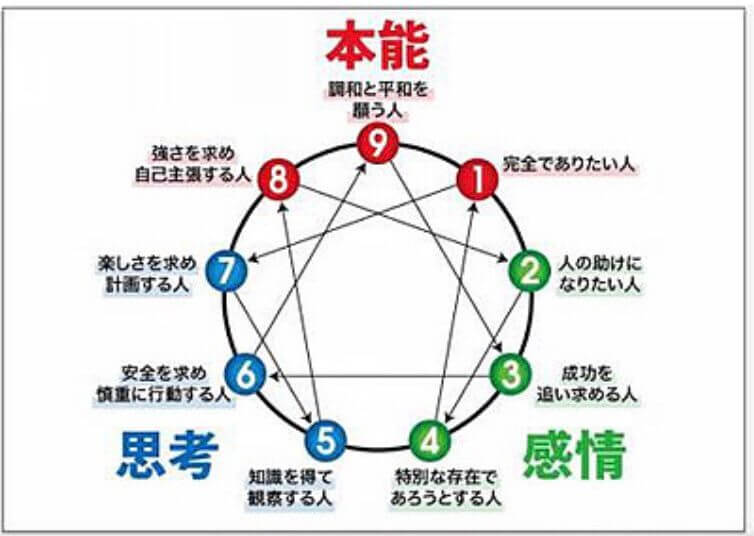
Characteristics and explanations of Enneagram types 1-9! (Quoted from)
↓EnneagramPersonality assessmentLet's try it!! ↓



A brief explanation of Type 9
Type 9 is...
A laid-back, self-tolerant type.
Accepting, reassuring, and friendly.
- desire"The pursuit of peace"
- 囚I"If I'm not kind, no one will love me."
Simple explanation
They tend to maintain inner peace and harmony, and try to avoid conflict and emotional turmoil. Generally, they are friendly, gentle, and easy to be around.
This type is easily accepted, trustworthy, and stable. They are creative, optimistic, and cooperative, but they may also be willing to compromise to maintain peace. They desire everything to go smoothly and without conflict, but they tend to become complacent by oversimplifying problems and minimizing upset. They can also be inert and stubborn.
They tend to go with the flow, but they dislike being controlled by others and will resist passively if forced. When heading towards collapse (stress), they suddenly become unhealthy.Type 6This can lead to feelings of anxiety and worry. However, moving in the direction of integration (growth) leads to a healthy state.Type 3In this way, you will grow more and become more energetic.
Details of Type 9
Type 9s are keen to pursue inner and outer peace for themselves and others. They seek peace and harmony in their own world and strive to maintain inner peace. In groups of friends and colleagues, they often work behind the scenes to maintain harmony. From childhood, they knew how to get along with classmates and are well-suited to group work. They easily understand that there are multiple sides to an issue and do not jump to conclusions. This type appreciates the small actions of others and the simple joys of life.
Type 9 is a type that is inclined towards the spiritual world,Type 8・Type 1Along with these, they belong to the Enneagram's "instinct type (body type)." All three types have anger as a core emotion. Type 1 emphasizes self-control by suppressing anger, while Type 8 emphasizes expressing anger and controlling others. On the other hand, Type 9 focuses on avoiding anger and maintaining inner peace. Although Type 9 may appear friendly at first glance, they actually resist external control, much like Type 8, and this resistance is passive.
Type 9s sometimes withdraw into their minds or emotional fantasies. (Therefore, they may...)typeやType 7The "brainy type (center)",Type 2やType 4This can sometimes be mistaken for the "emotional type (center)".
Because Type 9 is positioned at the pinnacle of the Enneagram symbols and appears to encompass the whole, it is sometimes called the crown of the Enneagram.Type 8The strength of,Type 7The fun and sense of adventure,Type 6obedience,Type 5intelligence,Type 4Creativity,Type 3The charm ofType 2The generosity of,Type 1They possess idealism and other positive traits. However, generally speaking, Type 9s often lack a strong sense of self-identity.
Ironically, the type that Type 9s dislike the most is Type 9 itself. Being an independent individual, having to assert oneself to others, is terrifying for this type. Rather, they would prefer to blend in with others or quietly indulge in idyllic daydreams.
Many Type 9s grow up in environments where they are forced to mediate conflicts between their parents and other family members. Surrounded by intense emotions, they learn to downplay their own feelings from a young age. Type 9s seek a degree of peace and comfort by ignoring the unsettling aspects of life. They cope with pain and suffering by trying to live in a premature state of peace, such as a false sense of accomplishment. More than any other type, this type tends to run away from life by trying to avoid its paradoxes and tensions, and by seeking simple, painless solutions to problems.
Of course, there's nothing wrong with emphasizing the fun aspects, but that's only a limited approach to life. Of course, other types also have distorted perspectives. For example, Type 4s focus on their own wounds and victim mentality, while Type 1s focus on what's wrong with the current situation. On the other hand, what this type needs to understand is that it's not about denying the dark side of life, but that all the perspectives presented by other types are also true.
Healthy Type 9s are excellent persuasives and mediators who can help others understand different perspectives. Unhealthy Type 9s, on the other hand, are characterized by apathy, excessive passivity, and high levels of self-criticism.
This type grows by deepening their connection with their true selves, prioritizing their own desires, and learning to express their wishes and needs to others.
Shy, timid, lazy
They are the type who don't like to stand out, yearn for peace and harmony, and are very afraid of causing conflict or disputes. Because they don't try to stand out, they tend to be shy, timid, and lazy. They love peace and hate hardship. If they want to do something big, they need to push themselves to the limit.
Interpersonal relationships
In many situations, you are a pacifist, understanding, and easygoing. While it's easy for you to understand others, you may sometimes appear indecisive because you're unsure of your own desires. You tend to be less proactive, preferring to go along with others' plans and be a supportive figure, which can lead to a passive approach.
Main personality traits
- I'm not good at rejecting people.
- Liked by many people
- It takes time to make a decision.
- A calm and composed demeanor
- A calm voice
- The ability to resolve conflicts smoothly
- Wide circle of friends
- They don't know how to express anger.
- Slow, flowing movements
values
- I am an idealist and aim to be a leader who brings people together, whether it be family, friends, or colleagues.
- The quickest way to win over this type of person is to acknowledge their contributions and reaffirm their importance.
Elements that make up Type 9
Basic fear: A sense of loss or separation.
This fear is dealt with by conforming to the desires and intentions of those around you; in other words, you become friendly in order to be accepted into the group.
basic needsI want to achieve inner peace and stability.
Main motivationI want to create harmony in my environment, avoid conflict and tension, maintain the status quo, and resist anything that disturbs or hinders me.
They are driven by a desire to seek peace and harmony in their surroundings, to avoid conflict, and to deal with unpleasant emotions.
Tips for growth
- Pay attention to your own desires and needs.You have a habit of forgetting yourself and conforming to the desires and needs of others. You're afraid that asserting yourself will cause conflict and discomfort. But can you truly build satisfying relationships by constantly fulfilling others' wishes? What you must remember is that you cannot love someone unless you are empathetic to their feelings. In other words, you must be yourself and (paradoxically) independent. Furthermore, suppressing your own desires limits your potential for growth. Take some time to reflect on your thoughts and feelings without listening to external opinions in order to understand what you truly want.
- Try listening to your own body.Just like mental health, physical health is often neglected. Regular exercise and meditation allow you to connect with your body and understand what it needs to grow. It also increases your awareness of your emotions. Increased body awareness helps improve focus and attention in other areas of life. Furthermore, exercise is suitable for addressing and expressing certain aggression. Exercise frequently and pay attention to your body and emotions. (Some people of this type believe that simply running around for errands is enough exercise.)
- Let's learn to find value in conflict.Expressing yourself can sometimes lead to conflict, but it can also lead to building deeper and more meaningful relationships. Cherish opportunities to connect with others by communicating your thoughts and accepting differences of opinion.
- Recognize that you too have aggression, anxiety, and other emotions, and that you need to deal with them.Negative emotions and impulses are a part of you, and they affect you emotionally and physically whether you acknowledge them or not. Furthermore, negative emotions are often expressed carelessly, hindering the peace and harmony you seek in relationships. At the very least, becoming aware of your emotions is the best way to be open about things.
- Don't be afraid to assert yourself.If you feel uncomfortable asserting your opinions directly in conversations, practice with someone you trust the most. This will help you become more comfortable expressing your views in everyday conversations.
- Let's immerse ourselves in the adventure.You tend to value the routine and resist change. Challenge your resistance to change by exploring ways to take control of your life. Step outside your comfort zone and think about ways to be more adventurous. Motivate yourself. You must motivate yourself and pay attention to what is happening in reality. Don't ignore people or daydream. Pay attention to actively participate in the world around you. Be more proactive, both mentally and emotionally.
- It is extremely difficult, but if you have divorced in your marriage or are experiencing problems in your relationship with your children, you need to honestly examine what you did to cause the situation.Relationship problems are especially difficult because they involve people who are close to you. Much of your identity and self-esteem stems from your feelings towards others. However, if you truly love someone, you should be able to examine what role you played, no matter what conflicts arise. In other words, it's a simple choice: sacrificing short-term peace of mind for long-term relationship satisfaction.
The "stages" in the Enneagram
* This chapter is,Stages (Enneagram)This is a quote from "[source]".
3 stages
Healthy (Stages 1-3)
- Problems stemming from obsession, primal fears, and desires.The state in which the problem has been resolved.
- In this state,freedomやsense of freedomYou can feel
Normal (Stages 4-6)
- The so-called "normal" state
- Most of us are in this state.
Unhealthy (Stages 7-9)
- Freedom is restricted,A state of suffering both physically and mentally.
- In other words, "sick"
- Stage 9 is no longerterminal stageThat is
- If you become unhealthy, you either fall even further down or have no choice but to call for help.
Stage 9
Click to display ↓
healthy
Stage 1: "A calm and collected guide"
- The misconception that one is unimportant disappears, and one can communicate with oneself and others.We can connect with each other from the heart.
- As a result of self-realization,Calm and gentle, yet with a strong presence.
Stage 2: "A highly receptive person"
- You will be able to keep an eye on your surroundings.
- I want to maintain harmony and stability in myself and those around me.
- Self-image"I am stable, laid-back, and kind." You will be able to have it in this form.
Stage 3: "A cooperative mediator"
- In my own worldPeace and HarmonyBy creating and maintaining itStrengthening self-image
- To mediate conflicts or patiently approach people to heal them.
usually
Stage 4: "A person who acts out a role to suit others."
- I begin to fear that the conflict might "shatter my inner peace."
- To avoid conflict,You'll start agreeing to things you don't want to do.
Stage 5: "People who only interact superficially"
- "What if significant changes or strong emotions in my world disrupt the peace in my world?"I worry
- Try not to be influenced by things,As beforeTrying to do it
- Take it easy and ignore the problem.
Stage 6: "A Resigned Fatalist"
- Being asked for some kind of response causes anxiety and disrupts inner peace.fear
- Underestimating the problem,Trying to distract someone
- Clinging to desires and angersuppressionTrying
unhealthy
Stage 7: "Vulnerable people who do not comply with demands"
- Faced with reality, one is forced to confront the problem.fear
- In every effortResisting, depressed, powerless, unmotivated
Stage 8: "Dissociated Automaton"
- To accept reality, even just a littlefear
- By cutting off relationships or denying reality, you can eliminate things that might affect you.To shut out of one's consciousness
- lonelinessでNo sensationでpowerlessIt becomes
- It can even lead to memory loss.
Stage 9: "The Desperate Ghost"
- Completely unable to face realityI feel
- To protect the illusion of peace,Splitting into sub-personalitiesThere are also
What happens when a Type 9 person takes a 16-type personality test...?
People with type 9 personality,16-Type Personality TestIf you receiveISFP (Artist type)、ISFJ (Parental Type)This often applies to people of this type. Common characteristics of this type include being cooperative, pacifist, and surprisingly stubborn.
↓Click here if you want to find out your personality type from the 16 personality types↓

↑Try taking the 16-type personality test↑
Related articles ↓
List of Enneagram types (click to view)
Click here to see other types! ↑

comment