

"Ketone bodies" are short-chain fatty acids produced in the mitochondria of liver cells when glucose in the body is depleted! So, that concludes our explanation of ketone bodies.
So, what is the difference between "ketone bodies" and "short-chain fatty acids"? Simply put, “The pathways through which they are produced are different.” That's all there is to it (and this is focused solely on energy sources).Understanding the difference in these production pathways reveals the difference between 'ketone bodies' and 'short-chain fatty acids'.This will be key to determining which is healthier.
Ketone bodies and short-chain fatty acids are short-chain fatty acids produced through different pathways. Both serve as alternative energy sources to glucose, and because they have small molecules like glucose, they can cross the blood-brain barrier and become an energy source for the brain.
Next, let's take a closer look at the production pathways for ketone bodies and short-chain fatty acids.


'Ketone bodies' and 'short-chain fatty acids' are produced through different pathways.
Ketone bodies are substances produced in the mitochondria of liver cells when glucose in the body is depleted, and they are short-chain fatty acids that the body produces during starvation.
The short-chain fatty acids obtained from a short-chain fatty acid diet are substances produced as fermentation products when intestinal bacteria ferment and break down "beta-starch (indigestible starch)," "cellulose (insoluble dietary fiber)," and "soluble dietary fiber" (indigestible components) in raw grains (such as raw brown rice).
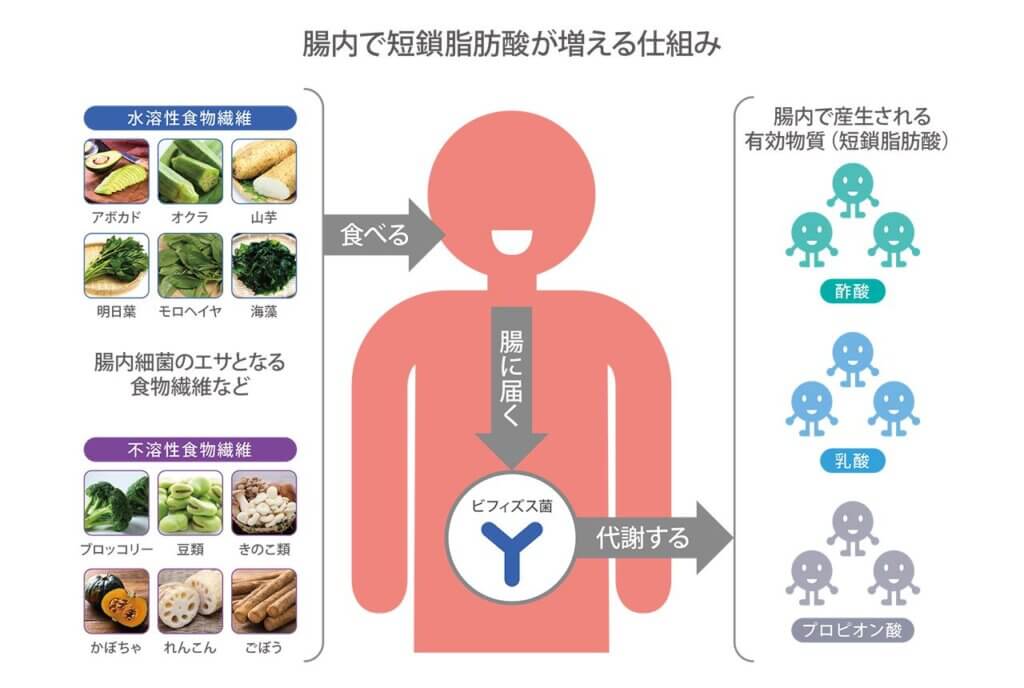
The above diagram shows,The key to increasing the much-talked-about short-chain fatty acids is dietary fiber and gut health. (Quoted from)
Both "ketone bodies" and "short-chain fatty acids" are "fatty acids with small molecules," and these are called "short-chain fatty acids."
These "small-molecule fatty acids" can cross the blood-brain barrier and reach brain cells because of their small size, thus becoming an energy source for the brain. Other "large-molecule fatty acids" cannot do this (they cannot cross the blood-brain barrier and therefore cannot become an energy source for the brain).
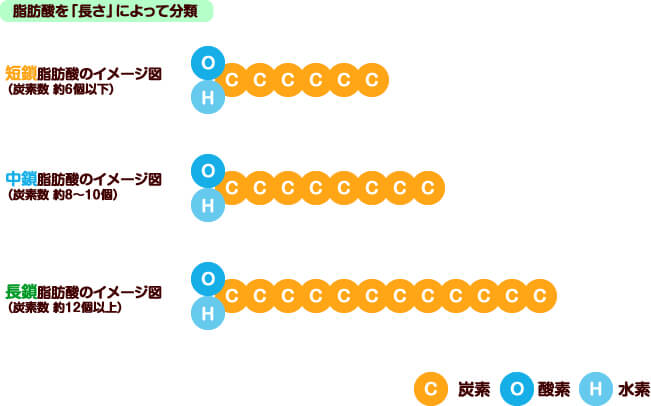
The above diagram shows,Caregiving Column 24 [Medium-Chain Fatty Acids] (Quoted from)
Ketone bodies are short-chain fatty acids that the body produces when it enters a state of starvation and its glucose reserves are depleted. These are short-chain fatty acids produced within the body. [Short-chain fatty acids produced via the internal production pathway]
The short-chain fatty acids obtained through a "short-chain fatty acid diet" are produced automatically by gut bacteria through fermentation and decomposition, provided you consume raw brown rice flour (raw brown rice: β-starch) and raw vegetables (insoluble dietary fiber, cellulose, and soluble dietary fiber). These are short-chain fatty acids produced by gut bacteria. [Short-chain fatty acids produced via the gut bacteria pathway]
To summarize the above,
- Ketone bodies
Starvation ⇒ Depletion of glucose in the body ⇒ Ketone bodies are produced from fatty acids in the mitochondria of liver cells.
[Short-chain fatty acids produced in the body] [Short-chain fatty acids produced via the body's internal production pathway] - Short-chain fatty acids
"Beta-starch" and "insoluble dietary fiber (cellulose) and soluble dietary fiber" go to the large intestine undigested! ⇒
⇒ Intestinal bacteria ferment and break down these ⇒ Short-chain fatty acids are produced as a fermentation product.
[Short-chain fatty acids produced in the body by gut bacteria] [Energy source of short-chain fatty acids produced via gut bacteria]
That's how it works.
Simply put, ketone bodies and short-chain fatty acids are both short-chain fatty acids, but they are produced through different pathways.
The entire process leading up to the production of "ketone bodies" is called "ketone production," but for more details,What is ketone production? Let's look at its mechanism. Please refer to the following.
Production pathways for ketone bodies and short-chain fatty acids

The above diagram shows,392) Ketogenic Diet and Dietary Fiber (Quoted from)
At the bottom, on the left side it says "Short-chain fatty acids: Gut bacteria," and on the right side it says "Ketone bodies: Liver."
Right sideKetone bodies: Liver"Ketone bodies" are an energy source (= short-chain fatty acids produced by the body) obtained through a pathway produced in liver cells (when glucose is depleted), and are short-chain fatty acids produced through the "in-vivo production" pathway.
Left sideShort-chain fatty acids: Gut bacteriaThis is a short-chain fatty acid energy source obtained through a pathway produced by intestinal bacteria; it is a short-chain fatty acid produced through the intestinal bacteria pathway. This is an "alternative energy source" to glucose, which will be automatically produced by intestinal bacteria through fermentation and decomposition, provided you have a diet consisting of raw brown rice flour (raw brown rice: β (beta) starch) and raw vegetables (insoluble dietary fiber cellulose and soluble dietary fiber).
Furthermore, the 'short-chain fatty acids' produced through the [internal production] pathway.The production of ketones absolutely requires the condition that "glucose in the body is depleted."And because it is "produced by the body," it requires energy to produce.
(Ketone bodies cannot be produced unless the body is depleted of glucose.)
However,The short-chain fatty acids obtained through the [intestinal bacteria production] pathway do not require the condition of "depletion of glucose in the body." If you eat a diet of raw brown rice flour (raw brown rice: β (beta) starch) and raw vegetables (insoluble dietary fiber cellulose and soluble dietary fiber), your intestinal bacteria will ferment and break them down and produce them on their own.The body can obtain short-chain fatty acids, which serve as an "alternative energy source" to glucose, without using any energy at all.This one's a better deal!
These "ketone bodies" and "short-chain fatty acids" serve as an "alternative energy source" that can replace (or even surpass) glucose. Since cancer cells cannot utilize them, they can nourish only normal cells without promoting the growth and proliferation of cancer cells.

comment