

When restricting carbohydrates, it's not enough to simply limit, suppress, or eliminate carbohydrates (glucose).
Because the body needs "some kind of energy source."
If you restrict, suppress, or eliminate carbohydrates (glucose), you must consume energy sources other than glucose that your body can utilize, such as "ketone bodies" and "short-chain fatty acids."It is necessary to take measures to prevent "gluconeogenesis" (the production of glucose within the body) from occurring in the body.is.


What is gluconeogenesis?
Even if you don't consume any carbohydrates (glucose) at all, your blood sugar level will not drop to zero.This is because the liver produces sugar (glucose) from amino acids, lactic acid, glycerol, etc."Gluconeogenesis"This is because the liver performs gluconeogenesis, so even if you don't consume any carbohydrates (glucose), your blood sugar levels will remain normal.
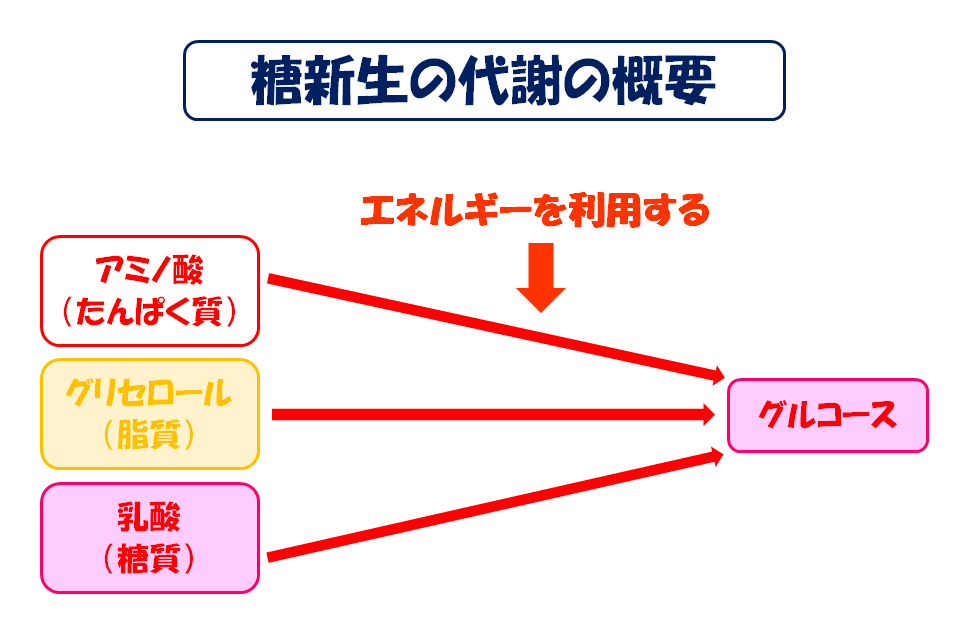
The above diagram shows,[This will clear things up!] A summary of the key points of the mechanism and metabolic pathway of gluconeogenesis! (Quoted from)
More specifically, gluconeogenesis is "a pathway in which animals in a state of starvation produce glucose (grape sugar) from non-carbohydrate substances such as pyruvate, lactate, glucogenic amino acids, propionic acid, and glycerol, using the secretion of glucagon as a signal."
As a side note, the opposite of gluconeogenesis, the process of converting glucose into another substance, is called glycolysis.
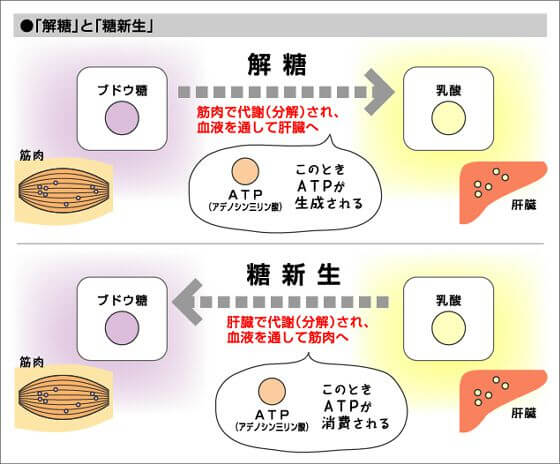
The above diagram shows,- Episode 18: Lactic Acid - Other Diabetes Tests (Quoted from)
Even if you're restricting carbohydrates, if glucose is produced in your body through "gluconeogenesis," it ultimately becomes the same as if you were consuming glucose normally.
To prevent the body from undergoing "gluconeogenesis" when glucose levels in the body are depleted, it is essential to consume an alternative energy source (such as ketones or short-chain fatty acids).
Otherwise, when the body's glucose stores are depleted, the body is forced to produce glucose through "gluconeogenesis." In this way, the body protects itself by responding to a "shortage" of glucose, an energy source. This is a "human body system that tries to protect itself," so it is a perfectly correct reaction.
If you only restrict carbohydrates, your body is still in a "glucose-dependent" state (a body that relies on glucose as its energy source).
In other words, even if you reduce your glucose intake through carbohydrate restriction, your body is still in a "glucose-dependent" state, so it tries to compensate for the glucose deficiency (glucose depletion) by producing glucose internally through "gluconeogenesis." This is because there are absolutely no other energy sources (other than glucose) available in the body.
Alternative energy sources to glucose: "Ketone bodies" and "short-chain fatty acids"
When restricting, limiting, or eliminating carbohydrates (glucose) as an energy source, it's crucial to ensure that you have some kind of alternative energy source in your body; otherwise, health problems may arise. To successfully implement a low-carbohydrate diet, it's essential to ensure you have access to other energy sources that your body can utilize (such as ketones and short-chain fatty acids).
Ketone bodies and short-chain fatty acids are "superior energy sources" to glucose, making them beneficial for health.
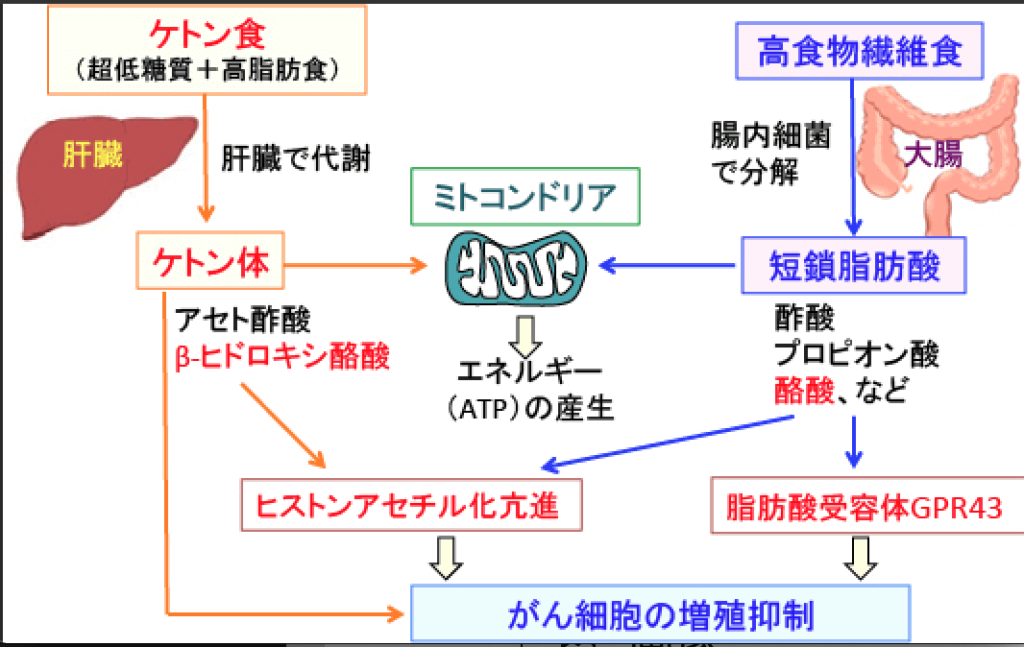
The above diagram shows,392) Ketogenic Diet and Dietary Fiber (Quoted from)
Excessive glucose intake, as is common among modern people, can be a cause of disease. Furthermore, reducing glucose intake significantly improves the condition. As long as glucose is consumed at normal levels, diseases tend to progress and worsen. While glucose is a very useful energy source for the body, it is also a tricky substance that causes problems when consumed in excess (though, of course, excessive consumption of anything causes problems).
To safely limit, suppress, or eliminate carbohydrates (glucose), it is essential to ensure that the body has sufficient energy sources other than glucose, such as ketone bodies and short-chain fatty acids, so that when glucose is depleted, the body does not have to resort to gluconeogenesis to produce glucose.
“If you can secure alternative energy sources (such as ketones and short-chain fatty acids) in your body, you can avoid gluconeogenesis, thus preventing the intake of excess glucose and allowing you to safely restrict, control, or eliminate carbohydrates (glucose).
When implementing a low-carbohydrate diet, please also consider the following: "By consuming alternative energy sources (ketone bodies and short-chain fatty acids) to replace glucose and ensuring they are available in the body, you can prevent the body from producing glucose through gluconeogenesis."
For more details on "ketone bodies" and "short-chain fatty acids," please see below ↓
- "Ketone bodies" are short-chain fatty acids produced in the mitochondria of liver cells when glucose in the body is depleted!
- What is the difference between 'ketone bodies' and 'short-chain fatty acids'?
- What is ketone production? Let's look at its mechanism.
The idea that "carbohydrate restriction = eliminating carbohydrates" is incorrect.
Furthermore, the understanding that "restricting, suppressing, or eliminating glucose intake" is equivalent to "cutting out carbohydrates" is inaccurate.
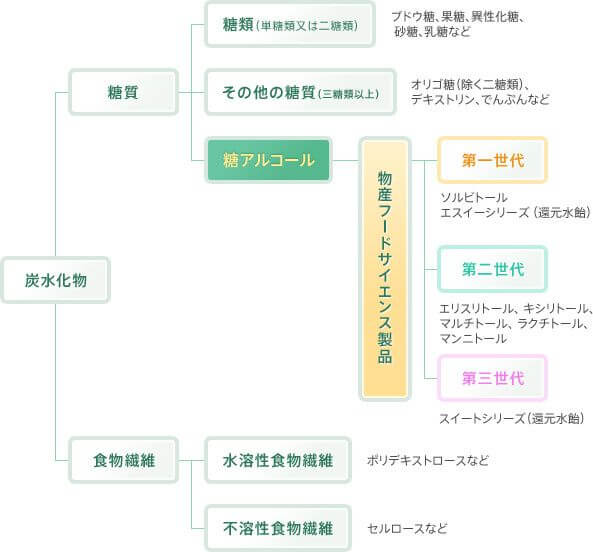
The term "carbohydrates" includes "sugars (monosaccharides and disaccharides)" and "other carbohydrates (trisaccharides and above)."Among the various types of carbohydrates, "other carbohydrates (trisaccharides or higher)" includes "starch." Naturally occurring crystalline starch is called "beta-starch," which is a type of "resistant starch" that is difficult to digest and cannot be digested by human digestive enzymes. This beta-starch passes through the small intestine undigested (i.e., not broken down into glucose) and reaches the large intestine, where it is fermented and broken down by intestinal bacteria to produce short-chain fatty acids.If consumed as "beta-starch," it will not result in glucose intake, but rather the intake of "short-chain fatty acids."That's right.
When "beta starch" is heated, it gelatinizes to "alpha starch" (starch in which the hydrogen bonds between sugar chains are broken, and the sugar chains become free). This "alpha starch" is then digested by human digestive enzymes and broken down into "glucose," so consuming "alpha starch" is equivalent to consuming "glucose."
If you're going to restrict carbohydrates, make sure to eat fiber.
Dietary fiber is not digested by human digestive enzymes, but is fermented and broken down by intestinal bacteria in the large intestine to produce "short-chain fatty acids."As mentioned above,Short-chain fatty acidsIt serves as an alternative energy source to glucose.
In other words,Even when restricting carbohydrates, if you consume enough dietary fiber, your body will use short-chain fatty acids as energy, so gluconeogenesis will not occur.

comment