
MBTI(MBTI: Myers-Briggs Type Indicator)It is very accurate.Personality testIt is known that each person has their own strengths (things they use often)Psychological functions (cognitive functions)It is believed that there is a reason for this.
MBTIIf you are not yet familiar with this topic, please refer to the article below.

check! The eight psychological functions (cognitive functions) are
| Psychological functions (cognitive functions) | English name | abbreviation | ||
| 知 覚 | 感 覚 | Extroverted Sensing | Extraverted Sensing | Se |
| Introverted Sensing | Introverted Sensing | Si | ||
| 直 観 | Extroverted Intuition | Extraverted Information | Ne | |
| Introverted Intuition | Introverted Institute | Ni | ||
| 判 断 | 思 考 | extraverted thinking | Extraverted Thinking | Te |
| introverted thinking | Introverted Thinking | Ti | ||
| 感 情 | extraverted feeling | Extraverted Feeling | Fe | |
| introverted feeling | Introverted Feeling | Fi |


The mechanism of type classification
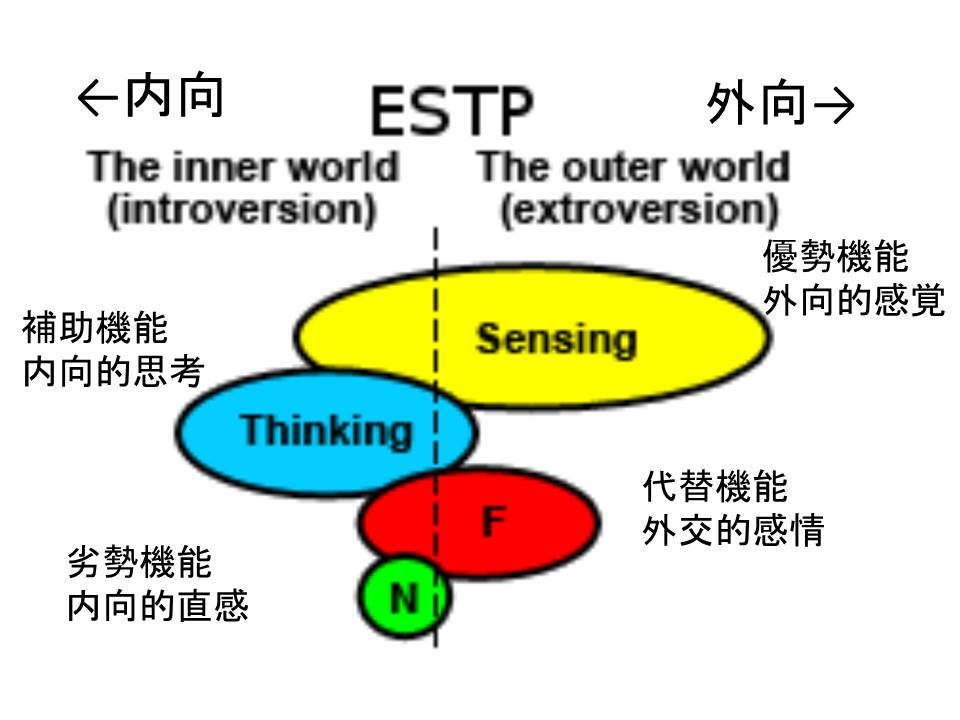
For example, if you are an ESTP type, your strongest psychological functions (cognitive functions) would be listed as follows:
- Dominant features:Extroverted Sensing(Very good at it)
- Assistive functions:introverted thinking(Somewhat good at it)
- Alternative function:extraverted feeling(I'm not very good at it)
- Inferior function:Introverted Intuition(I'm really bad at it)
The following is a quote (with some modifications) from "Let's Look at the World from the Perspective of MBTI Personality Type Theory" (website no longer exists).
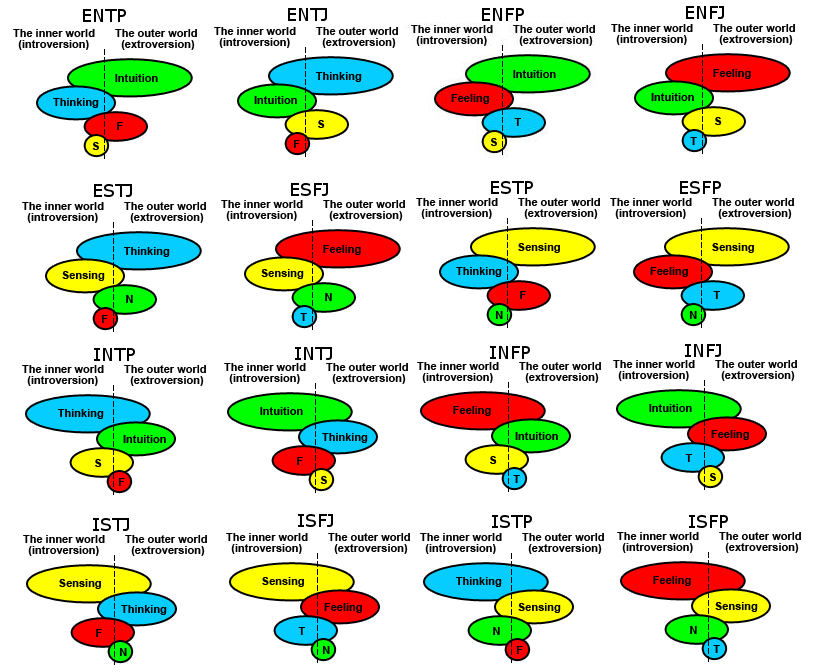
Each personality type is determined by which of the eight psychological functions a person trusts and relies on the most, and which they find difficult to rely on. Please see the following diagram.
In this way, personality types are explained by the permutation of psychological functions. The left side of the vertical dotted line represents the internal realm of consciousness, and the right side represents the external realm. The four psychological functions are arranged from top to bottom in order of the extent of their influence. Each type consciously utilizes all four psychological functions, and they are called the first, second, third, and fourth psychological functions, in order of their influence, from most powerful to least powerful. The top psychological function is the most dominant, and the use of each function weakens in turn. Based on this order, the characteristics of each type can be explained. For example, in the example in the diagram above, the first psychological function of an ESTP is extroverted sensing (Se), and as a starting point, they are broadly interested in the physical aspects of the outside world and actively gather information. On the other hand, internally, the second psychological function is very active, analyzing the information obtained from observing the external world, always seeking a logical and consistent understanding, and trying to solve problems efficiently. ...and so on.
The four psychological functions become less user-friendly and less likely to manifest their benefits in the order of first, second, third, and fourth. This also represents the priority and temporal flow of the psychological functions used when dealing with things. The first and second psychological functions are what largely characterize each type of personality. Normally, these two psychological functions can be used effortlessly and have a major influence on information gathering and decision-making. The third psychological function is often consciously recognized, but because it has the opposite nature to the second psychological function, the second function is usually prioritized. As a result, it is difficult to become familiar with the workings of this psychological function, and its development is delayed. The fourth psychological function is the most difficult to use consciously. This is because it has the opposite nature to the first psychological function, which is the most trusted. Therefore, the positive aspects of the third and fourth psychological functions do not become a person's strengths. These functions gradually become more effective from the middle of life onward, and develop unconsciously.
There are eight psychological functions, and in reality, all of them are used, but four psychological functions are particularly characteristic of personality. The remaining four psychological functions work in the background of consciousness and are utilized, but they are not very important when describing the characteristics of each type.
End of quote from "Let's Look at the World from the Perspective of MBTI Personality Type Theory" (website no longer exists) (partially modified)
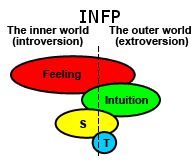
Diagram of all types ↓
comment