
In MBTI, each individualPsychological functions (cognitive functions)Of these,It is important to understand which aspects are developing and to what extent.That is. Of the eight psychological functions, that personOrder and degree of developmentTherefore, we refer to them as follows:
- First function (main function*)→ The psychological function that person started using from childhood and developed the most.(*Also known as the dominant function)
- Second function (auxiliary function)→ The next psychological function to develop. It works to support the primary function.
- Third function (alternative function)→ A psychological function that plays a supporting role to the primary psychological function when the secondary psychological function is not working effectively. It is usually hidden in the shadow of the secondary function.
- Fourth function (inferior function)→ A psychological function that has been strongly suppressed, hidden in the shadow of the development of the primary psychological function. It is the least developed.
Further details will be explained below.


- What are dominant, auxiliary, substitute, and inferior functions?
- The primary psychological function (dominant psychological function)
- The second psychological function (a psychological function that plays a supporting role)
- The third psychological function (alternative psychological function, child function)
- The fourth psychological function (the inferior psychological function, the longing psychological function)
What are dominant, auxiliary, substitute, and inferior functions?
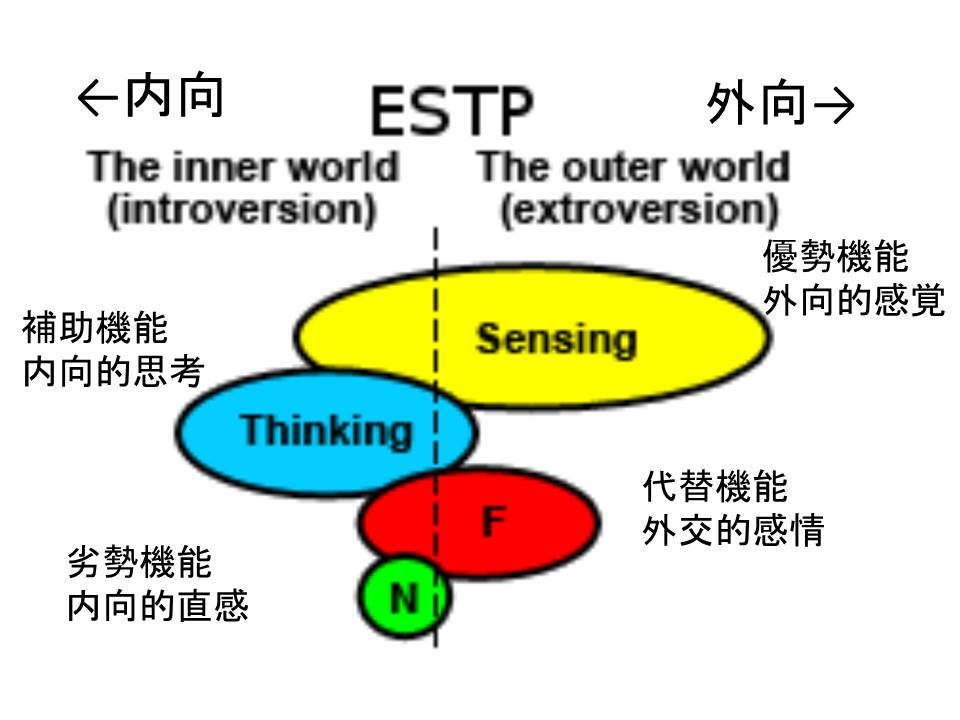
for example,ESTP (Adventurer type)If you are this type, your strongest psychological functions (cognitive functions) would be listed below in order.
- Dominant features:Extroverted Sensing(Very good at it)
- Assistive functions:introverted thinking(Somewhat good at it)
- Alternative function:extraverted feeling(I'm not very good at it)
- Inferior function:Introverted Intuition(I'm really bad at it)
↓Click here if you want to find out your personality type from the 16 personality types↓

↑Try taking the 16-type personality test↑
This time,We will now provide a more detailed explanation of dominant, auxiliary, substitute, and inferior functions.
The following is a quote (with some modifications) from "Let's Look at the World from the Perspective of MBTI Personality Type Theory" (website no longer exists).
The primary psychological function (dominant psychological function)
It is a psychological function that develops from childhood and is the most active in a person.
They are familiar with the workings of this psychological function and can use it without difficulty. Furthermore, they can effectively leverage the advantages of this psychological function, making it a strength of theirs.
On the other hand, there is a tendency to rely too much on the workings of this psychological function, which can lead to biases in perception and cause problems. Over-reliance on this psychological function manifests as a disadvantage.
This psychological function will develop most strongly throughout your life, and you will be most strongly influenced by its workings.
The second psychological function (a psychological function that plays a supporting role)
It is the second most active psychological function after the primary psychological function, and plays a supporting role to the primary psychological function.
They begin to demonstrate their strengths around their teenage years and start working without difficulty.
It balances both extroversion-introversion and information reception-judging in relation to the primary psychological function.
When the first and second psychological functions work together, the problems that arise from over-reliance on the first psychological function are eliminated. The biases in how we perceive things that were formed in early childhood by the first psychological function are somewhat resolved.
However, this second psychological function can also often become too strong, leading to harmful consequences.
The primary and secondary psychological functions determine the strengths of that type.
The third psychological function (alternative psychological function, child function)
This is a psychological function that plays a supporting role to the primary psychological function when the secondary psychological function is not working effectively.
The development of this psychological function follows the development of the first and second psychological functions. It works to some extent, but it rarely becomes a sustained advantage.
While I don't particularly suppress it, I still trust the second psychological function, which has the opposite characteristics. Even if the third psychological function comes to my conscious awareness, it gets pushed into the shadow of the second psychological function when it becomes active.
It's more common to recognize the value of this third psychological function. I'm impressed when I see someone whose psychological function is dominant.
Throughout one's life, balancing the second and tertiary psychological functions becomes a recognized challenge. When the shortcomings of the second psychological function are likely to have a significant impact, it is desirable to rely on the tertiary psychological function, but in most cases, this is not easily achieved.
It will likely take until around the age of 30 at the earliest to achieve such a stable balance. By balancing and utilizing the second and third psychological functions, you can gain great stability and psychological benefits.
The fourth psychological function (the inferior psychological function, the longing psychological function)
This is a psychological function that has been suppressed and hidden in the shadow of the development of the primary psychological function.
When we encounter someone with a strong function of this psychological trait, we usually feel aversion. Other negative emotions and undesirable effects may also appear. This is because they represent the exact opposite of what we most trust and believe to be true.
However, the opposite characteristic also exists within the person experiencing the aversion, and it operates, albeit to a limited extent.
In reality, it is essential for the primary psychological function to work properly. However, this fact is rarely acknowledged.
This is the least developed psychological function, and focusing on it requires considerable energy. It is not well-suited to effectively utilizing the fourth psychological function. There is little prospect of it becoming a consistent strength.
However, this fourth psychological function is what largely characterizes each type. Because it is repressive, the way people interact with this psychological function varies greatly.
There is a tendency to move from one extreme to the other, and this psychological function can be either obsessively clung to or completely rejected.
When we are forced to activate this function, negative emotions arise, and we perceive it as an obligation. However, if we want to accomplish something, we must effectively utilize this psychological function. This is especially true in the final stages.
Unfortunately, this unconscious repression of the fourth psychological function is self-suggestive, and even when necessary to accomplish something, it unconsciously leads to failure when it is activated.
When we experience stress, this psychological function can manifest in an unhealthy way.
Even when you are engrossed in your primary psychological function, it is still utilized to a limited extent and develops unconsciously.
In relaxed situations such as entertainment or taking a break, we can find enjoyment in engaging this psychological function.
Sometimes, we feel a slight envy towards the workings of this psychological function, stemming from a desire for what we ourselves lack. When this manifests in career choices or the selection of a marriage partner, it will inevitably lead to problems.
In an attempt to overcome the workings of this psychological function, which they find difficult, they deliberately try to dedicate themselves to things that don't suit their nature. This is often not a good thing when it comes to academic majors or career choices. Unfortunately, the period when people begin to become aware of and fixate on the workings of the fourth psychological function often coincides with the period when they make these important life choices, so they often end up making choices that are not actually right for them.
By focusing on activities that leverage the strengths of the first and second psychological functions, one can effectively utilize their abilities, and the fourth psychological function will develop unconsciously. It is said that self-realization in this way is desirable.
If development proceeds smoothly, it is believed that by middle age, a balance will be achieved between the first and fourth psychological functions, leading to great psychological well-being and inner peace. However, few people may actually reach that stage.
The following is a quote (with some modifications) from "Let's Look at the World from the Perspective of MBTI Personality Type Theory" (website no longer exists).

comment