

A personality test that classifies people into 16 personality types.MBTIThere is such a thing, and it has a reputation for being very accurate.

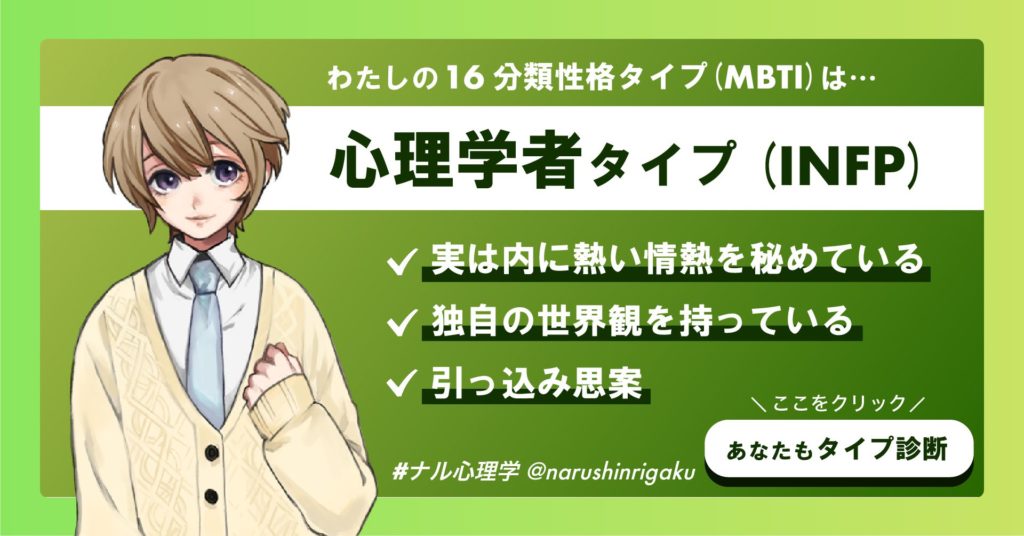
This article will cover the following 16 types.Psychologist type (INFP) I will explain the personality traits of [this person/character].
youINFP (Mediator = Psychologist type)Then
Share it on social media (tweet it) and let your followers know!
↓↓↓Share on social media (tweet)↓↓↓
↑↑↑Share on social media (tweet)↑↑↑


Description of the personality traits of the INFP (Mediator/Psychologist type)
The following is a quote (with some modifications) from "Let's Look at the World from the Perspective of MBTI Personality Type Theory" (website no longer exists).
INFP types possess strong sensitivity and are highly aware of their inner workings, while also exhibiting excellent insight into others.
They are thoughtful, compassionate, attentive, accepting, and empathetic. They want to understand others and have the strength to confront even negative emotions. In particular, they listen intently to those in distress, feel their pain as if it were their own, and try to think together about what to do.
I do not wish to discriminate against others for superficial reasons or to oppress them for the sake of profit or appearances. I believe it would be ideal if we could acknowledge the differences between individuals, find places where everyone can utilize their unique strengths, and live in peace.
They are kind, altruistic, and gentle, but it takes time for them to open up. They take everything seriously and think ethically.
On the other hand, I have a dreamy and imaginative side, and I tend to let my imagination run wild with funny and amusing thoughts, or unrealistic fantasies, laughing or feeling sad about them alone. I feel that these things are inappropriate to talk about in everyday conversation. I am shy and it takes courage for me to actively talk to others.
I'm not good at self-disclosure to anyone outside of my close circle. Because of this, I'm sometimes perceived as being reserved or reserved. However, I occasionally act childishly, which shatters even that image.
They may adopt a cynical attitude or make sarcastic remarks. They may also be cold towards people they are not interested in or people who show unsolicited attention.
We strive for authenticity in everything we do. When it comes to experience and knowledge, we don't get caught up in superficial details, but instead consider the underlying meaning and connections.
We examine various aspects, considering possibilities such as how it feels, what significance it has, what impact it has, and whether or not it aligns with our values. Through independent reflection, we organize our emotions and refine our sensibilities and values.
They are highly curious, exploring in search of new landscapes and thoroughly researching areas that interest them. They are drawn to unconventional ideas and unconventional values.
I am drawn to beautiful, cute, and mysterious things, and I develop a strong attachment to the things I like.
On the other hand, they sometimes greedily venture into uncharted territory, seeking out things that appeal to their senses. Furthermore, if they believe others need it, they will explain its appeal and value, and actively share information.
They feel a sense of wonder and curiosity about various things in the world. They are amazed and awe-inspiring by the complex and mysterious aspects of nature. They begin to ponder why this world exists and how humans should live.
INFPs trust their intuition, can quickly discern the essence and connections of things, and possess a rich sensibility. Their interests include the personal state of mind, the human mind, consciousness, psychology, relationships, literature, philosophy, ethics, art, music, science, languages, sociology, and fundamental questions about the existence of this world.
They possess a self-motivated learning attitude. While their interests tend to shift randomly and they can easily lose interest, they find connections at an abstract level even in things that seem unrelated at first glance. If they find something they are truly interested in, they will be filled with inspiration about it all day long.
However, it's essential not only to think about these things, but also to put them into practice and find answers through real-world human relationships. Several philosophical questions seem to warrant serious consideration.
Spending time alone—to look inward, enjoy inspiration, ponder, sometimes immerse oneself in a world of imagination, process emotions, and cultivate one's values—is very important, and especially necessary for extended periods.
On the other hand, they spontaneously venture out into the world and try to experience various things. They prefer to do these things at their own pace and don't like being forced to do so by others.
Similarly, I respect other people's methods and pace. I don't jump to conclusions about new ideas or other people's suggestions.
We often get excited about the unknown and are passionate about taking on challenges. This can stem from pure intellectual curiosity, or it can be motivated by the prospect of personal growth or the possibility of contributing to others.
Although she usually appears reserved and quiet, she thinks and feels many things. Because she judges what is appropriate and inappropriate to say from multiple perspectives, she usually keeps most things to herself.
I enjoy chatting with close friends and family, and I speak fluently about my thoughts. While I offer advice, I never try to force it on them. I don't push my opinions on others or boast excessively; instead, I respect the values of others.
I believe it's important for everyone to think for themselves and not to conform to societal values. Furthermore, if others follow their own unique values and have wonderful goals, I actively acknowledge and encourage their efforts.
Occasionally, they may express unrealistic ideas or fantasies and exhibit strange behavior. While this isn't particularly harmful and is enjoyable for them, others might perceive them as odd. Even when they are quiet, a small trigger can send them off into their own world of imagination, and they may not return for a while. It's important to keep them grounded in reality and take care not to get hurt.
Their expression is calm and gives a gentle impression. Or perhaps they are expressionless. However, deep down, you can sense strong emotions.
I'm not very good at expressing my own emotions. Nevertheless, strong feelings like joy or disgust sometimes surface unintentionally. On the other hand, less important thoughts also come out easily. Strong beliefs and passions, however, are usually kept hidden within my heart and not outwardly expressed.
I tend to be indifferent to my physical environment and the existence of my own body. My mind is full of thoughts, but most of them are not directly related to worldly practical benefits.
I may be oblivious to profit, but that's not because I'm suppressing it. Rather, it's because I'm so focused on enriching the substance and striving for something beyond mere tangible value. I seek conscious growth and intellectual wealth.
INFPs often possess a broad range of knowledge and keen intuition, but this can be extreme, sometimes making it difficult for them to adapt to the real world.
You may experience long periods of sorrow as you keenly perceive the dishonest and ugly aspects of the world, but eventually, you will realize that you need the courage to take responsibility for your own future and forge your own path, rather than simply passively making choices based on your environment. With your unwavering beliefs and challenging nature, some will even start their own businesses, utilizing their unique skills. In such cases, it will be crucial to act with careful planning and avoid straying from the right path.
Otherwise, you'll end up scrambling at the last minute before the deadline.
They don't schem or manipulate others for their own benefit. They also have little interest in promoting themselves; in fact, they might not even realize the need for it. However, they possess insight into human nature and can imagine how their words and actions affect others.
INFPs are often drawn to sad and painful things, but they don't actually enjoy them. They cannot truly experience positive emotions without confronting such negative situations. While they may sometimes be trapped in despair and decadent thoughts, they continue to refine their inner values, ultimately finding meaning and hope by seeing the beauty of existence and the positive aspects of humanity.
In order to maintain a constant pursuit of happiness, we sometimes unconsciously reject opportunities for actual happiness when they arise. One reason for this is that our idealized image of happiness is so strong that we cannot accept reality. We may not feel that the good fortune that comes easily is worthy of us, and therefore we may not be able to genuinely rejoice.
I often relive unpleasant experiences from the past, struggling to process them. I feel depressed and trapped by negative emotions for extended periods. However, I can usually confront my emotions and, with time, sublimate them. I can then find some meaning in them and become more positive. I come to believe that even unpleasant experiences were necessary lessons in life, and I quietly tuck them away inside.
I am an idealist and I am interested in the happiness of others, the public good, and world peace. My ultimate goal is always to help people, make the world a better place, and contribute to society.
I want to show concern for, help, protect, and nurture the weak, the young, and the powerless. I try to encourage those who are discouraged by showing them new possibilities. At such times, I become much more proactive than usual, reaching out to the outside world and striving to realize my ideas. I feel most alive when I can clearly see that I am contributing to others.
They are sensitive to the injustices and contradictions of the world. They can also face sad realities, even if they are frightening. They have a strong sense of justice, empathize with the oppressed, and feel that something must be done to change the unfortunate situation. They have strong opinions against arrogant people, those who exploit others, and those who commit injustice. They seriously consider how society should be structured and what kind of mindset each individual should have. When this develops further, they may start disseminating information and engaging in awareness campaigns to let everyone know about the current situation.
They desire authenticity, are perfectionists, and set high goals for themselves. They have a vague vision from the initial stage, but they don't have all the insights from the beginning. Specific procedures require repeated trial and error and persistent execution.
First and foremost, it's important to trust your intuition and just go for it. You'll learn something along the way, and by thinking things through as you go, you'll usually be able to overcome difficulties through this repetition process.
You might later realize how high your goals were and struggle as a result. Even if you successfully achieve them, you'll rarely feel satisfied. Recognition from others might ease your mind somewhat, but you'll still constantly be aware of your shortcomings and feel the need to improve. You'll likely continue to improve until you're satisfied, as long as time allows.
They possess a well-developed sense of beauty and are drawn to beautiful nature and poignant, yet beautiful, stories. They may engage in art themselves to express beauty. They are also imaginative and possess excellent language comprehension and expression skills. They can deeply appreciate and understand poetry, songs, and stories. Furthermore, they often demonstrate a talent for writing.
Even if you're awkward at speaking orally, you excel at expressing your feelings and opinions on paper. With a little practice, you'll be able to use your extensive vocabulary and diverse metaphors to clearly and fluently write down your thoughts and stories.
She has a knack for learning not only her native language but also classical grammar and foreign languages. She can concentrate and pay attention to even the smallest details when it comes to creative work in the arts or practical language learning.
I'm not sure if I'm good at taking care of children, but I am good at playing with them.
They try to convey necessary information and ways of thinking to their children. Being frugal, they may encourage their children to seek spiritual satisfaction rather than material satisfaction. They generally treat their children with love and kindness, allowing them to live without tension.
I don't strictly discipline my children in terms of social etiquette or manners. As a result, I sometimes spoil them. Rather, I raise them based on the ethical values I've cultivated throughout my life. I value honesty, so if my child behaves in a way that goes against morality, I'll keenly notice it and scold them sternly.
They are drawn to minorities and strive to understand them. INFPs themselves expend energy searching for their own niche, and they also try to defend the individuality of others.
They act as advocates for those generally considered socially vulnerable, oppressed, and marginalized. They also strive to deeply explore and reflect upon their own inner selves, maintaining a sincere and honest attitude.
They take on the role of presenting moral values. They confront sadness, suffering, and the ugly side of humanity, find hope, and offer healing. Literature and art are often chosen as means of expressing their values. When it comes to things they are truly interested in, inspiration constantly arises, and through trial and error, they can persistently achieve their goals.
End of quote from "Let's Look at the World from the Perspective of MBTI Personality Type Theory" (website no longer exists) (partially modified)
Are INFPs (Mediators/Psychologist types) highly sensitive people (HSP)?
INFPteeth,They are more sensitive than others and are more perceptive of the feelings of those around them.There seems to be a tendency for this to be the most sensitive temperament.HSPIt is called that.
If any of the following apply to you,HSPThere is a high probability that this is the case.↓
- My way of thinking is complex, and I think deeply before I act.
- Sensitive to stimuli and easily fatigued
- Easily swayed by other people's feelings, and easily empathetic.
- All senses are sharp
The following bookThat's an excessive level of sensitivity.In this book, the author, who is an HSP herself, introduces her daily life in easy-to-understand four-panel comics. Amazon reviews also say,However, this book, "Too Sensitive to Really Feel," humorously depicts the world through the eyes of an unconventional author, which is entertaining and uplifting in itself. It also includes coping strategies that might be helpful for highly sensitive people (HSPs).』(Review from qcteddy)As stated,This contains helpful information for people with sensitive constitutions.If you think you might be an HSP (Highly Sensitive Person), I recommend you read this.
『I hope this book will help you feel a little lighter in your heart, by making you think, "There are people just like me."』
by author
For those who want to learn more about INFP (Mediator/Psychologist type) (compatibility, etc.)
For more information, please see below.Highly recommended (click to open) ↓
Compatibility: You can learn about compatibility and how to interact with other types.
RoadmapYou can learn about personality types and personality theories (MBTI) in a systematic way, from basic to specialized.
Related articlesLearn about the characteristics of each type (take a look at the parts that interest you)
Compatibility between INFP (Mediator/Psychologist type) and other types (click to show)
Ideal compatibility type pair
INFPs are most compatible with people who respect each individual's values.
From an INFP's perspective...
- ISFP (Artist type):Fi – SeThey respect my feelings just as they are.
- INTP (Researcher Type):Ti – NeThey can discuss their ideas and exchange information.
- INFJ (Empathy Type):Ni – Fe, give personal advice
Type pairs that are prone to conflict
INFPs tend to clash with pushy types who don't respect individual values and exert psychological pressure.
From an INFP's perspective...
- ESTJ (Responsible type):Te – SiThey criticize while trying to control you.
- ESFJ (Sociable Type):Fe – SiSometimes they are too meddlesome.
- ENTJ (Leader type):Te – NiHe is very logical, meticulous, and rational, but his demands are intense, making him difficult to be around.
Romantic compatibility type pair
INFPs are most compatible in romantic relationships with people with whom they can easily discuss opinions and who can complement their weaknesses and shortcomings.
Similar to friendships, INFPs can sometimes struggle to get close to potential romantic partners. Once a relationship is established, they are fiercely loyal. However, their romantic views on love can be overly idealistic, leading them to have excessively high expectations of their partner, which can be difficult for the other person to handle. They also tend to take things personally and try to avoid conflict.
From an INFP's perspective...
- ENFP (Reformer type):Ne – Fi, respecting each individual and being able to have productive discussions
- ESTJ (Responsible type):Te – SiIt provides a sense of long-term security.
- ISTJ (Hardworking Type):Si – TeIt allows you to build a stable relationship, and you can trust and feel at ease.
*The pairs that tend to clash and the pairs that have good romantic compatibility may overlap. This is because while people may dislike those who are the complete opposite of themselves due to disagreements, they may also be attracted to those who appear mysterious because they are different. However, it seems that these relationships often end up breaking down.
(Advice for those dating an INFP)
If your partner is an INFP, keep in mind that you may have difficulty getting them to open up, they can be overly sensitive to criticism, and they may prioritize your happiness over their own.
INFP (Mediator = Psychologist type) Roadmap (Click to open)
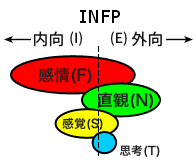
To truly understand the INFP (Psychologist type),Psychological functions (cognitive functions)* is important ↓
*Generally in cognitive science,Cognitive functions「The function by which living organisms actively collect external information, perceive and remember it, and then process it by adding reasoning and judgment in order to acquire knowledge about their subject.It is defined as "
- Introverted Feeling/Fi
Very good at it /First function: Decide what you believe is right for you, what is morally right within your worldview, and what you should do according to your personal values. - Extroverted Intuition/Ne
I'm a little good at it /second functionIt reveals the negative consequences of current actions, future outcomes, and the intentions behind people's actions. - Introverted Sensing/Si
I'm not very good at it.Third functionThey use past experiences to justify their current attitudes. They may also become risk-averse and unable to leave their comfort zone. - Extraverted Thinking/Te
I'm really bad at it /Fourth functionThey fear and worry about what others think of them. They are unable (or unwilling) to organize their thoughts rationally and logically.
<INFP's Cognitive Framework>
By reading the roadmap below, you can learn about cognitive functions and gain a systematic understanding of INFPs ↓
- Roadmap – INFP (Mediator = Psychologist) type –
- Introduction – What is MBTI?
- Summary of my personality
- Cognition is
- Type-specific cognitive characteristics
- Four personality indicators (psychological tendency axes)
- Conflicts over personality indicators
- “The meaning of the four letters "INFP"
- First character:Introvert (type I) or extrovert (type E)
- Second character:Intuitive type (N type) or Sensing type (S type)
- Third character:Feeling type (F type) or thinking type (T type)
- 4th character:Perceiving type (P type) or Judging type (J type)
- About psychological functions (cognitive functions)
- What are psychological functions (cognitive functions)?
- The eight psychological functions (cognitive functions)
- Decision-making (judgment) function
- Information gathering (perceptual) function
- Understanding your own psychological functions (cognitive functions)
- The developmental process of psychological functions (cognitive functions)
- The psychological functions (cognitive functions) of INFPs
- First function:Introverted Feeling (Fi)
- Second function:Extroverted Intuition (Ne)
- Third function:Introverted Sensing (Si)
- Fourth function:Extraverted Thinking (Te)
- Making good use of psychological functions (cognitive functions)
- The strengths and weaknesses of INFPs
- Make the most of your strengths
- Reasons for focusing too much on the advantages
- How to improve your weaknesses
- If you are alone
- In a team setting: Have others compensate for your weaknesses (fourth function).
INFP (Mediator = Psychologist Type) – A Comprehensive Link Guide
- INFP Explanation
- INFP Personality Trait 01
- INFP Personality Traits 02
- INFP Personality Trait 03
- INFP's hobbies
- Things that INFPs dislike
- The strengths and weaknesses of INFPs
- Suitable occupations for INFPs
- INFP leadership
- Compatibility between INFP and other personality types
- INFP Relationships and Romance
- How INFPs can grow and achieve their dreams
- How INFPs set goals and gather information
- INFP's Decision-Making Methods
- INFP parent-child relationships
- For INFPs to succeed
- INFP psychological function
- “The meaning of the four letters "INFP"
- The psychological functions (cognitive functions) of INFPs
- The integration of the second and third functions of the INFP (Psychologist type)
- The difference between introverted feeling (Fi) and extroverted feeling (Fe)
- The difference between extroverted thinking (Te) and introverted feeling (Fi)
- IP Type: People who develop through self-discipline
↑Click to open↑
youINFP (Mediator = Psychologist type)Then
Share it on social media (tweet it) and let your followers know!
↓↓↓Share on social media (tweet)↓↓↓
↑↑↑Share on social media (tweet)↑↑↑
comment