
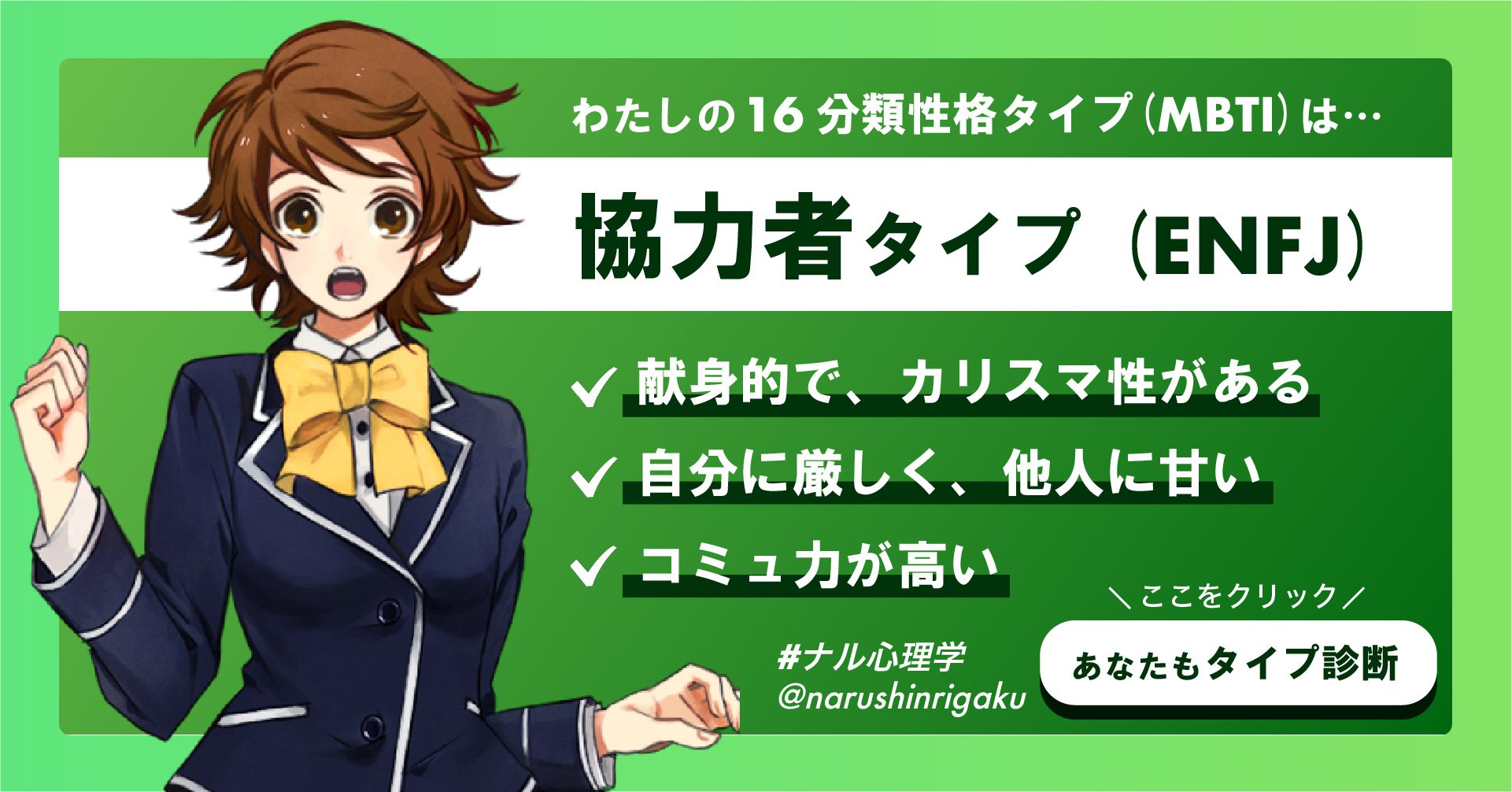
On this page, you can choose from 16 types.ENFJ (Collaborator Type)I will explain the personality traits of [this person/character].
youENFJ (Protagonist/Collaborator type)Then
Share it on social media (tweet it) and let your followers know!
↓↓↓Share on social media (tweet)↓↓↓
↑↑↑Share on social media (tweet)↑↑↑
Classifying personalities into 16 types16-Type Personality TestCheck which type you are using the following↓↓

↑16-Type Personality Test↑
↑Diagnose↑


Description of the ENFJ (Protagonist/Collaborator Type) personality traits
The following is a quote (with some modifications) from "Let's Look at the World from the Perspective of MBTI Personality Type Theory" (website no longer exists).
They are humble, polite, considerate, emotionally expressive, and genuinely empathetic to others. They are perceptive of everyone's feelings and can encourage and inspire positive thinking.
They are sociable and possess excellent communication skills. Whether interacting with one person or a group, they can sense and influence the emotions and atmosphere of others. They observe others carefully, using expressive eye contact and gestures to facilitate smooth communication, clarify consensus, and articulate their own opinions.
I sometimes tell stories based on my own experiences, vividly, incorporating the emotions I felt at the time. Such stories resonate deeply with people.
Throughout life, we meet many people, experience various thoughts and feelings, share emotions, and exchange opinions, thereby shaping our values. I hope that we can all share our experiences, knowledge, and values as much as possible, and live our lives sharing joy together.
You will learn manners through social life. You will want to respect your elders, cooperate with your colleagues, and help your subordinates. You will be able to see the good in people and will meet people you can respect. You may often express your dislike, but you will be able to forgive people and love them from the bottom of your heart.
They foster cooperation and always strive to move things in a constructive direction. To that end, they appeal to everyone and unite the group. They dislike conflict and believe that no one should be left out. They are quick to spot those in distress or those who look downcast and cannot ignore them.
I will dedicate myself to my family and community.
When one's efforts and talents are recognized by others, it brings genuine joy. This can even motivate oneself further. While being praised and receiving attention is an honor, it's not the goal in itself.
For ENFJs, interacting with people is very important, but they also need time alone to reflect. The thoughts and ideas that arise during such times can give new perspectives on their relationships with others. If they stay alone for too long, they may become trapped in negative thoughts or feel an overwhelming longing for companionship. They make an effort to meet people again and live an active life.
I tend to be easily swayed by the opinions of others. While I have my own firm beliefs, I'm still very interested in other people's perspectives. If I'm convinced that someone else's opinion is valid, I'll likely change my own attitude.
They strive to understand other people's values as much as possible and try to encourage them. Because of this, they sometimes give the impression of being chameleon-like, adapting themselves to others. However, this doesn't mean that ENFJs lack personal opinions. In fact, ENFJs are capable of expressing their opinions and values clearly and concisely.
Even when surrounded by many people, you may suddenly feel lonely. This might be because, while you try too hard to match the wavelength of others, you're not used to paying attention to your own true feelings.
When you're feeling angry, sad, or generally unsettled, and your mood is heavy, you need to talk to someone who understands you. Doing so can help you process and organize your emotions.
I desire a disciplined life and want to be fully prepared for important matters, but I sometimes struggle because I try to meet the needs of too many people.
When they set a goal with a strong passion akin to a sense of mission, they strive to achieve it. They are altruistic, desiring the benefit, safety, and development of others, while deliberately disregarding their own interests and safety.
It's not that I don't experience fear or anxiety. In fact, I feel physical pain more than most people, and I don't want a harsh life, but I choose to prioritize contributing to others over my own needs.
This is because they are well aware of the impact their actions have on others. However, they tend to overexert themselves and are not good at taking care of themselves. As a result, they may become ill or worsen their health.
It's important to clearly recognize what you need and what's important to you, and to be careful not to sacrifice yourself excessively.
While it's important to cherish relationships with family, friends, people in the community, and colleagues, I also begin to think about people in this world who are suffering misfortune or facing injustice.
Furthermore, you will develop a sense of respect for your ancestors, transcending your own lifetime, and become more aware of your role in relation to future generations.
I hope for a society where everyone can actively participate while making the most of their strengths. I believe it would be good if everyone could receive support so that they can successfully realize their potential. I will consider what I can do to make that happen.
Sometimes, inspiration strikes, and you embrace it as your destiny. To that end, you act energetically, spend as much time as possible with others, and have a significant impact on people throughout your life. Because your vision is grand and long-term, and you pursue your ideals without ever getting bored, you might feel that you won't see the fruits of your labor in your lifetime.
I tend to be impatient and easily angered by injustice. Sometimes, even knowing it's unreasonable, I try to push my opinion through and resist rules I find difficult to agree with. By doing so, I can create new precedents and break the status quo. I believe that at some point in life, one must make some kind of firm resolve in order to truly live life to the fullest.
ENFJs are idealistic. Those prone to nihilism or selfishness might perceive them as suspicious. However, there's no need to worry about that. What's important is to face reality and realize your vision while staying grounded in reality.
By continuously expanding their circle of relationships and paying attention to the diversity within it, they deepen their universal understanding by finding common ground. They constantly verify the reality of their understanding and concepts by seeing with their own eyes, touching with their own hands, and feeling with their own bodies. Eventually, they will be able to resolve and bring together problems through effective means while maintaining fairness, so that people can live meaningful lives in peace and happiness.
End of quote from "Let's Look at the World from the Perspective of MBTI Personality Type Theory" (website no longer exists) (partially modified)
Further characteristics of the ENFJ (protagonist/collaborator type) and compatibility with other types
- ENFJ (Collaborator Type) Personality
- ENFJ (Collaborator Type) Personality Trait 02
- Hobbies of ENFJ (Collaborator type)
- Things that ENFJs dislike
- The strengths and weaknesses of ENFJs
- Suitable occupations for ENFJs
- ENFJ leadership
- Compatibility between ENFJ and other personality types
- ENFJ Relationships and Romance
- How ENFJs set goals and gather information
- ENFJ's Decision-Making Methods
- ENFJ parent-child relationships
- ENFJ's Talents and How to Utilize Them
- For ENFJs to succeed
↓Learn more↓
Compatibility chart and advice for ENFJ (protagonist/collaborator type) and other types.
Ideal compatibility type pair
ENFJs are compatible with people who are sociable, understand others' feelings, and respect others.
From an ENFJ's perspective...
- INFP (Psychologist type):Fi – NeThey possess high empathy, the ability to understand other people's feelings, and creative thinking that can be applied in many different ways.
- ENFP (Reformer type):Ne – FiThey have a similar view of the world as I do, and they can understand other people's feelings.
- INTJ (Strategist type) :Ni – TeHaving a progressive vision and being able to translate it into practical, usable ideas.
Type pairs that are prone to conflict
ENFJs tend to clash with people who lack respect or consideration for others, have a different view of society than ENFJs, and are indifferent to social issues.
From an ENFJ's perspective...
- ISTP (Practitioner type):Ti – SeHe has his own unique preferences, is difficult to deal with, doesn't conform to those around him, and is excessively meticulous about minute details.
- INTP (Researcher Type):Ti – NeThey disregard the feelings of those around them and are only willing to follow their own opinions.
- ENTP (Inventor Type):Ne – TiThey are troublesome people who do not follow the common sense of society that should naturally be followed, thus creating conflicts of interest.
Romantic compatibility type pair
ENFJs are compatible with people who share their ideal vision and can reassure them even in difficult situations.
From an ENFJ's perspective...
- INTJ (Strategist type) :Ni – TeIt provides a logical explanation of how things work.
- INFP (Psychologist type):Fi – NeThey can understand other people's feelings and have their own ideals.
- INFJ (Empathy Type):Ni – FeBeing able to understand other people's feelings
- ISFP (Artist type):Fi – SeHe is able to see things realistically and is a charismatic person with a keen aesthetic sense.
*The pairs that tend to clash and the pairs that have good romantic compatibility may overlap. This is because while people may dislike those who are the complete opposite of themselves due to disagreements, they may also be attracted to those who appear mysterious because they are different. However, it seems that these relationships often end up breaking down.
(Advice for those dating an ENFJ)
ENFJs are very sensitive to the feelings of others, so the happiness of their partner is essential to their own happiness. ENFJ partners should express how grateful they are for the support and care their partner provides, and make an effort to reciprocate in the same way, even if their partner doesn't ask for help.
A collection of links explaining the psychological functions of the ENFJ (Protagonist/Collaborator type) (for those who want to understand the workings of the mind)
Reading the following roadmap from top to bottom will help you understand the ENJF mindset in a logical order ↓
- Roadmap – ENFJ (Collaborator Type) –
- Introduction – What is MBTI?
- Summary of my personality
- Cognition is
- Type-specific cognitive characteristics
- Four personality indicators (psychological tendency axes)
- Conflicts over personality indicators
- “The meaning of the four letters "ENFJ"
- First character:Introvert (type I) or extrovert (type E)
- Second character:Intuitive type (N type) or Sensing type (S type)
- Third character:Feeling type (F type) or thinking type (T type)
- 4th character:Perceiving type (P type) or Judging type (J type)
- About psychological functions (cognitive functions)
- What are psychological functions (cognitive functions)?
- The eight psychological functions (cognitive functions)
- Decision-making (judgment) function
- Information gathering (perceptual) function
- Understanding your own psychological functions (cognitive functions)
- The developmental process of psychological functions (cognitive functions)
- ENFJ's psychological functions (cognitive functions)
- First function:Extraverted Feeling (Fe)
- Second function:Introverted Intuition (Ni)
- Third function:Extroverted Sensing (Se)
- Fourth function:Introverted Thinking (Ti)
- Making good use of psychological functions (cognitive functions)
- The strengths and weaknesses of the ENFJ (Collaborator type)
- Make the most of your strengths
- Reasons for focusing too much on the advantages
- How to improve your weaknesses
- If you are alone
- In a team setting: Have others compensate for your weaknesses (fourth function).
To truly understand the ENFJ (Collaborator type),Psychological functions (cognitive functions)This is important ↓
- Extraverted Feeling/Fe
Very good at it /First functionFollow what you deem right for everyone, what is good for the group. - Introverted Sensing/Ni
I'm a little good at it /second function: You are responsible for predicting whether your will, desires, and actions will cause harm in the future. - Extroverted Sensing/Se
I'm not very good at it.Third functionPeople want to stop and listen to what you have to say. Otherwise, they feel stifled, become critical, and tend to try to impose their own opinions and positions on others. - Introverted Thinking/Ti
I'm really bad at it /Fourth functionThey fear and are anxious about things that are not logically correct. They don't know how to thoroughly analyze available information (or are unwilling to do so).
<The cognitive axis of ENFJ>

Related articles about ENFJ (Protagonist/Collaborator type) Click to open
↑Learn more↑
List of 16 types (≒MBTI types)
A Collection of Information on the 16 Personality Types – The Little-Known Truths of Each Type (Summary, Illustrations, and Analysis)
- Summary of 16 Personality Type Test Websites
- List of articles categorized by personality type (16 types)
- Compatibility chart for 16 personality types
- Suitable occupations, ideal jobs, and dream jobs for each of the 16 personality types
- Nicknames (names) for each of the 16 personality types
- What if there were a country with 16 personality types...?
- The relationship between national characteristics around the world and the 16 personality types
- List of 16 Personality Types Based on Famous Characters
- Detective Conan: A Summary of 16 Personality Types for Each Character
- Percentage of 16 personality types
- Reactions of 16 Personality Types – Heaven and Hell
- To describe the 16 personality types in one word:
- 16 Simple Explanations of Personality Types
- 16 Personality Types: Strengths, Weaknesses, and Ways to Improve Weaknesses
- 16 Personality Types: Preferences and Strengths/Weaknesses in Majors and Subjects
- 16 Personality Types: How to Enjoy Life to the Fullest…?
- 16 Personality Types: Inspiring Quotes from Great Figures
- What if each of the 16 personality types were a murderer?
- How to become an attractive husband or wife based on your personality type (16 types)
- What 16 personality types do after a breakup
- Reasons for fighting according to 16 personality types
- Income by 16 Personality Types - Misconceptions and Truths -
- Characteristics of employees based on 16 personality types
- Potential pathological tendencies of 16 personality types
- Psychological Functions of 16 Personality Types Based on Statistics
- Viewing percentage of the detailed personality pages for each of the 16 personality types
- Summary of the characteristics of the 16 personality types
- 8 psychological functions: "What if I did...?"
- Approaches to tasks based on psychological function: Intuitive (N-type) & Sensing (S-type)
- Social interaction explained by psychological functions
- Understanding Your Financial Habits Through Psychological Functions – Are You a Saver or a Spender?
- Humor (sense of humor) as revealed by psychological functions
- How extroverts (Type E) and introverts (Type I) can get along well
- How Sensing types (S type) and Intuitive types (N type) can get along well
- How Thinking (T-type) and Feeling (F-type) People Can Get Along Well
- How to get along well with Judging (J-type) and Perceiving (P-type) types
- Characteristics of parents with 16 personality types
- Parent-child relationships between extroverts (Type E) and introverts (Type I)
- Parent-child relationships between sensing types (S-type) and intuitive types (N-type)
- Parent-child relationships between thinking types (T-type) and feeling types (F-type)
- Parent-child relationships between judging (J-type) and percepting (P-type) types
- How to identify your partner's personality type: [16 Personality Types]

comment