
On this page, you can choose from 16 types.ISFP (Artist type)I will explain the personality traits of [this person/character].
youISFP (Adventurer/Artist Type)Then
Share it on social media (tweet it) and let your followers know!
↓↓↓Share on social media (tweet)↓↓↓
↑↑↑Share on social media (tweet)↑↑↑
Classifying personalities into 16 types16-Type Personality TestCheck which type you are using the following↓↓

↑16-Type Personality Test↑
↑Diagnose↑


Personality traits of ISFP (Artist type)
The following is a quote (with some modifications) from "Let's Look at the World from the Perspective of MBTI Personality Type Theory" (website no longer exists).
I aspire to live a sincere and honest life, guided by my own unique values, passions, and aesthetics, while seeking inner harmony. I want to be unpretentious, not imitate anyone, but simply follow my own feelings, seeking freedom of expression and action.
They are humble and reserved, speak in a gentle manner, and are good listeners. They do not intimidate or make assumptions about others.
Furthermore, I hope that we will respect the values of others in the same way, and that this will develop naturally.
I want to avoid doing anything unnatural or intrusive to the surrounding environment and plants and animals, and instead allow them to be in their natural state.
They possess keen observational skills and are sensitive to changes in their surroundings and environment. They are also proactive, seizing opportunities and responding quickly. Their keen observational abilities extend to others, and they behave gracefully and attentively.
If I see someone in trouble, I feel heartbroken, I want to think about them with genuine concern, and if possible, I want to offer a helping hand. If I have the means myself, I will try to support them through concrete actions.
While they can be imaginative and dreamy, they are also grounded and realistic in their thinking. They strive to overcome their current situation by tackling each challenge one by one.
The explanations are concise and straightforward, avoiding exaggeration and redundant expressions.
They perceive the shapes, colors, patterns, textures, sounds, tastes, smells, and feel of objects with a strong sense of sensitivity. They are highly perceptive and drawn to natural forms, delicious food, and skillfully crafted works of art and everyday objects.
I am captivated by the wonders of animals, plants, and all creation, and I find solace in the magnificent and harmonious landscapes of nature.
They are sensitive to stimuli that can be obtained through the five senses, such as the colors and textures of paintings and sculptures, the tones and moods of musical instruments, the presentation, taste, and smell of food, and the feel and comfort of bedding. These are just a few examples, but by actually touching various things, they cultivate a unique sensibility and individual tastes.
I actively seek out beautiful things, interesting things, and exciting experiences. These experiences are later processed, allowing me to understand the mechanisms and relationships of things, and ultimately making me wiser.
I'm active and seek out exhilarating and thrilling experiences. I love being physically active. I'm gutsy and don't mind a little risk.
I enjoy the cityscapes and nature through outdoor activities such as traveling, exploring, and mountain climbing. I feel the changing scenery and refreshing breeze while driving cars, bicycles, or motorcycles. I find joy in focusing my awareness and becoming one with the environment in the present moment.
There's a lot to learn from watching sports. I often participate in them, not just watch. Even then, I see the toughness of spirit and the determination to overcome difficulties by focusing intently on the moment.
They also enjoy activities like scuba diving and skydiving, which allow them to experience both the beauty of nature and the thrill of it. They also demonstrate concentration and intuition in competitive games like table games.
I have a strong desire to express, in some way, the deep-rooted emotions I possess.
The aesthetic sense and worldview of an ISFP are not always expressible in words. They excel at harmonizing and utilizing their bodily sensations, and are well-suited to expressing themselves through concrete actions such as creative work and performance.
Through painting, sculpture, design, photography, video, as well as music, poetry creation, performance, and dance, I express my soul by becoming engrossed in the mood.
Alternatively, one can find joy in acquiring a skill, creating products or providing services that utilize their aesthetic sense and preferences, and satisfying customers.
The image, atmosphere, realistic finish, and performance itself speak for themselves, and perhaps no verbal explanation is necessary.
Similarly, I have a strong attachment to fashion as a way to express myself and convey my personality. I also sometimes pursue physical expression and physical beauty.
I prefer music with a good tempo and lively playing of keyboard and percussion instruments. I have a talent for learning instruments, and I can become proficient at piano, drums, guitar, etc., with practice. Through playing music, I express various images and emotions, and I become one with the mood of the music. Rather than music that puts poetry or words front and center, or strongly expresses ideologies, I prefer music that expresses my feelings directly and allows me to surrender to a pleasant rhythm.
When I go to a bustling city, I want to do things that are fun and relaxing. I want to enjoy entertainment like karaoke and billiards, and try new menu items at restaurants. If I'm an adult, I want to drink with close friends at an izakaya (Japanese pub), have casual long conversations, and deepen my relationships. At such times, I want to be generous and have a service spirit that makes people happy. In addition, I want to experience services such as massage, acupuncture, and for women, hair salons and beauty salons.
I am grateful for and cherish those who understand my values. On the other hand, I am easily hurt by criticism and tend to be overwhelmed by opposing opinions.
They express themselves honestly and are especially charming when they are having fun or are excited by curiosity. They greet people in a friendly manner, which makes others feel comfortable.
On the other hand, they can sometimes seem distant. They value their alone time and may try to be inconspicuous or quietly slip away from a situation. They are generally quiet and reserved, so it may take some time for them to open up and talk to you.
I believe that having supportive and understanding colleagues who help us achieve our goals is very important. However, I don't want to control others, nor do I want to be controlled by others. I don't particularly like giving or receiving instructions. Rather than blindly seeking power, I value morality. I think it would be ideal if each individual could cooperate peacefully according to their own inner ethical values.
If we are given sufficient time and space to be alone, we can evaluate the extent of our achievements and goal attainment in light of our own values and sense of purpose. We can also recognize and interpret the essence and connections of our experiences, and use that to determine our direction. I believe that such opportunities should be respected by others as well.
They have ideals and tend to be perfectionists. When they re-evaluate their own achievements, they tend to set high standards for themselves. They are bothered by what needs to be improved and are rarely satisfied. However, if someone sees the good in their work, they feel happy and relieved.
They accept people's words and actions as they are, giving the impression of being honest and simple.
However, we sometimes fail to grasp the implied meaning and don't understand other people's sarcasm. We realize this later and become suspicious and distrustful. When we are reprimanded by others, we become preoccupied with all our own shortcomings.
I yearn for a glamorous and free life in the real world, and I want money. Ideally, I'd like to choose a profession where I can freely express my values, but being realistic, I might find myself torn between sticking to my beliefs or choosing a stable job.
They are reserved and don't often promote themselves. While humility and modesty are virtues, they are sometimes misunderstood and undervalued.
I am interested in contributing to others by satisfying their senses. If I can hone my skills and acquire a marketable skill, I won't have much trouble choosing a career. Alternatively, I might take a job where I can utilize my caring nature, such as looking after children or raising animals or plants.
You might find it difficult to disagree with others' opinions or refuse requests. While being helpful to others is a virtue, if you end up losing out because of it, you might feel like you're not being valued.
In such situations, it's natural to be critical, but you should avoid complaining to everyone. Doing so will only push opportunities further away.
We care about the weak, the young, and those in need. We want to reach out to the oppressed and those in distress. And we help them by offering our own labor and taking concrete action.
They possess a strong sense of ethics and take life seriously. They set high standards for themselves and strive to achieve their goals. However, especially in their youth, these positive traits are often lost when they impulsively seek fleeting pleasures and frivolous things. But as they get older, they become able to make wiser choices with an awareness of the future.
Learning through experience is enjoyable. Learning that utilizes observation skills, physical abilities, manual dexterity, and the expression of creativity is rewarding. On the other hand, structured learning or learning that deals with abstract theories may be challenging. Concrete examples can greatly improve understanding.
ISFPs are captivated by their deep experiences with things and people, shaping their aesthetic sense and ethical values through these encounters. They learn a great deal by immersing themselves in each moment and tackling challenges one by one. By carefully selecting their interests and focusing intensely, they acquire skills and reach a deep understanding. This eventually allows them to bring joy and help others.
End of quote from "Let's Look at the World from the Perspective of MBTI Personality Type Theory" (website no longer exists) (partially modified)
Further characteristics of the ISFP (Artist type) and compatibility with other types
- ISFP Personality Traits 02
- ISFP hobbies
- Things that ISFPs dislike
- Advantages and disadvantages of ISFP
- Suitable occupations for ISFPs
- ISFP Leadership
- Compatibility of ISFP with other types
- ISFP Relationships and Romance
- How ISFPs Set Goals and Gather Information
- ISFP decision-making methods
- ISFP parent-child relationships
- How ISFPs can succeed
↓Learn more↓
ISFP(Artist type)Compatibility chart and advice for other types
Ideal compatibility type pair
ISFPs are compatible with people who respect each other's freedom and with whom they can have positive experiences.
From an ISFP's perspective...
- INFP (Psychologist type):Fi – NeThey respect freedom and feelings.
- ENFP (Reformer type):Ne – FiThey respect individuality
- ISFJ (Parental Type):Si – FeThey treat you with consideration.
- INTP (Researcher Type):Ti – NeWe can share ideas and exchange information.
Type pairs that are prone to conflict
ISFPs tend to clash with overbearing people who don't respect their individual choices and actions.
From an ISFP's perspective...
- ESTJ (Responsible type):Te – SiThey criticize me and try to control me.
- ENTJ (Leader type):Te – NiHe is very logical, meticulous, and rational, but his demands are intense, making him difficult to be around.
Romantic compatibility type pair
ISFPs are most compatible in romantic relationships with people who offer positive experiences and who can provide reassurance during difficult times.
From an ISFP's perspective...
- ENFJ (Collaborator Type):Fe – NiThey make you feel safe and comfortable.
- INTJ (Strategist type) :Ni – Te, wisely prepare for the future and give you peace of mind
- ENFP (Reformer type):Ne – FiThey create a friendly and comfortable environment and understand your feelings.
- ISTJ (Hardworking Type):Si – TeIt reassures you even in difficult situations.
*The pairs that tend to clash and the pairs that have good romantic compatibility may overlap. This is because while people may dislike those who are the complete opposite of themselves due to disagreements, they may also be attracted to those who appear mysterious because they are different. However, it seems that these relationships often end up breaking down.
(Advice for those dating an ISFP)
ISFPs are very empathetic in relationships and often make concessions to others. Many struggle to express their feelings or assert their demands, so it's important to make an effort to understand them. When making decisions, listen to the ISFP's perspective and respect their feelings equally.
ISFP (Artist type)A collection of links explaining psychological functions (for those who want to understand how the mind works)
Reading the following roadmap from top to bottom will help you understand the ISFP mindset in a logical order ↓
- Roadmap – ISFP (Artist type) –
- Introduction – What is MBTI?
- Summary of my personality
- Cognition is
- Type-specific cognitive characteristics
- Four personality indicators (psychological tendency axes)
- Conflicts over personality indicators
- “The meaning of the four letters "ISFP"
- First character:Introvert (type I) or extrovert (type E)
- Second character:Intuitive type (N type) or Sensing type (S type)
- Third character:Feeling type (F type) or thinking type (T type)
- 4th character:Perceiving type (P type) or Judging type (J type)
- About psychological functions (cognitive functions)
- What are psychological functions (cognitive functions)?
- The eight psychological functions (cognitive functions)
- Decision-making (judgment) function
- Information gathering (perceptual) function
- Understanding your own psychological functions (cognitive functions)
- The developmental process of psychological functions (cognitive functions)
- ISFP's psychological functions (cognitive functions)
- First function:Introverted Feeling (Fi)
- Second function:Extroverted Sensing (Se)
- Third function:Introverted Intuition (Ni)
- Fourth function:Extraverted Thinking (Te)
- Making good use of psychological functions (cognitive functions)
- Strengths and weaknesses of the ISTP (Practitioner type)
- Make the most of your strengths
- Reasons for focusing too much on the advantages
- How to improve your weaknesses
- If you are alone
- In a team setting: Have others compensate for your weaknesses (fourth function).
ISFP (Artist type)To truly understand this,Psychological functions (cognitive functions)* is important ↓
*Generally in cognitive science,Cognitive functions「The function by which living organisms actively collect external information, perceive and remember it, and then process it by adding reasoning and judgment in order to acquire knowledge about their subject.It is defined as "
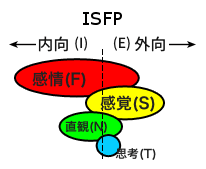
- Introverted Feeling/Fi
Very good at it /First function: Decide what you believe is right for you, what is morally right within your worldview, and what you should do according to your personal values. - Extroverted Sensing/Se
I'm a little good at it /second function: To make good use of physical space and create positive experiences for people, whether material or sensory. - Introverted Sensing/Ni
I'm not very good at it.Third functionBecause they believe they know what is right for them, they can get irritated when told what to do by others. - Extraverted Thinking/Te
I'm really bad at it /Fourth functionThey fear and worry about what others think of them. They are unable (or unwilling) to organize their thoughts rationally and logically.
<ISFP's cognitive framework>
ISFP (Artist type)Related articles (Click to open)
- ISFP psychological functions
- “The meaning of the four letters "ISFP"
- ISFP's psychological functions (cognitive functions)
- Integration of ISFP's second and third functions
- The difference between introverted feeling (Fi) and extroverted feeling (Fe)
- The difference between extroverted thinking (Te) and introverted feeling (Fi)
- To train your extroverted thinking (Te)
↑Learn more↑
List of 16 types (≒MBTI types)
A Collection of Information on the 16 Personality Types – The Little-Known Truths of Each Type (Summary, Illustrations, and Analysis)
- Summary of 16 Personality Type Test Websites
- List of articles categorized by personality type (16 types)
- Compatibility chart for 16 personality types
- Suitable occupations, ideal jobs, and dream jobs for each of the 16 personality types
- Nicknames (names) for each of the 16 personality types
- What if there were a country with 16 personality types...?
- The relationship between national characteristics around the world and the 16 personality types
- List of 16 Personality Types Based on Famous Characters
- Detective Conan: A Summary of 16 Personality Types for Each Character
- Percentage of 16 personality types
- Reactions of 16 Personality Types – Heaven and Hell
- To describe the 16 personality types in one word:
- 16 Simple Explanations of Personality Types
- 16 Personality Types: Strengths, Weaknesses, and Ways to Improve Weaknesses
- 16 Personality Types: Preferences and Strengths/Weaknesses in Majors and Subjects
- 16 Personality Types: How to Enjoy Life to the Fullest…?
- 16 Personality Types: Inspiring Quotes from Great Figures
- What if each of the 16 personality types were a murderer?
- How to become an attractive husband or wife based on your personality type (16 types)
- What 16 personality types do after a breakup
- Reasons for fighting according to 16 personality types
- Income by 16 Personality Types - Misconceptions and Truths -
- Characteristics of employees based on 16 personality types
- Potential pathological tendencies of 16 personality types
- Psychological Functions of 16 Personality Types Based on Statistics
- Viewing percentage of the detailed personality pages for each of the 16 personality types
- Summary of the characteristics of the 16 personality types
- 8 psychological functions: "What if I did...?"
- Approaches to tasks based on psychological function: Intuitive (N-type) & Sensing (S-type)
- Social interaction explained by psychological functions
- Understanding Your Financial Habits Through Psychological Functions – Are You a Saver or a Spender?
- Humor (sense of humor) as revealed by psychological functions
- How extroverts (Type E) and introverts (Type I) can get along well
- How Sensing types (S type) and Intuitive types (N type) can get along well
- How Thinking (T-type) and Feeling (F-type) People Can Get Along Well
- How to get along well with Judging (J-type) and Perceiving (P-type) types
- Characteristics of parents with 16 personality types
- Parent-child relationships between extroverts (Type E) and introverts (Type I)
- Parent-child relationships between sensing types (S-type) and intuitive types (N-type)
- Parent-child relationships between thinking types (T-type) and feeling types (F-type)
- Parent-child relationships between judging (J-type) and percepting (P-type) types
- How to identify your partner's personality type: [16 Personality Types]

comment