

Classifying personalities into 16 types16-Type Personality TestCheck which type you are using the following↓↓

↑16-Type Personality Test↑
↑Diagnose↑
This article will cover the following 16 types.ENFP (Reformer type) This explains what characteristics these individuals might have if they were parents or children.
youENFP (Activist/Reformer type)Then
Share it on social media (tweet it) and let your followers know!
↓↓↓Share on social media (tweet)↓↓↓
↑↑↑Share on social media (tweet)↑↑↑


Parent-child relationships of ENFP (Reformer type)
ENFPFor parents of this type, home is a playground where children can engage in fun and creative exploration.
I believe it's important to acknowledge the individuality and differences of each family member. I try to turn household chores into playful activities and make them meaningful.
When there's something that needs to be done, if it's boring, we either put it off, or if it seems interesting, we all decide to do it together.
ENFPA house of this type becomes a gathering place for neighbors and friends.
ChildrenENFPIf they don't fit the stereotype, they might not only be misunderstood as being outgoing and sociable, but they might also be confused or rebellious against their parent's childish behavior.
ENFPWhile having a child of this type can be a source of joy for parents, it can sometimes be physically and mentally exhausting.
Anything around me can become a plaything, and the character I become changes depending on the day.
For example, you could use a standing vacuum cleaner as a radio microphone and pretend to be a disc jockey.
The next day, I built a hut in a tree and became an architect, painter, and interior designer.
Children enjoy playing because they praise their parents or ask for their help, but for the parents, it can be a hectic and stressful experience.
Studying, like anything else, is a creative adventure, and when you do well, you want to be praised.
They are good at pleasing people. They want to be liked by teachers and classmates, and they want to like them.
ENFHe's naturally good at studying, but interestingly, he hates tests.
Even students who perform well in class and understand textbooks well often struggle with objective tests where there is only one "correct" answer.
On the other hand, I excel at essay tests where I only need to summarize my own knowledge.
ENFP (Reformer type) – Energetic (passionate) parent
ENFP parents strive to create a bright and loving environment for their children. They make an effort to convey their ideals and values to their children and respect their individuality. Sometimes, however, they may lack consistency as parents, which can confuse their children. ENFP parents are full of creativity and passion, and their children can thrive in a stimulating environment. They are also very affectionate and always mindful of how much they care for their children.
reference Characteristics of 16 types of parents
For those who want to learn more about ENFP (the reformer type) (including compatibility)
For more information, please see below.Highly recommended (click to open) ↓
Compatibility: You can learn about compatibility and how to interact with other types.
RoadmapYou can learn about personality types and personality theories (MBTI) in a systematic way, from basic to specialized.
Related articlesLearn about the characteristics of each type (take a look at the parts that interest you)
Compatibility between ENFP (Reformer type) and other types (click to show)
Ideal compatibility type pair
ENFPs are compatible with people who share their idealistic worldview, have a sense of humor, and are imaginative and understanding.
From an ENFP's perspective...
- ESFP (Optimist type):Se – Fi, a sense of humor and other things that we get along well with
- ENFJ (Collaborator Type):Fe – NiThey share a similar ideal vision and are compatible in their efforts to achieve it.
- ENTP (Inventor Type):Ne – TiIt also allows for brainstorming, deepening discussions, and exchanging information.
- ISFP (Artist type):Fi – SeWe can think about things from a practical perspective and be inspired by each other's ideas.
Type pairs that are prone to conflict
ENFPs tend to clash with people who not only refuse to accept opinions different from their own but also criticize them.
From an ENFP's perspective...
- ISTJ (Hardworking Type):Si – TeThey lack humor and are unwilling to accept new ideas.
- INTJ (Strategist type) :Ni – TeThey lack a good sense of humor, are overly cautious about new ideas, and tend to look for flaws that make them unlikely to work, offering harsh criticism.
Romantic compatibility type pair
ENFPs are most compatible in romantic relationships with someone who shares their ideal worldview, understands their groundbreaking ideas, and provides a sense of security even in difficult situations.
From an ENFP's perspective...
- ENFJ (Collaborator Type):Fe – NiThey actively accept my ideas and think about how to make them feasible.
- INTP (Researcher Type):Ti – NeThey can help us brainstorm ideas and discuss things, and they also gather information and teach us useful things.
- INTJ (Strategist type) :Ni – Te...and we can discuss our thoughts and, moreover, it gives us peace of mind in the long term.
- ESFJ (Sociable Type):Fe – SiThey're fun to talk to, and they help create schedules, making it easy to understand what needs to be done next.
*The pairs that tend to clash and the pairs that have good romantic compatibility may overlap. This is because while people may dislike those who are the complete opposite of themselves due to disagreements, they may also be attracted to those who appear mysterious because they are different. However, it seems that these relationships often end up breaking down.
(Advice for those dating an ENFP)
ENFPs tend to be passionate and enthusiastic in romantic relationships. Because they often focus on what's possible rather than the present, long-term relationships can sometimes be challenging. To maintain a romantic relationship and keep it going, it's important for them to explore new ways to add excitement to their love life.
ENFP (Reformer type) Roadmap (Click to open)
To truly understand the ENFP (Reformer type),Psychological functions (cognitive functions)This is important ↓
- Extroverted Intuition/Ne
Very good at it /First functionIt can control our perception of the future and allow us to predict various possibilities and destinies. - Introverted Feeling/Fi
I'm a little good at it /second functionIf your actions are based on moral reasons aligned with your vision, you can take responsibility for how others feel. - Extraverted Thinking/Te
I'm not very good at it.Third functionI prefer an environment where everyone can feel comfortable. Once an environment is disrupted, it cannot be fixed by avoiding responsibility. - Introverted Sensing/Si
I'm really bad at it /Fourth functionThey are afraid and anxious about trying new things and having unpleasant experiences. They don't know how to deal with routines and patterns (or don't like them).
<ENFP's cognitive axis>
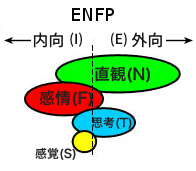
By reading the roadmap below, you can learn about cognitive functions and gain a systematic understanding of ENFPs ↓
- Roadmap – ENFP (Reformer type) –
- Introduction – What is MBTI?
- Summary of my personality
- Cognition is
- Type-specific cognitive characteristics
- Four personality indicators (psychological tendency axes)
- Conflicts over personality indicators
- “The meaning of the four letters "ENFP"
- First character:Introvert (type I) or extrovert (type E)
- Second character:Intuitive type (N type) or Sensing type (S type)
- Third character:Feeling type (F type) or thinking type (T type)
- 4th character:Perceiving type (P type) or Judging type (J type)
- About psychological functions (cognitive functions)
- What are psychological functions (cognitive functions)?
- The eight psychological functions (cognitive functions)
- Decision-making (judgment) function
- Information gathering (perceptual) function
- Understanding your own psychological functions (cognitive functions)
- The developmental process of psychological functions (cognitive functions)
- ENFP's psychological functions (cognitive functions)
- First function:Extroverted Intuition (Ne)
- Second function:Introverted Feeling (Fi)
- Third function:Extraverted Thinking (Te)
- Fourth function:Introverted Sensing (Si)
- Making good use of psychological functions (cognitive functions)
- Strengths and weaknesses of ENFPs
- Make the most of your strengths
- Reasons for focusing too much on the advantages
- How to improve your weaknesses
- If you are alone
- In a team setting: Have others compensate for your weaknesses (fourth function).
ENFP (Activist/Reformer Type) – A Comprehensive Guide to Links
- Explanation of ENFP
- ENFP personality
- ENFP Personality Traits 02
- ENFP's hobbies
- Things that ENFPs dislike
- Compatibility between ENFP and other personality types
- ENFP and Relationships
- ENFP and romance
- Strengths and weaknesses of ENFPs
- Suitable occupations for ENFPs
- ENFP leadership
- Compatibility between ENFP and other personality types
- ENFP and Relationships
- ENFP and romance
- How ENFPs set goals and gather information.
- ENFP's Decision-Making Methods
- ENFP parent-child relationships
- For ENFPs to succeed
- ENFP psychological functions
- “The meaning of the four letters "ENFP"
- ENFP's psychological functions (cognitive functions)
- Integration of ENFP's second and third functions
- The difference between extroverted thinking (Te) and introverted feeling (Fi)
- The difference between introverted feeling (Fi) and extroverted feeling (Fe)
- EP Type: A curious challenger
↑Click to open↑
youENFP (Activist/Reformer type)Then
Share it on social media (tweet it) and let your followers know!
↓↓↓Share on social media (tweet)↓↓↓
↑↑↑Share on social media (tweet)↑↑↑

comment