
Classifying personalities into 16 types16-Type Personality TestCheck which type you are using the following↓↓

↑16-Type Personality Test↑
↑Diagnose↑
This article will cover the following 16 types.Success of ENFP (Reformer type)This will explain the following.
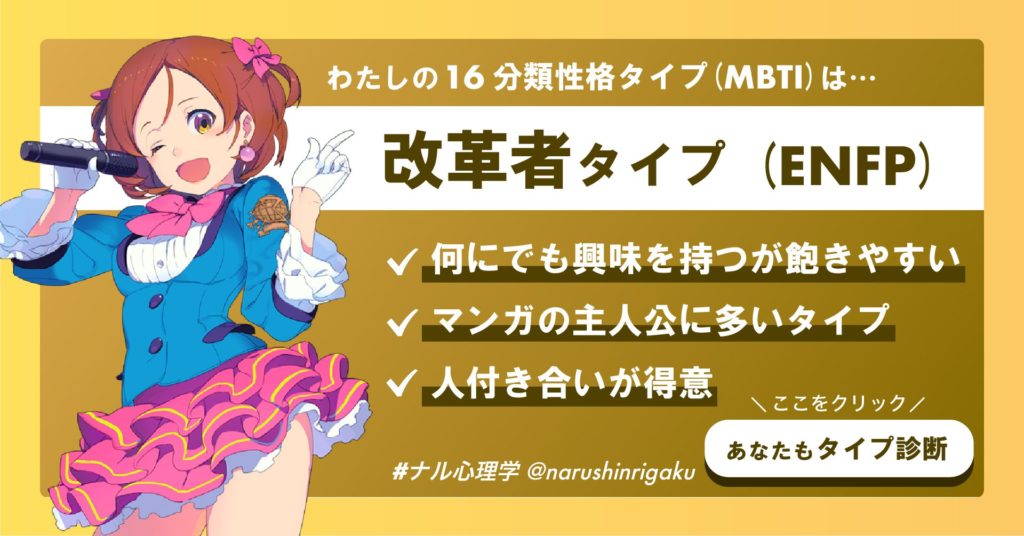
youENFP (Activist/Reformer type)Then
Share it on social media (tweet it) and let your followers know!
↓↓↓Share on social media (tweet)↓↓↓
↑↑↑Share on social media (tweet)↑↑↑


What does success mean to an ENFP (Reformer type)?
ENFPs rarely feel they have achieved enough success and always believe they can do better and achieve more. They want to make a difference in the world and be someone their loved ones can be proud of. ENFPs often compare their success to that of others and feel compelled to push themselves further. ENFPs feel a sense of accomplishment when their loved ones support them and appreciate them. However, ENFPs do not neglect themselves; on the contrary, they cherish their own values.
ENFP values often prioritize individual desires over what is expected of a social group. They respect the individual and dislike controlling others or being controlled by others. ENFPs are passionate about their beliefs, whatever they may be. If someone threatens their values or passions, they will stubbornly defend them. They value staying true to their beliefs more than the expectations and demands of the social group they belong to.
However, when it aligns with their beliefs, they often actively participate in social movements. They believe it is extremely important to back up compassionate words with good deeds. Contrary to their friendly nature, they can assert themselves quite loudly if necessary to get their way. The driving force behind ENFPs is their own values and beliefs, and finding that driving force is important for success. Because ENFPs have a strong need for recognition, they are more likely to succeed when their values align with what is socially commendable. However, instead of forcing themselves to change their values, it is better to look for something socially commendable within their existing values.
ENFPs dislike personal criticism because it threatens their personal validity and the validity of their values. However, even when subjected to such criticism, ENFPs may not express anger. This is because they respect other individuals and find it difficult to hurt others. An ENFP's sense of success depends on whether they have opportunities to deepen their understanding of the world, whether they feel they are living true to their values, and the state of their close relationships.
Just because ENFPs value their own values doesn't mean they're self-centered. They have excellent communication skills, can quickly strike up conversations with anyone, and know how to draw others out to keep discussions going. Whether in casual conversation or collaborative work at the office, ENFPs often make an effort to actively engage in conversations.
Furthermore, ENFPs are driven by a desire to understand the world around them. Their minds and bodies are constantly searching for information to better grasp the bigger picture. They are also open to new encounters and experiences, and eagerly await such opportunities. ENFPs are imaginative and seek solutions that differ from conventional methods. They believe that a unique approach is possible and desirable in any situation, and they are not bound by habits or routines. They see obstacles as opportunities and face every challenge they encounter with an open mind and a fresh perspective.
Strengths that ENFP (Reformer type) should develop
- They have a very good understanding of people's thoughts and motivations.
- To motivate people and bring out their full potential.
- Possessing warm affection and a positive attitude
- Loyal and devoted
- I can work logically and rationally.
- They are sensitive to the feelings of others and can understand and appreciate how others feel.
- I'm good at comforting and encouraging others.
- They are warm and genuinely interested in people.
- Future-oriented
- Project-Oriented
- Cheerful and capable
- It is possible to understand complex theoretical concepts.
- I'm good at conceptualizing things and deriving principles from them.
- You can intuitively understand the goal and work backward to achieve it.
- High level of verbal and written communication skills
- I need approval and gratitude from others.
- Cooperativeness and approachability
- Creative and full of energy
- You can interact with people at a level that suits you.
- They have a strong service-oriented spirit and tend to prioritize others' needs over their own.
- It's fun to be with you
- Pursue a win-win situation.
- To strive to meet the other person's needs
- Skilled in strategic thinking
- He can naturally become a leader, but he doesn't like to control people.
- I resist being controlled by others.
- It allows you to understand difficult concepts and abstract theories.
- Excellent communication skills
- I'm good at analysis and summarization.
- I'm good at understanding things from a holistic perspective.
Tips for success for ENFP (Reformer type)
- Express your emotions.
For example, try not to bottle up your anger. If you have strong emotions, you need to process and express them, otherwise they may one day become destructive. - Let's make a decision and move forward.
ENFPs tend to think of many possibilities, but this can sometimes make it difficult to decide which one to choose. They may also feel anxious about whether their decision is truly the right one. However, they shouldn't be afraid to have their own opinion. Unless they make a choice, the chances of success are zero. Start by trying things that they can recover from if they fail, and as they learn from their mistakes, they will eventually find themselves able to make decisions. - Let's respond to criticism with a smile.
ENFPs can feel intense anger towards those who criticize them. Try to view disagreements and differences of opinion as opportunities for growth. Avoid becoming overly defensive in the face of criticism; listen to it and judge it objectively. The criticism may not be a hurtful attack, but rather a helping hand (even if the critic did not intend it that way), so be careful not to overlook it. - Make the most of your strengths.
ENFPs enjoy new experiences in order to understand and explore the world, making them ideally suited to jobs that involve creatively generating new ideas and close interaction with people. They are likely to be dissatisfied with restrictive and routine work. Furthermore, ENFPs get along well with people who embrace change and new experiences, so finding like-minded individuals is important for them. - Let's try to find something that we can enjoy until the very end.
ENFPs love novelty, variety, and new challenges. They find the initial stages of a project far more exciting and enjoyable than the final stages. As a result, they are drawn to a variety of things, and without the right systems and foresight, they can spend a lot of time getting started without achieving much. While it's in ENFP nature to enjoy many things, ultimately accomplishing nothing is undesirable. Choosing projects that offer a wide range of experiences will help them see them through to the end (or find themselves continuing with them without realizing it). - Be careful not to overthink things.
ENFPs are intuitive and possess a keen eye for detail. However, they often make mistakes when trying to uncover hidden motives and intentions in everything they do. In normal social interactions, ENFPs need to make an effort to take words and actions at face value. By overthinking and anticipating only the worst-case scenarios, they can actually increase the likelihood of those worst-case scenarios occurring (this is called a self-fulfilling prophecy). - Let's see it through to the end.
ENFPs don't always see things through to the end once they start, and they like to try new things one after another. So, perhaps it would be good for ENFPs to try to manage things meticulously from time to time for a change of pace. Detailed work and planning management aren't necessarily natural for ENFPs. However, ENFPs have insight and the ability to complete even the smallest tasks.
If that proves too difficult, consider partnering with someone who is patient and good at planning. ENFPs are independent and may not often ask for help from others, but having an assistant or colleague to handle tasks they tend to overlook will be an invaluable asset. Also, ENFPs enjoy working in teams, so building relationships and partnerships with people who complement their strengths shouldn't be too difficult. In their personal lives, they will likely also often connect with people who excel at things they tend to neglect. - Let's look inward.
ENFPs love being praised and work hard to please others, but remember that this doesn't always have a positive effect. If ENFPs worry too much about what others think, they may lose their intuition, become easily manipulated, and be unable to reach their full potential. When you're paralyzed by worrying too much about what others think (i.e., external opinions), it's important to confront your own values and ideals.
For those who want to learn more about ENFP (the reformer type) (including compatibility)
For more information, please see below.Highly recommended (click to open) ↓
Compatibility: You can learn about compatibility and how to interact with other types.
RoadmapYou can learn about personality types and personality theories (MBTI) in a systematic way, from basic to specialized.
Related articlesLearn about the characteristics of each type (take a look at the parts that interest you)
Compatibility between ENFP (Reformer type) and other types (click to show)
Ideal compatibility type pair
ENFPs are compatible with people who share their idealistic worldview, have a sense of humor, and are imaginative and understanding.
From an ENFP's perspective...
- ESFP (Optimist type):Se – Fi, a sense of humor and other things that we get along well with
- ENFJ (Collaborator Type):Fe – NiThey share a similar ideal vision and are compatible in their efforts to achieve it.
- ENTP (Inventor Type):Ne – TiIt also allows for brainstorming, deepening discussions, and exchanging information.
- ISFP (Artist type):Fi – SeWe can think about things from a practical perspective and be inspired by each other's ideas.
Type pairs that are prone to conflict
ENFPs tend to clash with people who not only refuse to accept opinions different from their own but also criticize them.
From an ENFP's perspective...
- ISTJ (Hardworking Type):Si – TeThey lack humor and are unwilling to accept new ideas.
- INTJ (Strategist type) :Ni – TeThey lack a good sense of humor, are overly cautious about new ideas, and tend to look for flaws that make them unlikely to work, offering harsh criticism.
Romantic compatibility type pair
ENFPs are most compatible in romantic relationships with someone who shares their ideal worldview, understands their groundbreaking ideas, and provides a sense of security even in difficult situations.
From an ENFP's perspective...
- ENFJ (Collaborator Type):Fe – NiThey actively accept my ideas and think about how to make them feasible.
- INTP (Researcher Type):Ti – NeThey can help us brainstorm ideas and discuss things, and they also gather information and teach us useful things.
- INTJ (Strategist type) :Ni – Te...and we can discuss our thoughts and, moreover, it gives us peace of mind in the long term.
- ESFJ (Sociable Type):Fe – SiThey're fun to talk to, and they help create schedules, making it easy to understand what needs to be done next.
*The pairs that tend to clash and the pairs that have good romantic compatibility may overlap. This is because while people may dislike those who are the complete opposite of themselves due to disagreements, they may also be attracted to those who appear mysterious because they are different. However, it seems that these relationships often end up breaking down.
(Advice for those dating an ENFP)
ENFPs tend to be passionate and enthusiastic in romantic relationships. Because they often focus on what's possible rather than the present, long-term relationships can sometimes be challenging. To maintain a romantic relationship and keep it going, it's important for them to explore new ways to add excitement to their love life.
ENFP (Reformer type) Roadmap (Click to open)
To truly understand the ENFP (Reformer type),Psychological functions (cognitive functions)This is important ↓
- Extroverted Intuition/Ne
Very good at it /First functionIt can control our perception of the future and allow us to predict various possibilities and destinies. - Introverted Feeling/Fi
I'm a little good at it /second functionIf your actions are based on moral reasons aligned with your vision, you can take responsibility for how others feel. - Extraverted Thinking/Te
I'm not very good at it.Third functionI prefer an environment where everyone can feel comfortable. Once an environment is disrupted, it cannot be fixed by avoiding responsibility. - Introverted Sensing/Si
I'm really bad at it /Fourth functionThey are afraid and anxious about trying new things and having unpleasant experiences. They don't know how to deal with routines and patterns (or don't like them).
<ENFP's cognitive axis>
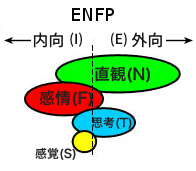
By reading the roadmap below, you can learn about cognitive functions and gain a systematic understanding of ENFPs ↓
- Roadmap – ENFP (Reformer type) –
- Introduction – What is MBTI?
- Summary of my personality
- Cognition is
- Type-specific cognitive characteristics
- Four personality indicators (psychological tendency axes)
- Conflicts over personality indicators
- “The meaning of the four letters "ENFP"
- First character:Introvert (type I) or extrovert (type E)
- Second character:Intuitive type (N type) or Sensing type (S type)
- Third character:Feeling type (F type) or thinking type (T type)
- 4th character:Perceiving type (P type) or Judging type (J type)
- About psychological functions (cognitive functions)
- What are psychological functions (cognitive functions)?
- The eight psychological functions (cognitive functions)
- Decision-making (judgment) function
- Information gathering (perceptual) function
- Understanding your own psychological functions (cognitive functions)
- The developmental process of psychological functions (cognitive functions)
- ENFP's psychological functions (cognitive functions)
- First function:Extroverted Intuition (Ne)
- Second function:Introverted Feeling (Fi)
- Third function:Extraverted Thinking (Te)
- Fourth function:Introverted Sensing (Si)
- Making good use of psychological functions (cognitive functions)
- Strengths and weaknesses of ENFPs
- Make the most of your strengths
- Reasons for focusing too much on the advantages
- How to improve your weaknesses
- If you are alone
- In a team setting: Have others compensate for your weaknesses (fourth function).
ENFP (Activist/Reformer Type) – A Comprehensive Guide to Links
- Explanation of ENFP
- ENFP personality
- ENFP Personality Traits 02
- ENFP's hobbies
- Things that ENFPs dislike
- Compatibility between ENFP and other personality types
- ENFP and Relationships
- ENFP and romance
- Strengths and weaknesses of ENFPs
- Suitable occupations for ENFPs
- ENFP leadership
- Compatibility between ENFP and other personality types
- ENFP and Relationships
- ENFP and romance
- How ENFPs set goals and gather information.
- ENFP's Decision-Making Methods
- ENFP parent-child relationships
- For ENFPs to succeed
- ENFP psychological functions
- “The meaning of the four letters "ENFP"
- ENFP's psychological functions (cognitive functions)
- Integration of ENFP's second and third functions
- The difference between extroverted thinking (Te) and introverted feeling (Fi)
- The difference between introverted feeling (Fi) and extroverted feeling (Fe)
- EP Type: A curious challenger
↑Click to open↑
youENFP (Activist/Reformer type)Then
Share it on social media (tweet it) and let your followers know!
↓↓↓Share on social media (tweet)↓↓↓
↑↑↑Share on social media (tweet)↑↑↑

comment