

Classifying personalities into 16 types16-Type Personality TestCheck which type you are using the following↓↓

↑16-Type Personality Test↑
↑Diagnose↑
This article will cover the following 16 types.ESTJ (Responsible type)SuccessI will explain this.
youESTJ (Executive/Responsible Type)Then
Share it on social media (tweet it) and let your followers know!
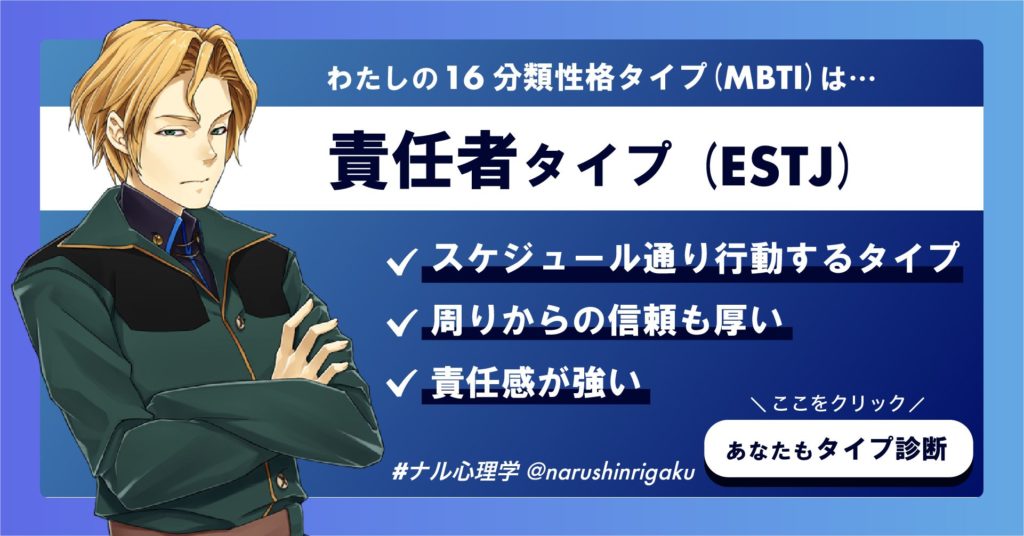
↓↓↓Share on social media (tweet)↓↓↓
↑↑↑Share on social media (tweet)↑↑↑


What does success mean to an ESTJ (the type of person in charge)?
ESTJThe emphasis is on how efficiently goals are achieved. It's not simply about getting the job done, but about fully utilizing one's abilities and ensuring everything is done efficiently.
ESTJs are good at getting things done and enjoy making things happen. Because they act based on their beliefs, they can persevere and see things through even when faced with great difficulties; they are tenacious and reliable. They are also highly responsible and keep their promises. They like things to be neat and tidy, and have a great memory and organizational skills. ESTJs tend to be confident in their abilities. Rather than spending time doubting their own capabilities, they tend to prove their potential through action.
ESTJs feel happier and more productive when they engage in work they excel at. By proactively taking on tasks and seizing opportunities to leverage their strengths, they may be able to stay in their positions long-term.
When faced with a decision, ESTJs base their conclusions on past experiences and social principles. They are objective, organizational, analytical, and possess strong reasoning abilities. At the same time, ESTJs are realistic, calm, and pragmatic.
They are more interested in "real things" than intangible things like abstract ideas or theories. They tend to show little interest in things that they perceive as having no practical value. They are aware of what is happening around them and prioritize reality.
ESTJs believe that "what you see is what matters," so they generally understand things easily. For ESTJs, the most important thing is doing the right thing and taking control of what is happening. Success means achieving visible results in the world and gaining social recognition.
ESTJs genuinely enjoy being with others and value traditional relationships. While they may not place as much importance on emotional life or social activities as other aspects of their lives, they do cherish family relationships. They are also straightforward and friendly. ESTJs may feel successful if they can live within societal norms.
Extroverted ESTJs are keen to bring people together, that is, to supervise and manage. They are confident in front of others and possess leadership qualities, making them well-suited to leading large teams. They can focus on goals and determine how each person can contribute effectively. While they prefer to organize and mobilize people according to their own theoretical tactics, they are also happy to follow "rules" such as traditional customs and orders from superiors.
ESTJs place great importance on social order and structure, and demand that both themselves and others adhere to social principles. Therefore, they tend to respect rules and authority figures, and aspire to be so themselves. ESTJs strongly believe in these principles and strongly reject any violation. They unconditionally follow these principles because they believe they represent appropriate behavior and attitudes. ESTJs take a very firm stance when these principles are violated. For ESTJs, respecting the principles is more important than considering the position or feelings of the individual who violated them.
Tips for success for ESTJs (the leader type)
- Let's develop our strengths.
ESTJs are endowed with a great ability to generate logical and ethical principles that go beyond personal experience. Take all the data into consideration and strive to make these principles as good as possible. - Be careful not to dismiss opinions too quickly.
ESTJs may be convinced they know the motives, intentions, results, and conclusions before even knowing a fraction of the details, and they may not admit that they know everything. Such people should be a little more cautious before making hasty decisions or judgments. Focus on asking more questions, waiting for more information, and acknowledging that there may be just as much that they don't see as there is that they are convinced of.
Just because you know the answer doesn't mean you should dismiss the idea prematurely. - Suppress the urge to try to control others.
You cannot force others to conform to your way of thinking. You may think you know what is best for others, but just as you have the right to live your life the way you want, others have their own rights as well. Instead of judging and trying to control others, focus on using your own judgment to create more equitable principles. - Let's become more self-critical.
ESTJs tend to believe they are always right and that their moral values are objective, absolute, and universal. However, this objectivity is not always as objective as it appears. Recognizing that individual objectivity is, by definition, somewhat subjective, it is beneficial for them to take the time to examine the basis of their beliefs. - Actively engage in empathy and emotional expression.
The biggest weakness of the ESTJ personality type is their ability to express healthy emotions. They struggle to feel and empathize with others. They often prioritize emotions over their own and others' feelings, which can make them appear harsh, unfriendly, pragmatic, and inconsiderate. They become so fixated on the objective facts of each situation and focused on finding effective solutions that they forget basic concepts like happiness and peace. This can harm relationships and even hinder their social life. Their strictness and rigidity can alienate talented employees and alienate family members. They should make an effort to acknowledge and appreciate the talents and abilities of others. They can improve relationships by offering words of encouragement that take their personal circumstances into consideration and by expressing their emotional needs, such as how much they expect from them. - Let's try challenging ourselves with new environments and methods.
ESTJs prefer stable and comfortable environments. They highly value traditions shaped by the evaluation of best practices. However, they can be fixated on the objective correctness of their own methods and ways of thinking, which can sometimes hinder their personal growth.
When you propose a new idea to someone with this personality type, it may be perceived as rude, nonsensical, or negative. ESTJs dislike the idea of abandoning their routines unless there is irrefutable evidence that a new method is more effective. Additionally, ESTJs can be so fixated on their beliefs and sense of rightness that they may be unable to accept new or contradictory information.
As a result, they sometimes miss out on ideas that could have worked better. ESTJs are reluctant to trust others because they believe everything is just an opinion until it's proven otherwise. This can make them inflexible in many situations. However, they should remember that new ideas and reforms are not harmful, but rather lead to great success and growth. - Make sure to take some time to relax.
ESTJs prefer to be constantly busy, seeing it as a way to maintain dignity in their work. However, a major problem is that the lack of rest can lead to stress that significantly impacts their lives. To address this issue, ESTJs need to work on stress relief and intentional rest, as well as trustworthy relationships with family and friends. ESTJs don't want to be seen as lazy, but it's good to remember that leisure and rest are not symbols of laziness, but normal ways for people to recharge. Practices like yoga, tai chi, and meditation can also be effective. Furthermore, being in close friendships allows them to make decisions that might be considered socially foolish without affecting their social standing, thus relieving tension. - Try to find a job that involves interacting with people as much as possible.
For ESTJs, the key to job satisfaction lies in connecting with others. They are often found among business owners, bankers, and financial managers. They also value order and tradition, using their understanding of right and wrong and social norms to unite their communities and families. Furthermore, they revere honesty, dignity, and dedication, and place great emphasis on providing clear advice and guidance.
On the other hand, they may not be able to tolerate solitary work. For example, data entry is generally quite solitary. In contrast, extroverted people often seek social situations, but data entry jobs lack this. Data entry jobs only involve facing loneliness and repetition, which can lead to a socially isolated life for an ESTJ. - Extraverted Thinking (Te)とIntroverted Sensing (Si)Let's find a balance.
ESTJs possess extroverted thinking (Te), a cognitive function that uses societal rules and traditions to make judgments and efficiently accomplish things. However, when this extroverted thinking (Te) is strongly expressed, it can affect interpersonal relationships.
First, bringing a harsh attitude into personal relationships may damage those relationships. Second, there's the issue of how society perceives you based on your gender. Female ESTJs may be seen as domineering, controlling, or masculine, and may not be readily accepted by societal standards. As a result, female ESTJs may have low self-esteem. Male ESTJs may find that societal stereotypes encourage them to believe they have the right to be dominant.
Some ESTJs struggle to integrate into society. The problems often relate to controlling others, having unrealistic expectations of their behavior, failing to consider others' needs and feelings, and generally being overly assertive. These issues primarily stem from a habit of using extroverted thinking (Te) in a mode that quickly and automatically applies existing principles to the external world, rather than comparing them with one's own internal data and principles of action. Extroverted thinking (Te) is fundamentally a function that creates structures and rules by identifying and adhering to logical principles. It is a form of social judgment, defined by the external world rather than an internal sense of right and wrong. The true strength of extroverted thinking (Te) lies in its high ethical standards. It genuinely believes in the merits of principles without being swayed by individual appeals.
ESTJs need to utilize the wealth of internal data gained through their introverted sensing (Si) to shape their principles. Introverted sensing (Si) is an auxiliary function for ESTJs, a means of observing data and storing and remembering it for future reference. Introverted sensing (Si) can analyze and store vast amounts of data. When this data is incorporated into extroverted thinking (Te), it can be used to form principles and enforce structures in the world using real-world data. In the case of ESTJs, if extroverted thinking (Te) becomes excessively dominant, the importance of the auxiliary introverted sensing (Si) diminishes. ESTJs may fail to see beyond the fact that principles have been broken and lose the ability to view data objectively. Ignoring facts and clinging to firm principles is a source of trouble, as seen in various dictators throughout history. For ESTJs to develop healthily, they need to recognize the importance of the data accumulated within themselves and use all available data to form good principles. To achieve this, ESTJs should recognize the importance of introverted sensing (Si), remove the filters of principles and societal traditions, and remember to see the facts.
Understanding the strengths of your own personality type and developing those strengths will also be helpful.Strengths and weaknesses of ESTJs
youESTJ (Executive/Responsible Type)Then
Share it on social media (tweet it) and let your followers know!
↓↓↓Share on social media (tweet)↓↓↓
↑↑↑Share on social media (tweet)↑↑↑
Further characteristics of ESTJ (the responsible type) and compatibility with other types
- What is ESTJ? – Main Page –
- "Taking on one challenge after another" - ESTJ ~ How do gender differences affect the lives of ESTJs? ~
- A Personality Guide for ESTJs
- ESTJ's hobbies
- Things that ESTJs dislike
- Strengths and weaknesses of ESTJs
- Suitable occupations for ESTJs
- ESTJ leadership
- Compatibility between ESTJ and other types
- ESTJ and relationships
- ESTJ and romance
- How ESTJs set goals and gather information.
- ESTJ parent-child relationships
- For ESTJs to succeed
↓Learn more↓
Compatibility chart and advice for ESTJ (the leader type) and other personality types.
Ideal compatibility type pair
ESTJs are compatible with people who value practical application in external settings, the knowledge of predecessors, and information that is actually useful.
From an ESTJ's perspective...
- ESTP (Adventurer type):Se – Ti, put knowledge into practice and quickly implement what can be done in reality.
- ISTJ (Hardworking Type):Si – Te, maintain and preserve order
- ESFJ (Sociable Type):Fe – SiTo show respect and reverence to society
Type pairs that are prone to conflict
ESTJs tend to clash with idea-driven individuals who don't share a realistic worldview and don't place much value on tradition.
From an ESTJ's perspective...
- INFP (Psychologist type):Fi – NeThey pursue ideals, value personal values, and crave alone time.
- INTP (Researcher Type):Ti – NeHe has a unique personality, is always thinking about something, and is difficult to deal with.
Romantic compatibility type pair
ESTJs are compatible with people who are open and willing to discuss their thoughts intimately, without regard for personal gain.
From an ESTJ's perspective...
- ESFJ (Sociable Type):Fe – SiRespecting society and being able to discuss ideas
- ISFJ (Parental Type):Si – Fe, respecting the organization and traditions
- ISTJ (Hardworking Type):Si – TeThey value the organization and possess practical insight.
- INFP (Psychologist type):Fi – NeYou can enjoy your hobbies intimately and relieve stress.
*The pairs that tend to clash and the pairs that have good romantic compatibility may overlap. This is because while people may dislike those who are the complete opposite of themselves due to disagreements, they may also be attracted to those who appear mysterious because they are different. However, it seems that these relationships often end up breaking down.
(Advice for those dating an ESTJ)
reference ESTJ and romance
ESTJs are trustworthy and keep their promises seriously. While they can be inflexible, once they build a relationship, they will likely maintain it for life. However, they often avoid touching on emotions and feelings, prioritize their own opinions, and don't listen to others', which can be difficult for their partners. Remember that while they may not always express their feelings in words, they often communicate through actions.
For example, ESTJs put a great deal of effort into fulfilling their obligations to loved ones. Social events are also important to them, and ESTJs remember important events such as birthdays and anniversaries.
ESTJ (Responsible Type) Roadmap (Click to open)
Reading the following roadmap from top to bottom will help you understand the ESTJ mindset in a logical order ↓
- Roadmap – ESTJ (Executive/Responsible Type) –
- Introduction – What is MBTI?
- Summary of my personality
- “The meaning of the four letters "ESTJ"
- What are the personality traits of the four pairs?
- First character:Introvert (type I) or extrovert (type E)
- Second character:Intuitive type (N type) or Sensing type (S type)
- Third character:Feeling type (F type) or thinking type (T type)
- 4th character:Perceiving type (P type) or Judging type (J type)
- The quirks (tendencies) and conflicts of the four pairs of personality traits
- Cognitive mechanisms
- What are the personality traits of the four pairs?
- About psychological functions (cognitive functions)
- What are psychological functions (cognitive functions)?
- The eight psychological functions (cognitive functions)
- Decision-making (judgment) function
- Information gathering (perceptual) function
- Understanding your own psychological functions (cognitive functions)
- The developmental process of psychological functions (cognitive functions)
- Psychological functions (cognitive functions) of ESTJs
- First function:Extraverted Thinking (Te)
- Second function:Introverted Sensing (Si)
- Third function:Extroverted Intuition (Ne)
- Fourth function:Introverted Feeling (Fi)
- Making good use of psychological functions (cognitive functions)
- Strengths and weaknesses of ESTJs
- Make the most of your strengths
- Reasons for focusing too much on the advantages
- How to improve your weaknesses
- If you are alone
- In a team setting: Have others compensate for your weaknesses (fourth function).
To truly understand the ESTJ (Responsible Type),Psychological functions (cognitive functions)This is important ↓
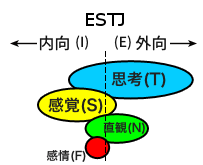
- Extraverted Thinking/Te
Very good at it /First functionThey are skilled at objectively grasping specific facts using inductive reasoning (practical observation that leads to immediate conclusions). - Introverted Sensing/Si
I'm a little good at it /second function: To bear the responsibility and obligations to society, discipline, loyalty, and honor. - Extroverted Intuition/Ne
I'm not very good at it.Third functionThey aim for their actions and procedures to be effective in the future, but they can become neurotic if things don't go their way. - Introverted Feeling/Fi
I'm really bad at it /Fourth functionI feel anxious or afraid that I am not moral. I don't know how to confront (or don't want to confront) my own moral values.
<The cognitive axis of ESTJ>
List of articles related to ESTJ (Responsible Type)
↑Learn more↑

comment