
On this page, you can choose from 16 types.ESFJ (Consul/Social Type)I will explain the personality traits of [this person/character].
youESFJ (Consul/Social Type)Then
Share it on social media (tweet it) and let your followers know!
↓↓↓Share on social media (tweet)↓↓↓
↑↑↑Share on social media (tweet)↑↑↑
Classifying personalities into 16 types16-Type Personality TestCheck which type you are using the following↓↓

↑16-Type Personality Test↑
↑Diagnose↑


Description of the personality traits of the ESFJ (Consul/Société type)
The following is a quote (with some modifications) from "Let's Look at the World from the Perspective of MBTI Personality Type Theory" (website no longer exists).
They are sociable, interested in others, and have a good memory. They can notice what others need before they even realize it themselves and try to take care of them. If necessary, they will actively build relationships and try to be helpful. In this way, they expand their circle of friends.
I am emotionally expressive, genuinely empathetic to others, and want to share their joy as much as possible. In public, I can behave politely and considerately, without causing offense. I value relationships and want to live a safe and secure life by cooperating with each other and making the most of each individual's strengths.
I strive to ensure that each individual is in their best possible condition. I am attentive to the small details necessary to maintain daily life. I will quickly notice and worry when others are not feeling well or are in poor health. I find joy in using these qualities to care for, look after, and assist others.
I interact with many people, learn how to behave in public, and develop a strong sense of ethics. I am good at understanding the atmosphere and general consensus of those around me. I accept the values and opinions of others and try to share them with everyone. If someone is in a difficult situation, I would like to cooperate and help them.
They tend to hold traditional values and desire disciplined and respectful relationships. They take social roles, gender roles, and parent-child roles seriously. They respect their elders, cooperate with colleagues, and try to take care of their subordinates.
The home is designed to be orderly and functional. The interior, furniture, decorations, tableware, and ornaments reflect the parents' aesthetic sense. Parents take their roles seriously and take meticulous care of their children. They also strive to properly discipline their children so that they do not behave in a way that would be embarrassing in public. Children want to respect their parents. They help with household chores, complete their schoolwork diligently, and deal with the repetitive daily routine without neglecting anything.
Family, relatives, special events at school, and other social interactions are important and enjoyable for me. I gladly participate in and help as much as I can with regular events such as cherry blossom viewing, birthday parties, holidays, commemorative ceremonies, and family gatherings. I keep in touch with a wide range of people, from old friends to new acquaintances, and try to spend time with them. I also enjoy coming up with new ideas for things like engaging in conversation at restaurants, hosting international students, and planning surprise parties. I have a talent for hospitality and can naturally make everyone feel at ease.
They don't neglect old relationships, but they actively try to get to know a variety of people. If they feel a connection with someone, they might invite them to an event or even to their home.
When I feel anger, sadness, or an inexplicable sense of unease, I need someone to listen to me. I listen to others' opinions with sincerity and humility. I can be motivated when I am praised or receive positive feedback. On the other hand, I am easily hurt when I receive blunt criticism, indifference, or unkind treatment. And I express that pain and aversion.
Following traditional values, there is a clear awareness of gender roles in society. For women, considerate and polite characteristics are readily accepted. Of course, these qualities also make men attractive. However, men sometimes believe that their susceptibility to the opinions of others and their vulnerability are things they must overcome. Therefore, they may try to force themselves to be masculine by working out physically or striving to become knowledgeable in fields such as mechanics or theory.
They value courtesy, manners, and etiquette, and will never forget to thank someone who is kind to them. They expect others to also value courtesy and behave appropriately in any given situation. They feel disgusted by those who disrupt harmony and act disrespectfully. They may severely reprimand such individuals and demand that they reflect on their actions.
I am strongly aware that social life is built on people supporting one another. I believe that everyone should get along and cooperate, and that no one should be left out. To that end, I think it is important to share and understand each other's experiences, knowledge, and values as much as possible.
I want to get along with everyone, but I clarify what I need to do, set priorities, and choose the people with whom I should build trusting relationships.
To value relationships, one must let go of self-interest, self-centered obsessions, and idle time as much as possible. ESFJs unconsciously understand this and believe that other people behave in the same way. They consider it selfish to disregard the needs of others, to rudely try to satisfy their curiosity, or to pursue their own interests alone. They humbly accept their personal limitations and weaknesses and believe that building constructive cooperative relationships is essential.
Even when something new is proposed, I won't readily adopt it until its advantages and risks are clear. I will adopt it if it's explained clearly and logically, and if I'm fully convinced of the considerations for others. Otherwise, I won't try to adopt it until it's accepted by many people and begins to be widely used. I am actually interested in new methods and ideas, but I tend to be cautious about introducing them. The more familiar something is, the more I tend to stick to that pattern, and it feels difficult to let go of it. I may act out of curiosity when the risk is low. For example, I might look at a catalog of everyday items and become interested in something that looks good.
I'm very practical and have a good memory, but I'm not very interested in abstract theories. I struggle quite a bit when I have to understand such things on my own. However, I find them interesting when they're explained clearly to me. I also enjoy playing popular games and intellectual toys. It's even better if I can enjoy them with other people.
Because they accept so many people and are willing to help them without reservation, they sometimes end up taking on too much responsibility. As a result, their kind nature may cause them to lose time, money, or opportunities. They may be oblivious to their own interests. However, they can humbly realize that they can only live by being appreciated and supported by many people.
By demonstrating meticulous attention to detail, showing appropriate consideration, and proactively practicing courtesy, they play a role in stabilizing society.
End of quote from "Let's Look at the World from the Perspective of MBTI Personality Type Theory" (website no longer exists) (partially modified)
reference
・What is ESFJ? – Main Page –
・"Caring" ESFJ How do gender differences affect the lives of ESFJs?
Further characteristics of the ESFJ (Consul/Société type) and compatibility with other types
- ESFJ Personality Traits 02
- ESFJ hobbies
- Things that ESFJs dislike
- Strengths and weaknesses of ESFJs
- Suitable occupations for ESFJs
- ESFJ leadership
- Compatibility between ESFJ and other personality types
- ESFJ Relationships and Romance
- How ESFJs set goals and gather information
- ESFJ's Decision-Making Methods
- ESFJ parent-child relationships
- How to succeed as an ESFJ
↓Learn more↓
Compatibility chart and advice for ESFJ (Consul/Société type) and other personality types.
Ideal compatibility type pair
ESFJs tend to get along well with cooperative people who follow social rules and are good at conversation.
From an ESFJ's perspective...
- ESFP (Optimist type):Se – FiThey have excellent social skills and can quickly become friends with people they talk to.
- ENFJ (Collaborator Type):Fe – NiThey have strong social skills and are good at bringing people together.
Type pairs that are prone to conflict
Those who tend to clash with ESFJs are often those whose values do not place much emphasis on social traditions, making it difficult for them to quickly connect with ESFJs.
From an ESFJ's perspective...
- INTP (Researcher Type):Ti – NeThey are obsessively meticulous about minute details, like nitpicking, they prefer to be alone, and they don't like to open up to people.
- INFP (Psychologist type):Fi – NeTheir pursuit of their ideals has gone to an excessive level, and while they should interact with more people, they prefer to be alone.
Romantically compatible type pairs
ESFJs are compatible with charismatic people who can fulfill their inner needs.
From an ESFJ's perspective...
- ESTJ (Responsible type):Te – SiThey share the same values, including an emphasis on social rules, and can discuss their ideas with each other.
- ESTP (Adventurer type):Se – TiThey are sociable, make you feel comfortable, are good at getting along with people, and can quickly open up to you.
- ENTJ (Leader type):Te – NiThey provide practical and realistic solutions, and demonstrate strong leadership to guide the team.
- INTP (Researcher Type):Ti – NeThey help organize and explain the chaotic and uncertain situation.
*The pairs that tend to clash and the pairs that have good romantic compatibility may overlap. This is because while people may dislike those who are the complete opposite of themselves due to disagreements, they may also be attracted to those who appear mysterious because they are different. However, it seems that these relationships often end up breaking down.
(Advice for those dating an ESFJ)
In relationships, ESFJs are very devoted, supportive, and loyal. They are not interested in casual relationships and focus on building long-term commitments. You can support your partner by showing how much you love and appreciate them. It is important to respond by showing affection and returning gestures of love. ESFJs also tend to seek relationships with honest people who are open about their feelings.
A collection of links explaining the psychological functions of the ESFJ (Consul/Sociable Type) (for those who want to understand how the mind works)
Reading the following roadmap from top to bottom will help you understand the workings of the ESFJ mind in a logical order ↓
- Roadmap – ESFJ (Sociable Type) –
- Introduction – What is MBTI?
- Summary of my personality
- Cognition is
- Type-specific cognitive characteristics
- Four personality indicators (psychological tendency axes)
- Conflicts over personality indicators
- “The meaning of the four letters "ESFJ"
- First character:Introvert (type I) or extrovert (type E)
- Second character:Intuitive type (N type) or Sensing type (S type)
- Third character:Feeling type (F type) or thinking type (T type)
- 4th character:Perceiving type (P type) or Judging type (J type)
- About psychological functions (cognitive functions)
- What are psychological functions (cognitive functions)?
- The eight psychological functions (cognitive functions)
- Decision-making (judgment) function
- Information gathering (perceptual) function
- Understanding your own psychological functions (cognitive functions)
- The developmental process of psychological functions (cognitive functions)
- Psychological functions (cognitive functions) of ESFJs
- First function:Extraverted Feeling (Fe)
- Second function:Introverted Sensing (Si)
- Third function:Extroverted Intuition (Ne)
- Fourth function:Introverted Thinking (Ti)
- Making good use of psychological functions (cognitive functions)
- Strengths and weaknesses of ESFJs
- Make the most of your strengths
- Reasons for focusing too much on the advantages
- How to improve your weaknesses
- If you are alone
- In a team setting: Have others compensate for your weaknesses (fourth function).
To truly understand the ESFJ (Société type),Psychological functions (cognitive functions)This is important ↓
- Extraverted Feeling/Fe
Very good at it /First functionFollow what you deem right for everyone, what is good for the group. - Introverted Sensing/Si
I'm a little good at it /second function: To bear the responsibility for social obligations and responsibilities, discipline, loyalty, and honor. - Extroverted Intuition/Ne
I'm not very good at it.Third functionThey aim for their actions and procedures to be effective in the future, but they can become neurotic if things don't go their way. - Introverted Thinking/Ti
I'm really bad at it /Fourth functionThey fear and are anxious about things that are not logically correct. They don't know how to thoroughly analyze available information (or are unwilling to do so).
<ESFJ Cognitive Axis>
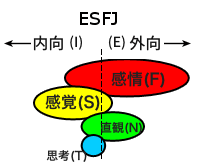
List of articles related to ESFJ (Consul/Socialist type)
↑Learn more↑
List of 16 types (≒MBTI types)
A Collection of Information on the 16 Personality Types – The Little-Known Truths of Each Type (Summary, Illustrations, and Analysis)
- Summary of 16 Personality Type Test Websites
- List of articles categorized by personality type (16 types)
- Compatibility chart for 16 personality types
- Suitable occupations, ideal jobs, and dream jobs for each of the 16 personality types
- Nicknames (names) for each of the 16 personality types
- What if there were a country with 16 personality types...?
- The relationship between national characteristics around the world and the 16 personality types
- List of 16 Personality Types Based on Famous Characters
- Detective Conan: A Summary of 16 Personality Types for Each Character
- Percentage of 16 personality types
- Reactions of 16 Personality Types – Heaven and Hell
- To describe the 16 personality types in one word:
- 16 Simple Explanations of Personality Types
- 16 Personality Types: Strengths, Weaknesses, and Ways to Improve Weaknesses
- 16 Personality Types: Preferences and Strengths/Weaknesses in Majors and Subjects
- 16 Personality Types: How to Enjoy Life to the Fullest…?
- 16 Personality Types: Inspiring Quotes from Great Figures
- What if each of the 16 personality types were a murderer?
- How to become an attractive husband or wife based on your personality type (16 types)
- What 16 personality types do after a breakup
- Reasons for fighting according to 16 personality types
- Income by 16 Personality Types - Misconceptions and Truths -
- Characteristics of employees based on 16 personality types
- Potential pathological tendencies of 16 personality types
- Psychological Functions of 16 Personality Types Based on Statistics
- Viewing percentage of the detailed personality pages for each of the 16 personality types
- Summary of the characteristics of the 16 personality types
- 8 psychological functions: "What if I did...?"
- Approaches to tasks based on psychological function: Intuitive (N-type) & Sensing (S-type)
- Social interaction explained by psychological functions
- Understanding Your Financial Habits Through Psychological Functions – Are You a Saver or a Spender?
- Humor (sense of humor) as revealed by psychological functions
- How extroverts (Type E) and introverts (Type I) can get along well
- How Sensing types (S type) and Intuitive types (N type) can get along well
- How Thinking (T-type) and Feeling (F-type) People Can Get Along Well
- How to get along well with Judging (J-type) and Perceiving (P-type) types
- Characteristics of parents with 16 personality types
- Parent-child relationships between extroverts (Type E) and introverts (Type I)
- Parent-child relationships between sensing types (S-type) and intuitive types (N-type)
- Parent-child relationships between thinking types (T-type) and feeling types (F-type)
- Parent-child relationships between judging (J-type) and percepting (P-type) types
- How to identify your partner's personality type: [16 Personality Types]

comment