

ESFJ (Sociable Type)のHow to set goals and gather informationI will explain this.


How ESFJs (Sociable Type) Set Goals and Gather Information
ESFJ types tend to be highly organizational and detail-oriented, setting goals that yield quantifiable results. They set deadlines for completion and specify when to begin taking action or conducting research.
This personality type should create long-term plans to view their short-term goals within a broader context. When creating a schedule to achieve their goals, ESFJs should work backward from the end date to allow for unexpected situations. This helps them understand what intermediate goals or other adjustments may be necessary.
Furthermore, people of this type should take the time to consider possibilities they haven't thought about before. If it's difficult to think about these things on their own, it's a good idea to freely seek advice from friends.
Once your goals are set, the next step is to start gathering information.
For example, an ESFJ aiming for employment will naturally reach out to people working in the field they are interested in. If they are interested in nursing, they will visit nursing schools and hospitals, talk to nurses, and ask about the job and what it takes to succeed. Some may also participate in work experience programs to see the daily life of a nurse firsthand. This method of gathering information is an excellent opportunity for ESFJs to ask frank questions that might not be appropriate in an interview. For example, they might ask questions such as, "What are the worst aspects of the job, employer, and environment?" or "What would current employees like to change if they could?"
Generally, ESFJs gather the minimum information necessary for decision-making, but it's important to note that they may sometimes overlook facts about long-term consequences.
Other types of "goal setting and information gathering methods"If you would like to read more about this,Click here ↓
16Personalities: Goal Setting and Information Gathering Methods by Personality Type
For those who want to learn more about ESFJ (Sociable Type) (including compatibility)
For more information, please see below.Highly recommended (click to open) ↓
Compatibility: You can learn about compatibility and how to interact with other types.
RoadmapYou can learn about personality types and personality theories (MBTI) in a systematic way, from basic to specialized.
Related articlesLearn about the characteristics of each type (take a look at the parts that interest you)
Compatibility between ESFJ (Sociable Type) and other types (Click to view)
Ideal compatibility type pair
ESFJs tend to get along well with cooperative people who follow social rules and are good at conversation.
From an ESFJ's perspective...
- ESFP (Optimist type):Se – FiThey have excellent social skills and can quickly become friends with people they talk to.
- ENFJ (Collaborator Type):Fe – NiThey have strong social skills and are good at bringing people together.
Type pairs that are prone to conflict
Those who tend to clash with ESFJs are often those whose values do not place much emphasis on social traditions, making it difficult for them to quickly connect with ESFJs.
From an ESFJ's perspective...
- INTP (Researcher Type):Ti – NeThey are obsessively meticulous about minute details, like nitpicking, they prefer to be alone, and they don't like to open up to people.
- INFP (Psychologist type):Fi – NeTheir pursuit of their ideals has gone to an excessive level, and while they should interact with more people, they prefer to be alone.
Romantically compatible type pairs
ESFJs are compatible with charismatic people who can fulfill their inner needs.
From an ESFJ's perspective...
- ESTJ (Responsible type):Te – SiThey share the same values, including an emphasis on social rules, and can discuss their ideas with each other.
- ESTP (Adventurer type):Se – TiThey are sociable, make you feel comfortable, are good at getting along with people, and can quickly open up to you.
- ENTJ (Leader type):Te – NiThey provide practical and realistic solutions, and demonstrate strong leadership to guide the team.
- INTP (Researcher Type):Ti – NeThey help organize and explain the chaotic and uncertain situation.
*The pairs that tend to clash and the pairs that have good romantic compatibility may overlap. This is because while people may dislike those who are the complete opposite of themselves due to disagreements, they may also be attracted to those who appear mysterious because they are different. However, it seems that these relationships often end up breaking down.
(Advice for those dating an ESFJ)
In relationships, ESFJs are very devoted, supportive, and loyal. They are not interested in casual relationships and focus on building long-term commitments. You can support your partner by showing how much you love and appreciate them. It is important to respond by showing affection and returning gestures of love. ESFJs also tend to seek relationships with honest people who are open about their feelings.
ESFJ (Sociable Type) Roadmap (Click to open)
To truly understand the ESFJ (Société type),Psychological functions (cognitive functions)This is important ↓
- Extraverted Feeling/Fe
Very good at it /First functionFollow what you deem right for everyone, what is good for the group. - Introverted Sensing/Si
I'm a little good at it /second function: To bear the responsibility for social obligations and responsibilities, discipline, loyalty, and honor. - Extroverted Intuition/Ne
I'm not very good at it.Third functionThey aim for their actions and procedures to be effective in the future, but they can become neurotic if things don't go their way. - Introverted Thinking/Ti
I'm really bad at it /Fourth functionThey fear and are anxious about things that are not logically correct. They don't know how to thoroughly analyze available information (or are unwilling to do so).
<ESFJ Cognitive Axis>
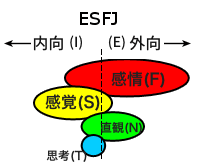
By reading the roadmap below, you can learn about cognitive functions and gain a step-by-step understanding of the ESFJ (Sociable type) ↓
- Roadmap – ESFJ (Sociable Type) –
- Introduction – What is MBTI?
- Summary of my personality
- Cognition is
- Type-specific cognitive characteristics
- Four personality indicators (psychological tendency axes)
- Conflicts over personality indicators
- “The meaning of the four letters "ESFJ"
- First character:Introvert (type I) or extrovert (type E)
- Second character:Intuitive type (N type) or Sensing type (S type)
- Third character:Feeling type (F type) or thinking type (T type)
- 4th character:Perceiving type (P type) or Judging type (J type)
- About psychological functions (cognitive functions)
- What are psychological functions (cognitive functions)?
- The eight psychological functions (cognitive functions)
- Decision-making (judgment) function
- Information gathering (perceptual) function
- Understanding your own psychological functions (cognitive functions)
- The developmental process of psychological functions (cognitive functions)
- Psychological functions (cognitive functions) of ESFJs
- First function:Extraverted Feeling (Fe)
- Second function:Introverted Sensing (Si)
- Third function:Extroverted Intuition (Ne)
- Fourth function:Introverted Thinking (Ti)
- Making good use of psychological functions (cognitive functions)
- Strengths and weaknesses of ESFJs
- Make the most of your strengths
- Reasons for focusing too much on the advantages
- How to improve your weaknesses
- If you are alone
- In a team setting: Have others compensate for your weaknesses (fourth function).
ESFJ (Consul/Société Type) – A Comprehensive Guide to Findings
- Explanation of ESFJ
- Psychological functions of ESFJs
↑Click to open↑

comment