

ESFP (Optimist type)のdecision making methodI will explain this.
Decision-making methods vary greatly from person to person. Some are frank and direct, clearly communicating their intentions without compromise or negotiation. Others present multiple options, consider them, and then make a decision. Still others prefer a combination of strategies, such as brainstorming in a group, then considering options individually, and finally presenting their clear ideas for feedback. There is no right or wrong way to make decisions. There is only your way of making decisions, and the method that works best for you.
However, when people with different decision-making styles work together, tension can rise. Understanding each other is key to maintaining communication and ensuring the success of the project.MBTIThis provides valuable insights into your decision-making process and preferences, helping others better understand you, and these insights can also help you improve and optimize your own decision-making in your personal and professional life.


Decision-making methods of ESFP (Optimist type)
ESFPs carefully consider how their choices will affect those close to them. For example, when considering a job change, ESFPs will reflect on how changes in working hours and income will impact their spouse, children, roommates, and other important people in their lives.
ESFPs are inherently social individuals who seek advice from others, especially those who have offered helpful opinions in the past. While seeking advice is an important part of the decision-making process, ESFPs prefer to form their own opinions first rather than blindly accepting the advice of others.
Furthermore, although it may not seem so at first glance, ESFPs can find decision-making difficult if other team members feel uncomfortable with the direction of a decision. ESFPs tend to value harmony within the team, which can sometimes hinder their leadership role. However, this can be improved by making an effort to explain their decisions to those who hold dissenting opinions.
When brainstorming options and beginning to evaluate them, ESFPs tend to be flexible, considering various different data sources and choices, especially for others.We will consider action plans that will bring direct and immediate benefits.(Extroverted Sensing: SeHaving a broad perspective can be useful in some situations, but spending too much time researching minute details can waste valuable time, so ESFPs should be careful to maintain their focus.
Those supporting ESFPs, whether as managers or team members, may find it helpful to create organizational structures such as matrices or flowcharts to allow for a more detailed examination of each option.
ESFPs choose certain options based on their common sense and what they see. They tend to make decisions relatively quickly, avoiding options that seem overly complex or difficult, and choosing the path with less resistance. They prioritize action over consideration, and practice over theory. Because this action-oriented approach is not optimal in all environments, ESFPs often benefit from people who resonate with the practical implications of a more strategic approach. Once a choice is made, ESFPs execute it quickly and efficiently, but their emphasis on speed can sometimes cause them to overlook subtle resistances or concerns.
When reflecting on and evaluating their decisions, ESFPs strive to acknowledge the contributions of team members and quickly seek ways to apply successful interventions elsewhere to achieve better results. To continue growing as leaders, ESFPs should strive to analyze and accept the complexity of specific situations. They should also consider how seemingly unrelated scenarios connect with others. By doing so, they can become better decision-makers, team members, and leaders.
Other types of "decision-making methods"If you would like to read more about this,Click here ↓
16 Types of Decision-Making Methods
For those who want to learn more about ESFP (Optimist type) (compatibility, etc.)
For more information, please see below.Highly recommended (click to open) ↓
Compatibility: You can learn about compatibility and how to interact with other types.
RoadmapYou can learn about personality types and personality theories (MBTI) in a systematic way, from basic to specialized.
Related articlesLearn about the characteristics of each type (take a look at the parts that interest you)
Compatibility between ESFP (Optimistic type) and other types (click to view)
Ideal compatibility type pair
ESFPs are compatible with people who understand their practical perspective, who think simply, have a sense of humor, and focus on taking quick action.
From an ESFP's perspective...
- ENFP (Reformer type):Ne – FiHe has a quick mind, a good sense of humor, and can come up with many ideas.
- ESTP (Adventurer type):Se – TiThey possess practical insight and can act quickly depending on the situation.
- ESFJ (Sociable Type):Fe – SiThey create a good atmosphere and help expand your circle of acquaintances.
- ISTP (Practitioner type):Ti – SeThey have good athletic ability and the ability to apply their knowledge in a realistic and practical way.
Type pairs that are prone to conflict
ESFPs tend to clash with people who are insensitive, critical, and lack a sense of humor.
From an ESFP's perspective...
- INTJ (Strategist type) :Ni – TeA serious person who is overly critical and nitpicky, while doubting other people's opinions.
- INFJ (Empathy Type):Ni – FeThey lack a sense of humor, and despite having overly high ideals, they rarely take action.
- ESTJ (Responsible type):Se – TiThey are excessively strict and conservative, and critical.
Romantic compatibility type pair
ESFPs are most compatible in romantic relationships with charming individuals who don't interfere too much with their lifestyle and make them feel comfortable.
From an ESFP's perspective...
- ESFJ (Sociable Type):Fe – SiYou can quickly make friends and enjoy shared hobbies together.
- ISFJ (Parental Type):Si – Fe, makes you feel comfortable
- ENFP (Reformer type):Ne – FiWe can respect each other's freedom and share our thoughts.
- ISTJ (Hardworking Type):Si – Te, guarantees a stable life
*The pairs that tend to clash and the pairs that have good romantic compatibility may overlap. This is because while people may dislike those who are the complete opposite of themselves due to disagreements, they may also be attracted to those who appear mysterious because they are different. However, it seems that these relationships often end up breaking down.
(Advice for those dating an ESFP)
ESFPs tend to be honest and straightforward in relationships. In romantic relationships, they are warm and passionate, without playing games. It's important to note that ESFPs tend to take criticism personally and dislike conflict. While being straightforward is important in relationships with ESFPs, try to avoid being overly confrontational or harsh.
ESFP (Optimist Type) Roadmap (Click to open)
To truly understand ESFP (Optimist type),Psychological functions (cognitive functions)This is important ↓
- Extroverted Sensing/Se
Very good at it /First functionThey are familiar with the real physical space ("what is happening right now") and possess high spatial awareness. - Introverted Feeling/Fi
I'm a little good at it /second functionIf your actions are based on moral reasons aligned with your vision, you can take responsibility for how others feel. - Extraverted Thinking/Te
I'm not very good at it.Third functionI prefer an environment where everyone can feel comfortable. Once an environment is disrupted, it cannot be fixed by avoiding responsibility. - Introverted Sensing/Ni
I'm really bad at it /Fourth functionThey feel anxious and fearful because they don't know what will happen in the future. They are unable to (or do not like) making long-term predictions.
<ESFP's cognitive axis>
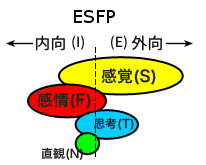
By reading the roadmap below, you can learn about cognitive functions and gain a systematic understanding of the ESFP (Optimist type) ↓
- Roadmap – ESFP (Optimist type) –
- Introduction – What is MBTI?
- Summary of my personality
- Cognition is
- Type-specific cognitive characteristics
- Four personality indicators (psychological tendency axes)
- Conflicts over personality indicators
- “The meaning of the four letters "ESFP"
- First character:Introvert (type I) or extrovert (type E)
- Second character:Intuitive type (N type) or Sensing type (S type)
- Third character:Feeling type (F type) or thinking type (T type)
- 4th character:Perceiving type (P type) or Judging type (J type)
- About psychological functions (cognitive functions)
- What are psychological functions (cognitive functions)?
- The eight psychological functions (cognitive functions)
- Decision-making (judgment) function
- Information gathering (perceptual) function
- Understanding your own psychological functions (cognitive functions)
- The developmental process of psychological functions (cognitive functions)
- ESFP's psychological functions (cognitive functions)
- First function:Extroverted Sensing (Se)
- Second function:Introverted Feeling (Fi)
- Third function:Extraverted Thinking (Te)
- Fourth function:Introverted Intuition (Ni)
- Making good use of psychological functions (cognitive functions)
- Make the most of your strengths
- Reasons for focusing too much on the advantages
- How to improve your weaknesses
- If you are alone
- In a team setting: Have others compensate for your weaknesses (fourth function).
↑Click to open↑

comment